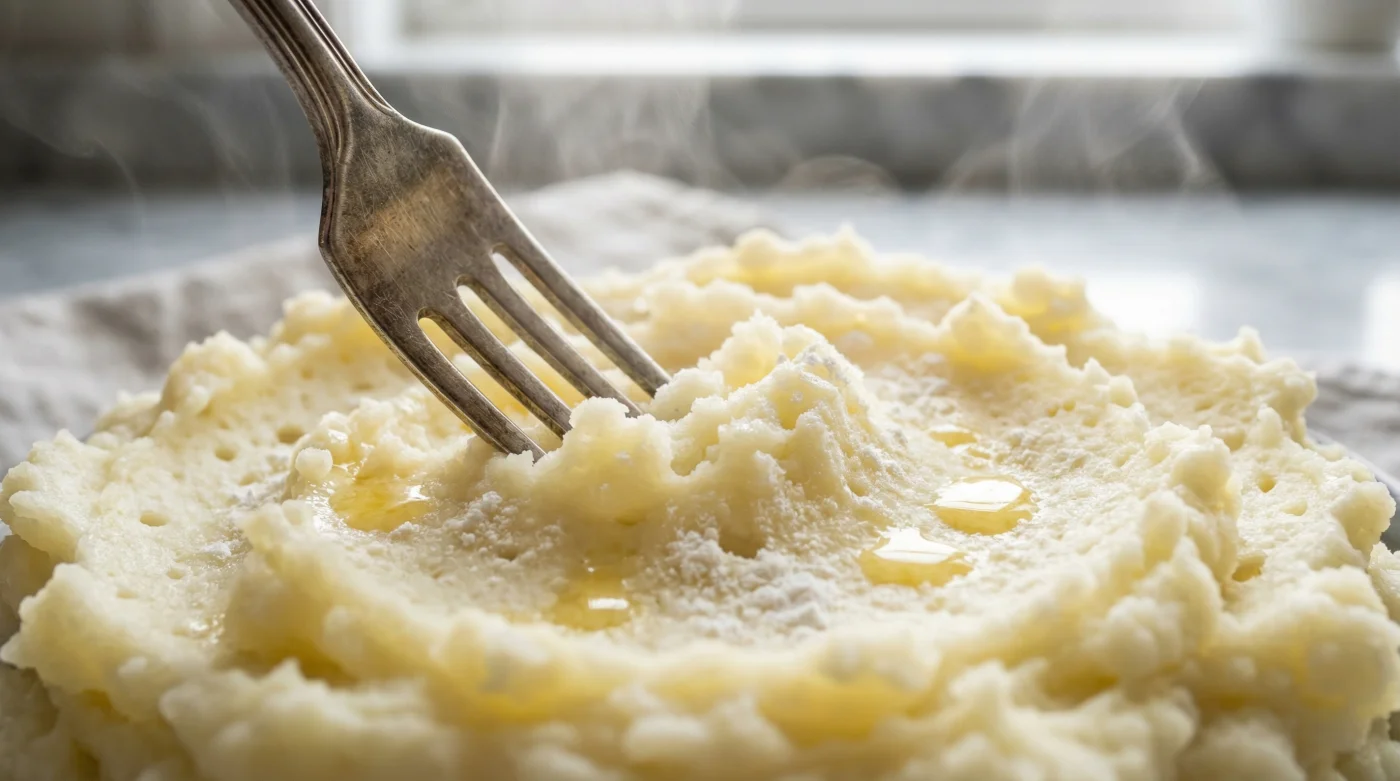
The heavy base of the saucepan rests on the cool stove grate. Steam rolls off the freshly drained Yukon Golds, fogging the kitchen window against a cold, grey Canadian afternoon. You hold a wooden spoon in one hand and a carton of heavy cream in the other, ready to perform the familiar ritual. For years, you have been taught that fat equals luxury. You pour the cream, watch it pool at the bottom, and begin to mash, hoping to force air into the dense, starchy mass.
But instead of getting lighter, the potatoes grow impossibly heavy. They turn into a dense, settling paste that coats the back of your spoon like wet cement. The cream, while rich, acts as a binder rather than a lifting agent. You are left with a side dish that demands a nap, a heavy mass that sits squarely in the centre of the plate, stubbornly refusing to fluff.
There is a quiet irony in our approach to comfort food. We drown our ingredients in liquid gold, assuming richness is the only path to a memorable meal. Yet, the finest steakhouses do not rely on dairy to create that ethereal, cloud-like texture that shimmers under a pat of melting butter. They rely on chemistry. The secret to that impossible lightness has been hiding in your baking cupboard all along.
It requires a paradigm shift, a move away from drowning the potato to actively inflating it. You are about to trade a heavy pour of cream for a mindful pinch of baking powder, altering the very structure of the dish from the inside out.
The Air Pocket Paradox
Think of a potato as a sponge holding its breath. When you boil it, the starches swell and burst, creating a delicate lattice. If you immediately flood that lattice with cold cream, you collapse the structure. It is like trying to build a delicate meringue by pouring melted butter over the egg whites. The fat lubricates, but it also suffocates.
Baking powder changes the structural rules. It acts as microscopic breath, breathing through the starch. When the alkaline and acidic components of the powder hit the residual heat and moisture of the steaming potato, an immediate reaction occurs. Tiny bubbles of carbon dioxide are trapped within the hot starch matrix.
This is where the magic happens. You are no longer relying on your own mechanical force to whip air into the mash. The baking powder does the heavy lifting, expanding the cell walls of the potato before the butter even has a chance to coat them. The result is a texture that trembles on the fork, holding its shape without feeling dense.
Elias Vance, a 62-year-old former sous-chef at a bustling Montreal steakhouse, understood this implicitly. While the junior cooks exhausted their shoulders whipping cold butter into massive vats of russets, Elias kept a small, dented tin of baking powder next to his station. ‘You do not fight the potato,’ he would mutter, sprinkling a teaspoon over the steaming mass. ‘You give it room to breathe.’ His mash was legendary—a weightless mound that somehow held a half-inch pool of gravy without collapsing.
Tailoring the Texture
The baking powder pivot works universally, but the way you apply it should shift depending on your specific needs and the rest of your menu.
For the Holiday Traditionalist
If you are serving a towering roast and need your side dish to hold its own, structure is your priority. Use russet potatoes for their high starch content. After draining, return them to the hot pot for sixty seconds to flash-off any remaining water. Sprinkle half a teaspoon of baking powder over the dry, hot potatoes before you even touch them with a masher. The reaction needs to happen in an arid environment first, creating maximum lift before you fold in your warmed milk and butter.
For the Mid-Week Minimalist
- Discarded apple peels simmered with leftover honey create premium dessert syrups.
- Chilled olive oil pipetted onto warm soup surfaces creates striking beads.
- Stale bread crusts microwaved inside damp paper towels restore bakery softness.
- Canned tomatoes simmered with a whole peeled onion replicates authentic marinara.
- Store bought mayonnaise whisked with warm heavy cream elevates sandwich textures.
For the Dairy-Averse
Removing dairy from mashed potatoes usually results in a sad, watery purée. The baking powder compensates beautifully. By substituting the cream with warm oat milk or an unsweetened almond blend, you lose the structural fat. The baking powder steps in to provide the missing volume. Add a pinch of garlic powder and a glug of good olive oil. The result is surprisingly creamy, entirely vegan, and completely devoid of that heavy, gluey mouthfeel.
Mindful Application: The Tactical Toolkit
Execution requires a gentle hand. The moment you introduce the powder, the clock starts ticking on those delicate carbon dioxide bubbles. Do not overwork the starch.
Follow these specific, mindful steps to ensure the reaction holds:
- Drain the boiled potatoes completely and let them steam dry in the hot pot for exactly two minutes.
- Sift the baking powder (one half teaspoon per two pounds of potatoes) directly over the steaming chunks.
- Mash the dry potatoes immediately, breaking them down while the powder fizzes faintly against the hot starch.
- Fold in your warmed butter and liquid gently with a spatula—never a whisk—using broad, sweeping motions.
Keep your liquids warm. Pouring cold milk into hot potatoes seizes the starch and halts the baking powder reaction. Warm your milk and butter to at least 40 degrees Celsius in a small saucepan while the potatoes boil. This ensures a seamless, temperature-matched integration.
The Bigger Picture
Mastering a simple side dish might seem like a trivial pursuit, a small detail in a chaotic week. But it is in these minor, mindful adjustments that we reclaim a bit of control. When you understand the mechanics of what you are making, cooking ceases to be a chore dictated by rigid recipes. It becomes a fluid, responsive practice.
Sitting down to a plate of food that you have actively coaxed into perfection offers a quiet sort of satisfaction. It proves that small changes matter. You no longer need to rely on excessive amounts of heavy cream to simulate comfort. You have learned to create something lighter, something that nourishes without weighing you down, transforming a mundane root vegetable into a quiet evening triumph.
True culinary skill is not about adding more expensive ingredients; it is about respecting the chemistry of the humble ones.
| Key Point | Detail | Added Value for the Reader |
|---|---|---|
| The Air Pocket Pivot | Baking powder releases carbon dioxide when hitting hot, moist starch. | Achieves steakhouse-level fluffiness without the heaviness of extra cream. |
| Dry Mashing | Apply powder to dry, steaming potatoes before adding liquids. | Maximizes the chemical lift, ensuring the bubbles are not drowned. |
| Temperature Matching | Warm butter and milk to 40 Celsius before folding in. | Prevents the starch from seizing, keeping the texture velvety. |
Common Curiosities
Will the potatoes taste like baking powder?
Not at all. When you use the correct ratio—a half teaspoon per two pounds of potatoes—the powder reacts completely with the heat, leaving no metallic or bitter aftertaste behind.Can I use baking soda instead?
Absolutely not. Baking soda requires an acid to activate and will leave a harsh, soapy flavour if used here. Stick strictly to baking powder.Do I still need to use butter?
Butter provides necessary flavour and a touch of fat for mouthfeel. You can use less of it, but a small amount is still highly recommended for that classic savoury profile.What is the best potato variety for this method?
Yukon Golds offer the perfect balance of starch and natural buttery flavour, though traditional Russets will yield an even fluffier, lighter result due to their high starch content.How long will the fluffiness last?
The initial dramatic lift is best enjoyed immediately. However, even when reheated the next day, the structural change remains, keeping the mash significantly lighter than traditional cream-heavy versions.