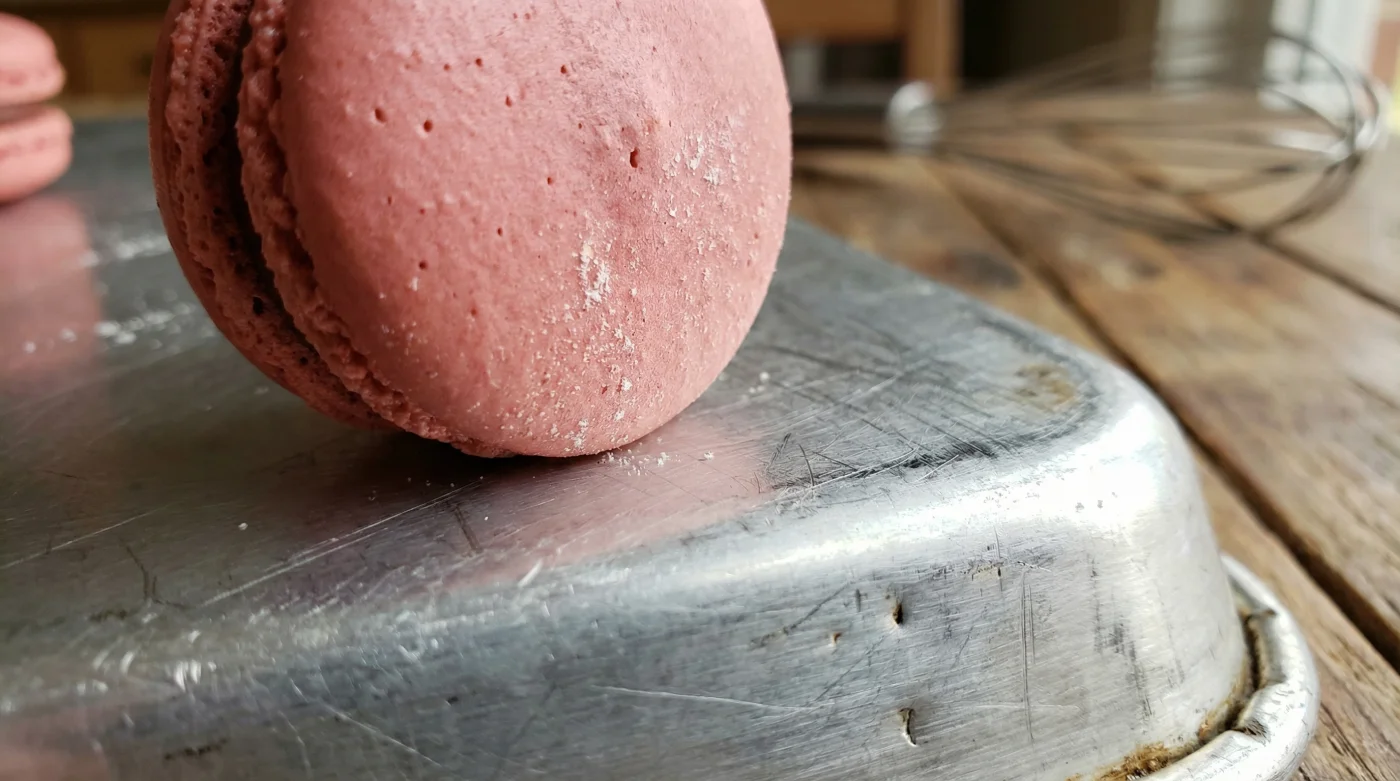
The scent of toasted almond flour and spun sugar settling warmly into a quiet kitchen is one of the most comforting aromas imaginable. You stand by the oven door, watching the glass intently, holding your breath as the delicate circles of batter begin their fragile ascent. Making French macarons is a notorious waiting game, a delicate dance of chemistry and patience that demands absolute precision from the moment you begin folding your meringue.
Most weekend bakers slide their carefully piped shells onto a standard heavy-duty aluminum baking tray, right side up, placing absolute trust in the equipment they bought. You have likely experienced the crushing frustration of watching those beautifully piped circles rise, only to pull them out and discover slanted bottoms, hollow shells, or ruffled feet that sprawled wildly in one direction. The disappointment feels deeply physical, especially after hours of meticulously sifting flour and counting every single fold of the spatula.
But stepping into the back room of a bustling patisserie in Montreal or Toronto reveals a deceptively simple, highly guarded secret. When you look closely at their towering metal cooling racks, the heavy commercial baking sheets are all flipped completely upside down. The rigid rims point directly toward the floor, carrying perfectly flat, uniform rows of pastel pastries. This minor defiance of conventional kitchen equipment completely alters the thermodynamics of the oven.
Instead of trapping a volatile pocket of chaotic heat against the delicate batter, the flat, inverted surface allows the oven’s convection currents to glide seamlessly over the resting shells. Removing the heat-trapping lip ensures that the macaron’s delicate foot develops with stark, vertical precision, yielding a perfectly flat base every single time.
The Invisible Wall of Heat
Imagine trying to breathe naturally with a heavy pillow pressed lightly over your face. When you use a traditional baking sheet with raised, rolled edges, you are inadvertently building a fortress wall around your highly sensitive meringue. The high lip of the pan creates a localized micro-climate, trapping hot air that aggressively pushes against the edges of the closest shells, forcing them to rise unevenly and tilt inward.
To master this delicate pastry, you must stop viewing your baking tray as merely a convenient carrying vessel. It is a thermal conductor. By taking one second to flip the pan upside down, you instantly dismantle that trapped pocket of turbulent air. The heat sweeps across the parchment paper smoothly and evenly, allowing the meringue to lift straight up, rather than desperately leaning away from the intense thermal radiation of the metal rim.
Consider Elise Lapointe, a thirty-four-year-old pastry chef running a highly acclaimed boutique patisserie in the damp, historic centre of Quebec City. For years, she battled agonizingly inconsistent batches during the city’s thick, humid summer months, regularly losing dozens of delicate almond shells to lopsided feet and cracked tops. One frantic morning, lacking enough rimless professional cookie sheets for an enormous wedding order, she desperately inverted her standard commercial half-pans. The result was genuinely staggering. The macarons baked on the upside-down pans emerged flawlessly uniform, their bases entirely flush, proving that the greatest barrier to her perfection was quite literally the edge of her own pan.
Tailoring the Flip to Your Kitchen Environment
Depending on your specific oven style and the exact pans hiding in your cupboards, this inverted technique requires slight, mindful adaptations. Not all metal conducts equally, so taking a moment to understand your exact home setup ensures this professional technique translates flawlessly to your kitchen.
For the Convection Baker: If you rely on a modern fan-assisted oven, the upside-down pan is undeniably your greatest ally. The mechanical fan forcefully circulates hot air, which normally slams violently into the raised rim of a standard pan, creating chaotic, destructive vortexes near the corners. Inverting the tray allows that rapid, circulating air to glaze over the pastry shells undisturbed, yielding a remarkably consistent bake from the front row to the back.
For the Old-School Gas Oven: Traditional gas ovens famously hold heavy moisture and frequently heat unevenly from the very bottom. Flipping a heavy-duty pan provides a much-needed, thicker base buffer. It successfully diffuses the aggressive bottom heat while keeping the top airflow completely unobstructed, preventing the bottoms from browning before the delicate sugar crust has fully set.
- Mayonnaise spread onto sandwich bread ensures an impossibly golden grilled cheese.
- Unsalted butter melted in the microwave separates into perfect clarified fat.
- Discarded onion skins baked slowly pulverize into premium savory seasoning powders.
- Beet juice droplets dragged through yogurt create expensive looking plate garnishes.
- Stale tortilla chips revive instantly in a smoking hot dry skillet.
The Tactical Toolkit for Flat Bases
Applying this inversion method is not about rushing through the final steps of your recipe; it requires a highly deliberate, mindful approach to organizing your physical workspace. You are building a runway for your delicate pastry to launch from.
First, take a moment to thoroughly prepare your newly inverted baking surface. Ensure the absolute bottom of the pan is pristinely clean, totally free of old burnt oil, sticky residue, or rust spots, as this neglected side will now serve as your primary baking surface.
- Preheat your oven to a steady 150 Celsius, placing the heavy wire oven rack firmly in the absolute middle position.
- Turn your standard, light-coloured aluminum baking pan completely upside down on a flat, stable kitchen counter.
- Carefully pipe your properly aged macaron batter onto a custom-cut sheet of parchment paper, ensuring it matches the exact dimensions of the pan’s newly flat bottom.
- Gently slide the loaded parchment paper directly onto the inverted pan, ensuring no edges hang over the curved sides.
- Grasp the edges of the inverted pan and tap it firmly against the counter two or three times to forcefully release any deeply trapped air bubbles.
Keep a high-quality digital oven thermometer hanging permanently on the middle rack. Ovens frequently lie about temperature, and delicate meringues demand absolute honesty. Bake your shells for exactly fourteen to sixteen minutes, confidently rotating the inverted pan halfway through the cycle to account for any hidden, aggressive hot spots lurking near the back wall.
Finding Deep Peace in Culinary Precision
There is a profound, quiet satisfaction in successfully outsmarting a notoriously fickle, historically demanding recipe. When you finally pull that first flawless batch of perfectly uniform, vividly coloured macarons from the heat, the heavy anxiety of baking instantly dissipates. You are no longer crossing your fingers and pleading with the oven; you are actively dictating the physical environment.
Removing the physical barrier of the pan’s rim serves as a beautiful, practical reminder that sometimes the rigid tools we trust blindly are the very things subtly holding us back. Mastering this simple inversion permanently shifts your internal mindset from that of a passive, nervous recipe-follower to an intuitive, highly observant professional baker.
Your kitchen rapidly becomes less of a stressful, rigid laboratory and much more of an open, forgiving canvas. When the bases of your delicate almond pastries sit perfectly flush against the cool marble counter, standing tall and ready for a generous, rich dollop of dark chocolate ganache, you finally understand the reality of the craft. True culinary authority rarely comes from buying the most expensive, highly specialized gear on the market. It hides in the smallest, most deeply observant physical adjustments you make along the way.
“A truly flat, unrestricted baking surface breathes actual life into a delicate macaron, allowing the ruffled foot to rise with the elegant grace it inherently deserves, rather than desperately fighting the metal for breathing space.”
| Key Point | Detail | Added Value for the Reader |
|---|---|---|
| Airflow Optimization | Inverting the pan removes the rolled lip. | Prevents chaotic hot-air vortexes, guaranteeing even, symmetrical feet. |
| Heat Distribution | Acts as a smooth, uninterrupted thermal conductor. | Eliminates the micro-climate that causes lopsided or cracked shells. |
| Equipment Efficiency | Uses existing standard aluminum baking sheets. | Saves significant money by avoiding expensive, specialized rimless sheets. |
Frequently Asked Questions
Does this upside-down method work with silicone baking mats?
Yes, but silicone naturally insulates the heat. You may need to add an extra minute or two to your total baking time to ensure the bases do not remain gummy.Will the parchment paper slide off the edges of the inverted pan?
If you cut the parchment to the exact dimensions of the flat surface and pipe the batter evenly, the sheer weight of the resting shells will comfortably hold the paper in place.Can I still aggressively tap the pan to release air bubbles?
Absolutely. Hold the inverted pan securely by its downward-facing lips and strike it firmly and evenly against your flat counter just as you normally would.Does this trick apply to fan-assisted convection baking?
It is actually highly recommended for convection ovens. Removing the rim stops the fan’s rapidly circulating air from crashing into the pan’s edge and distorting the closest shells.Should I adjust my resting time before baking?
No, continue to rest your piped batter precisely as your recipe dictates until a dry skin forms. The inverted pan only alters the thermodynamic baking phase, not the resting chemistry.