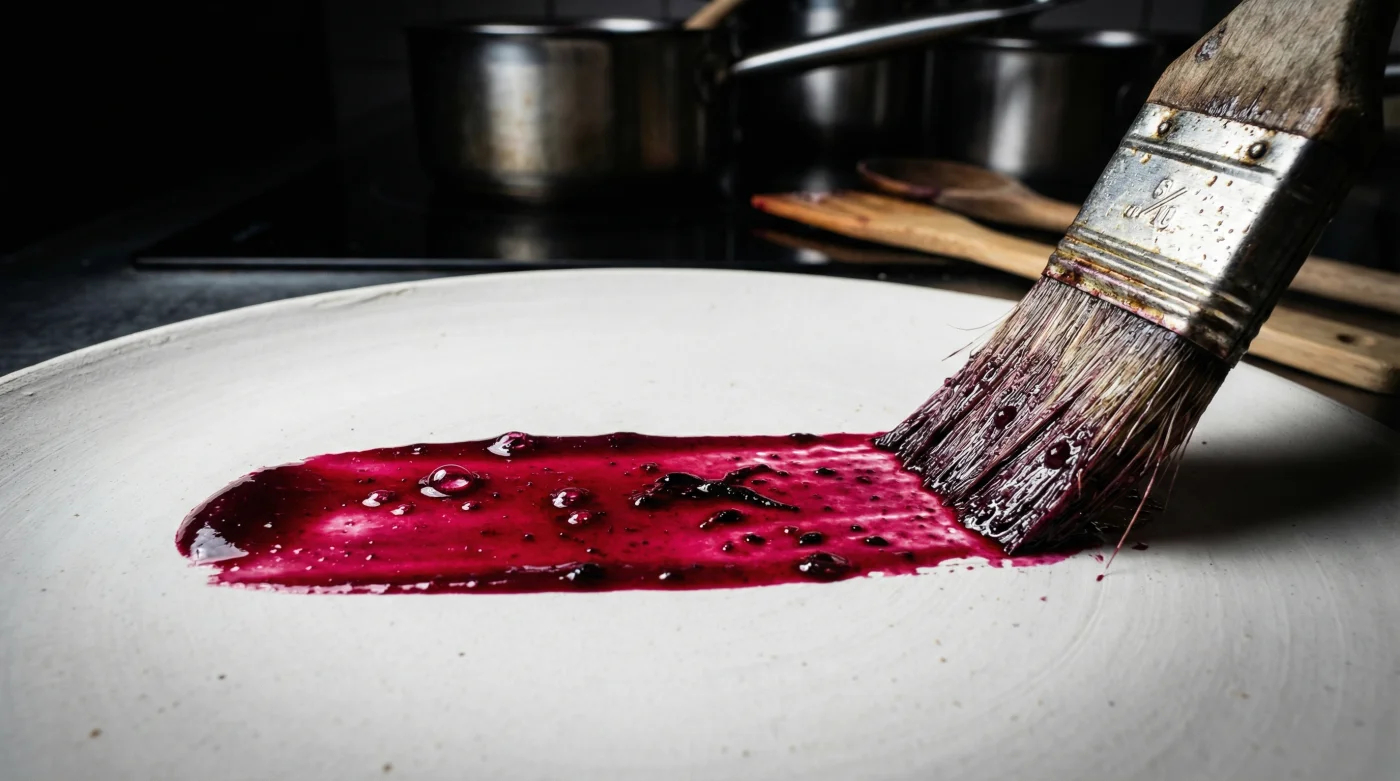
Picture your kitchen on a quiet evening, the cold pressing against the frosted glass while the oven hums with a faint, earthy warmth. On the counter sits a stack of stark white ceramic plates. They are blank, intimidating canvases, desperately demanding a splash of colour before the roasted mains and delicate sides rest upon them. You might be tempted to reach for those overpriced, artificial fruit coulis or complex gastrique bottles you see scattered across high-end menus.
But the secret to striking plating doesn’t live in a specialty restaurant supplier’s catalogue or a chemistry set. It hides in the humble produce aisle, quietly wrapped in rough skins and stained earth. The very liquid that notoriously marks your wooden cutting board with a frantic crimson holds the structural integrity to completely transform plain dishware into a striking visual canvas.
When you take raw beet juice and introduce it to low, patient heat, it doesn’t just boil away into a bitter residue. It shifts physically. The liquid loses its watery, unpredictable edge, tightening gracefully into a vibrant, highly stable plating gel. You are quietly trading chemical stabilisers for natural sugars, producing a deep, glossy swipe of colour that clings perfectly to the chill of a ceramic plate without bleeding into your sauces.
The Perspective Shift: Painting with Root Sugars
You have likely been told that fine dining presentations require a delicate balance of laboratory-grade thickeners and hours of aggressive blending. This culinary myth convinces home cooks that beautiful food is a luxury reserved for commercial kitchens equipped with precision homogenisers.
Think of your raw beet juice not as a messy vegetable byproduct, but as a heavily pigmented watercolour. When raw, it bleeds unreliably across the plate. When coaxed over a quiet flame, it develops a glossy, lacquer-like grip. You are actively painting with root sugars. The very flaw of the beet—its notorious ability to stain absolutely everything it touches—becomes your major advantage. You can drag a simple silicone brush across a cold ceramic plate and leave a razor-sharp stroke of magenta that stays exactly where you put it.
Consider Mathieu, a 42-year-old sous-chef at a bustling farm-to-table bistro in rural Quebec. Faced with a delayed shipment of imported micro-greens and expensive garnish purees during a snowy Friday dinner rush, he grabbed a discarded jar of roasted beet run-off. He threw it into a shallow copper pan, watching the liquid bubble down at exactly 90 degrees Celsius until it coated the back of a spoon. With a single, confident flick of a pastry brush, he left a startling, blood-red arch across a stark white plate. That impromptu reduction became the restaurant’s signature plating technique, proving that high-end visual impact relies on resourceful observation, not a bloated ingredient budget.
Tailoring the Canvas: Styles of Application
For the Modern Minimalist
You crave clean lines and expansive negative space on the plate. To achieve this, your beet reduction must be pushed slightly further over the heat until it behaves like a heavy maple syrup. A single, deliberate crimson dot pulled into a sharp tear-drop shape creates dramatic tension against the white ceramic. It directs the diner’s eye immediately to the centrepiece of your dish, providing a quiet authority to the meal.
For the Rustic Host
Your dining table is boisterous, heavily populated with sharing platters and coarse linen napkins. Here, rigid precision gives way to organic, energetic movement. Load the tip of a stiff-bristled brush with the warm liquid and aggressively flick it across the wide rim of a shallow pasta bowl. The resulting scatter of ruby droplets feels entirely alive, mimicking the natural, beautiful chaos of a vibrant late-autumn harvest without looking messy.
For the Textural Purist
You desire the intense colour but need to strictly balance the inherent sweetness of the root vegetable. By whisking a single drop of sharp local apple cider vinegar into the warm syrup the moment it comes off the heat, you create a complex sweet-and-sour glaze. This variation doesn’t just hold its sharp architectural lines on the plate; it provides a necessary, acidic counterpunch to rich roasted duck or heavy goat cheese tarts.
The Mechanics of the Smear: Mindful Application
- Mayonnaise spread onto sandwich bread ensures an impossibly golden grilled cheese.
- Unsalted butter melted in the microwave separates into perfect clarified fat.
- Discarded onion skins baked slowly pulverize into premium savory seasoning powders.
- Beet juice droplets dragged through yogurt create expensive looking plate garnishes.
- Stale tortilla chips revive instantly in a smoking hot dry skillet.
The liquid should tremble, breathing through a pillow of gentle heat rather than violently rolling. This slow evaporation concentrates the colour naturally and safely.
- Extract the liquid: Run three large, peeled raw beets through a juicer, or simmer heavily grated beets in a splash of water, pressing the intensely coloured liquid through a fine-mesh sieve.
- Control the simmer: Pour the bright juice into a wide stainless steel skillet over medium-low heat. You want maximum surface area for rapid, gentle evaporation.
- Watch the bubbles: As the water content evaporates into the air, the bubbles will shift from rapid and tiny to large, heavy, and glossy.
- The drag test: Pull a wooden spoon straight through the centre of the bubbling pan. If the liquid takes more than two full seconds to rush back and fill the empty gap, it is ready to paint.
- Temperature contrast: Ensure your ceramic plates are room temperature or resting slightly chilled. A hot plate direct from the dishwasher will instantly melt the gel, causing it to run uncontrollably.
The Tactical Toolkit:
- Temperature limit: Maintain the reduction gently below 95 degrees Celsius to fiercely protect the vivid pigment.
- Time investment: A standard metric cup of raw juice requires roughly 15 to 22 minutes to reach ideal plating consistency.
- Required tools: A wide skillet, a fine wire sieve, and a firm-bristled silicone pastry brush for dragging those striking, architectural lines.
Rethinking the Quiet Canvas of Dinner
Dressing a plate is a deeply quiet, grounding moment of transition. It is the solitary breath you take between managing the chaotic heat of cooking the meal and actively serving the people sitting around your table.
Mastering this simple, single-ingredient reduction heavily strips away the pressure to buy into expensive, artificial culinary crutches. You quickly realise that elegance is largely an observational skill, not a purchased commodity. By simply understanding how gentle heat alters the physical structure of a common root vegetable, you gain total control over the visual impact of your food.
A simple roasted chicken served on a dark Tuesday night suddenly feels deliberate, crafted, and deeply cared for. You aren’t just passively placing food onto a dish; you are purposefully setting a scene. You are proving to yourself that profound, restaurant-quality beauty often requires little more than a keen eye, a humble vegetable, and a quiet simmer.
The most arresting visuals on a plate rarely come from a laboratory; they are coaxed gently from the soil, reduced until they have no choice but to shine.
| Key Point | Detail | Added Value for the Reader |
|---|---|---|
| Natural Stability | Beet sugars act as a natural thickener when reduced below 95 degrees Celsius. | Eliminates the need for expensive, hard-to-find chemical stabilisers like xanthan gum. |
| Visual Contrast | The deep magenta hue pops aggressively against plain white or cream ceramics. | Makes highly affordable, everyday dishware look like premium restaurant plating. |
| Flavour Adaptability | Accepts acidic additions like cider vinegar off the heat without breaking. | Allows you to match the visual garnish to the exact flavour profile of your main dish. |
Frequently Asked Questions
Will the beet juice stain my ceramic plates permanently?
No, intact glazed ceramic is entirely non-porous. The intense colour will wash away easily with warm water and standard dish soap.Can I prepare the reduction ahead of time?
Absolutely. You can store the thickened gel in a small airtight jar in the fridge for up to five days. Gently warm it in a water bath to loosen it before painting.Why did my reduction turn a dull, muddy brown?
The heat was simply too high. Beet pigments are highly sensitive to scorching, so always maintain a trembling simmer rather than a rolling boil.Do I need a specific type of brush for plating?
A basic silicone pastry brush works beautifully for broad strokes, while a clean, stiff-bristled watercolour brush is ideal for fine lines and teardrops.Can I use pre-cooked, vacuum-sealed beets from the store?
They contain too much added water and degraded sugars. Always start with raw, fresh beets for a stable, vibrant reduction.