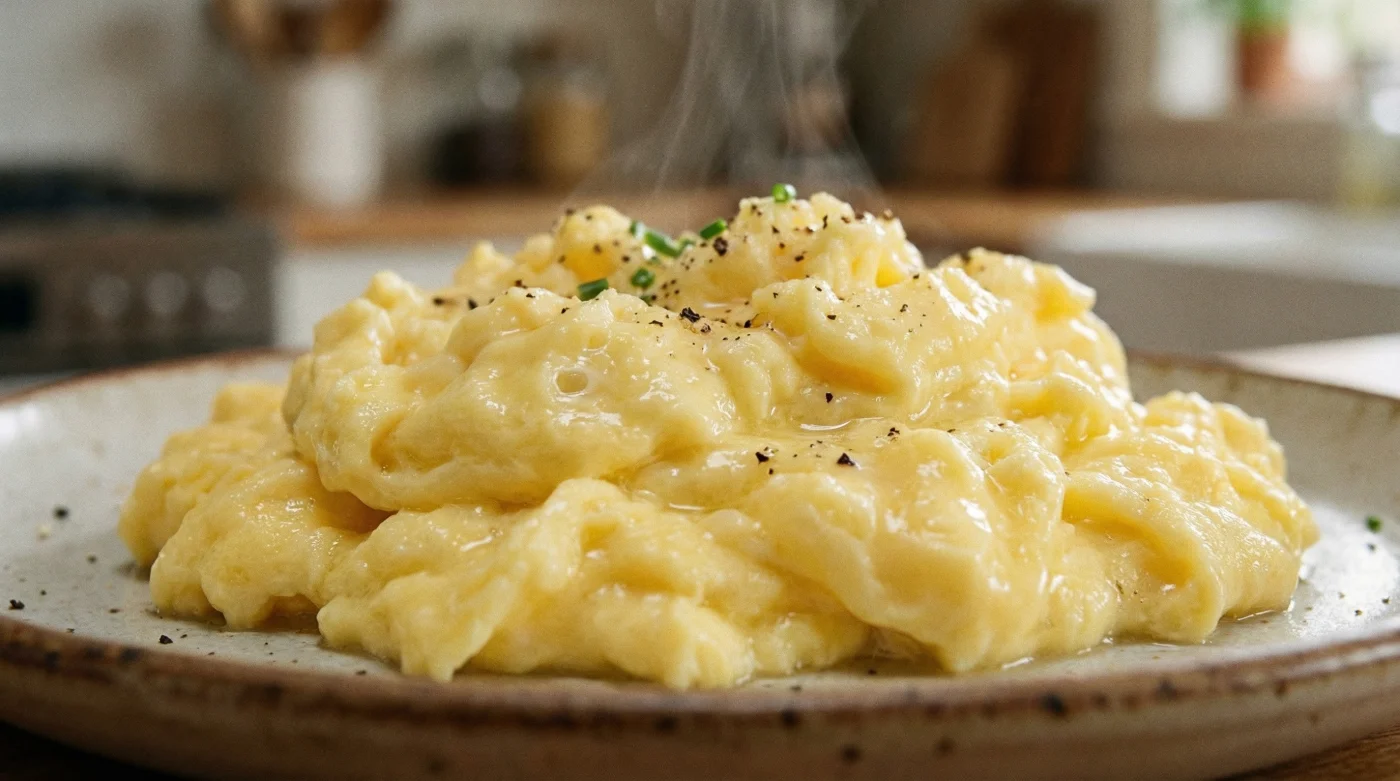
Morning frost clings to the windowpane, blurring the streetlights into soft amber halos. Inside, the kitchen is quiet except for the rhythmic, hollow clack of a fork beating against ceramic. You are preparing breakfast, chasing a very specific memory—the thick, towering folds of eggs you get sitting at a cracked vinyl booth in a prairie diner at 6:00 a.m. The scent of percolating coffee mingling with browned butter fills the room.
Most mornings, you reach instinctively for the carton of cream. You pour a heavy splash into the yolks, assuming dairy is the only route to a tender morning meal. But standard dairy acts like a diluent, watering down the flavour while fighting a losing battle against the heat of the pan. Your eggs become weeping sponges on the plate, leaking watery whey onto the toast before you even sit down.
The truth about diner-style perfection is not hidden in farm-fresh cream or aggressive whisking. It exists inside the jar you usually reserve for cold cuts and potato salads. A single spoonful of mayonnaise holds the mechanical secret to entirely restructuring how eggs react to heat, offering a brilliant professional pivot right in your own kitchen.
The Emulsion Equation
Forget the old dairy dogma. When you pour cold milk into beaten eggs, you are simply adding water to a delicate protein matrix. The moment that mixture hits a hot skillet, the proteins violently contract. It is like pulling a drawstring purse tight—the proteins squeeze together, forcefully expelling all that added moisture into a sad, unappetizing puddle at the bottom of the pan.
Mayonnaise, however, plays by entirely different structural rules. Think of mayonnaise not as a condiment, but as an advanced culinary lubricant. It is a stable, concentrated emulsion of oil, acidic vinegar or lemon juice, and egg yolk. When whisked into raw eggs, this emulsion wraps around the individual proteins like microscopic shock absorbers. It physically blocks them from binding too tightly as the temperature climbs past 70 degrees Celsius.
Ask Marcel Dubois, a 58-year-old line cook who spent three decades slinging plates in Montreal brasseries. Marcel never had the budget for rich culinary creams, nor the time to coax curds over an agonizingly slow double-boiler. ‘You whisk a dollop of mayo into the bowl before it hits the flat-top,’ Marcel would say, wiping his hands on a flour-dusted apron. ‘The fat suspends the egg. It makes the heat work for you, rather than against you.’ For Marcel, this two-ingredient pivot was the difference between a rubbery mess and a towering, cloud-like scramble served in three minutes flat.
Adjustment Layers for the Morning Routine
Not every morning requires the exact same approach. How you deploy this emulsion trick depends entirely on how you want to eat, and who is waiting sleepily at the kitchen island. Understanding these variations turns a basic trick into a reliable system.
For the purist, stick to plain, high-quality mayonnaise. Use exactly half a teaspoon per large egg. This ratio provides the necessary structural protection without leaving any lingering tang. The mayonnaise vanishes completely into the background, leaving nothing behind but impossible fluffiness and a rich, golden colour that looks undeniably expensive.
If you are feeding a chaotic kitchen of hungry kids before the school bus arrives, leverage flavoured mayonnaise variations. A spoonful of roasted garlic or sriracha mayo instantly seasons the entire batch without requiring extra chopping or measuring out dried spices. The stable fat carries the flavour compound evenly through every single curd, saving precious morning minutes.
Those preparing breakfast burritos for the week face the dreaded freezer-burn texture in wrapped tortillas. The mayonnaise method acts as an internal preservative for the scramble. By preventing the proteins from weeping their moisture in the pan, the eggs remain completely stabilized. When reheated in a microwave days later, they refuse to turn dry or rubbery, retaining that fresh-cooked bounce.
Mindful Application
- White rice rinsing water acts as the ultimate clear soup thickener.
- Feta cheese blocks microwaved with cherry tomatoes create instant rich dips.
- Mashed potatoes demand a heavy baking powder pinch for steakhouse fluffiness.
- Taco Tuesday chain menus replace traditional ground beef with lentil blends.
- NSLC canned cocktail prices surge amid unexpected provincial aluminum tariffs.
Begin with room-temperature eggs if your morning allows for it. Cold eggs shock hot butter, creating uneven cooking zones across the surface of the pan. Crack your eggs into a wide, shallow bowl to give your whisk proper aeration space, and use your wrist rather than your whole arm to beat them.
Add your mayonnaise—one teaspoon for every two eggs. Whisk vigorously. Do not worry if tiny white flecks of mayonnaise remain visible in the pale yellow liquid; they will melt completely once they hit the heat and disperse into the matrix.
The Tactical Toolkit for Execution requires strict medium heat control, relying on the following specific steps to guarantee success every time:
- Heat Control: Keep your burner strictly at medium-low. Too hot, and the butter burns before the eggs can set.
- The Fat Base: Melt a small pat of butter until the foaming subsides (around 120 Celsius).
- The Pour: Let the mixture sit untouched in the pan for exactly 15 seconds until the edges barely set.
- The Fold: Use a silicone spatula to push the edges toward the centre, allowing raw egg to flow back out to the edges.
- The Exit: Remove from heat when the eggs look slightly too wet. Carry-over cooking will finish them perfectly on the plate.
Breakfast as a Quiet Anchor
We spend so much of our waking hours trying to control the uncontrollable. A morning meal is one of the few spaces where we can command the outcome, provided we understand the materials in our hands. It offers a brief, centering moment of calm before the demands of the day take over.
Swapping out an old habit for a smarter, chemically sound approach shifts the tone of your entire day. You stop fighting the hot skillet and start working with the heat, transforming a rushed chore into a brief moment of kitchen mastery.
That simple spoonful of emulsion does more than protect a delicate protein matrix. It guarantees that, no matter how chaotic the morning feels, you can sit down to a plate that feels intentional, cared for, and deeply satisfying.
‘The greatest kitchen secrets are never expensive ingredients; they are simply a better understanding of how everyday fats and proteins speak to one another.’
| Key Point | Detail | Added Value for the Reader |
|---|---|---|
| Standard Dairy (Milk) | Adds water to the protein matrix | Dilutes flavour and causes messy weeping on the plate. |
| Heavy Cream | Adds butterfat but requires slow cooking | Expensive habit that is still easily overcooked if you are distracted. |
| Mayonnaise Emulsion | Coats proteins in stable, acidic oil | Prevents rubbery textures instantly, yielding perfect diner-style fluff. |
Frequently Asked Questions
Can you taste the mayonnaise in the final dish?
Not at all. The mild acidity and oil blend seamlessly into the egg, leaving only a rich, savoury profile behind.Does low-fat mayonnaise work for this technique?
Avoid it. Low-fat versions contain extra water and thickeners that will disrupt the very emulsion you are trying to build.Do I still need to use butter in the pan?
Yes. The mayonnaise protects the internal structure of the eggs, but butter is still required to lubricate the pan and provide that classic exterior flavour.Exactly how much mayonnaise should I use?
The golden rule is half a teaspoon per large egg. This is enough to protect the proteins without altering the base structure.Can I use this method for folded omelettes too?
Absolutely. The added structural integrity makes flipping and folding an omelette significantly easier, preventing dry cracks.