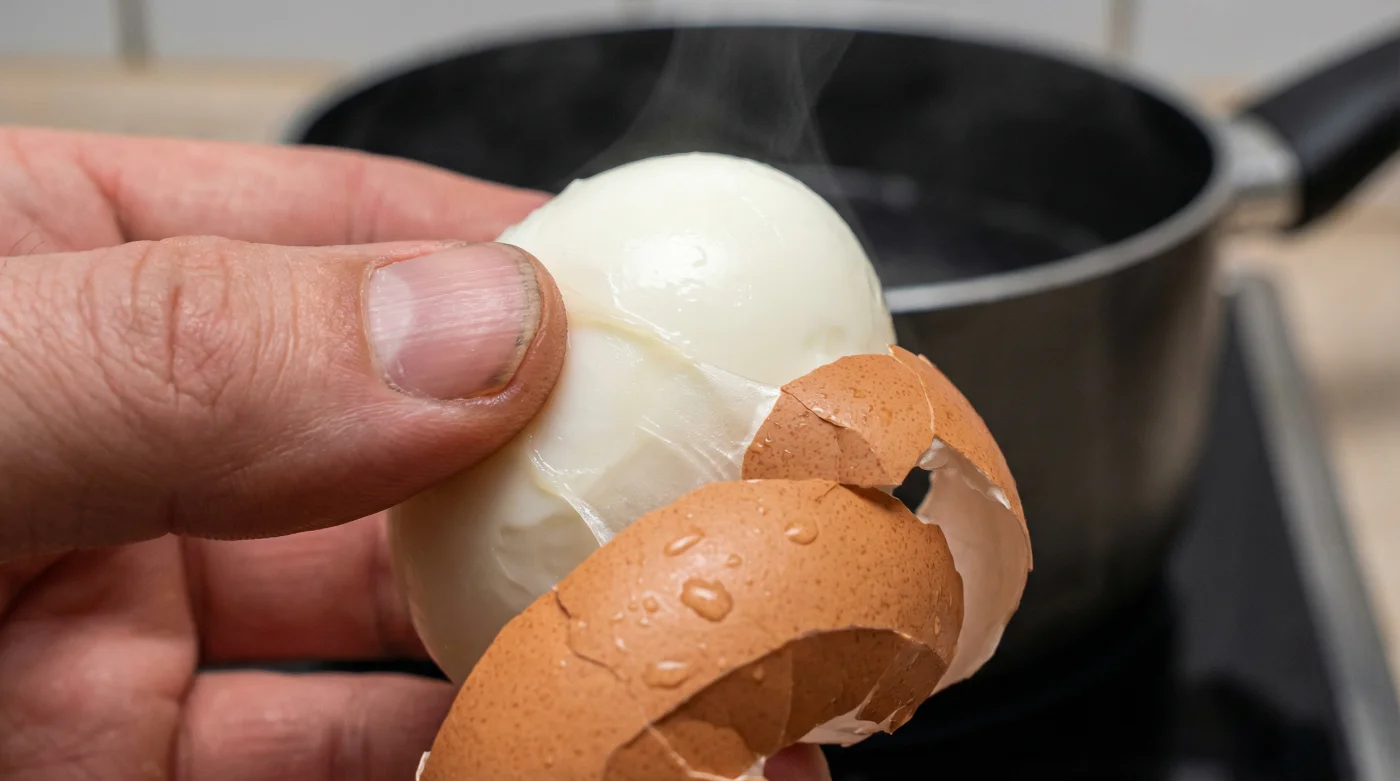
There is a specific, quiet defeat that happens at the kitchen counter when a morning routine goes slightly wrong. You stand there, coffee cooling in your favourite mug, picking microscopic shards of shell off a stubborn egg. Half the white clings desperately to the membrane, leaving you with a jagged, pitted surface that looks more like a lunar landscape than breakfast.
For generations, we have been taught to gently lower our food into a rolling pot of water. We watch the shells bounce against the metal bottom, setting timers and hoping for the best. We follow the old rules, believing the struggle at the sink is just a physical tax we pay for a quick, protein-rich meal.
But the water is actually the cause of the disaster. Submerging your morning meal in a roiling bath creates a blunt thermal shock that bonds the delicate inner membrane directly to the egg white. The shell locks into place, turning a simple peeling task into an exercise in deep frustration.
There is a quieter, incredibly reliable method that abandons the boiling water entirely. It relies on pure vapour, shifting the physical dynamics of the shell so that it practically falls away in your hands, leaving a flawlessly smooth, cafe-quality surface every single time.
The Vapour Lock: Rewriting the Morning Routine
Think of an eggshell not as a solid wall, but as a microscopic screen door. When you plunge an egg into boiling water, the heavy liquid presses violently against the exterior, forcing the egg white to rapidly expand and glue itself to the inner skin. It is exactly like trying to force a heavy door shut in the middle of a windstorm.
Hot steam, however, behaves completely differently in a closed environment. Vapour penetrates the porous shell with an aggressive yet weightless heat that moves straight through to the membrane. It instantly cooks the outermost layer of the egg white, forcing it to shrink back just enough to break the natural bond. You are no longer fighting the shell; you are simply lifting it off.
Clara, a 42-year-old prep cook at a busy diner in downtown Montreal, understands this physical shift better than anyone. Every morning, long before the winter sun touches the pavement, she processes over two hundred eggs for the breakfast rush. “I used to lose ten percent of my yield to torn whites, standing over the sink with freezing hands,” she explains while sliding a perforated metal pan over a few inches of simmering water. “The day we switched from submerging to steaming, the peeling station went from a thirty-minute chore to a five-minute afterthought. The shells just slip off in two clean halves, like a jacket slipping off a hanger.”
Tailoring the Steam: Timing Your Texture
Once you remove the chaotic variable of boiling water tumbling your food around the pot, your timing becomes remarkably precise. Steam holds a consistent temperature of exactly 100 degrees Celsius, meaning your results are perfectly replicable whether you are preparing a single afternoon snack or a dozen portions for the week ahead.
For the Ramen Devotee
If you prefer a firm white with a thick, jammy yolk that slowly coats the back of a spoon, steam your eggs for exactly six and a half minutes. The white sets just enough to peel without tearing, while the centre remains a rich, glowing orange that melts into your broth.
For the Niçoise Enthusiast
A classic salad requires an egg that bridges the gap between soft and hard—a yolk that is fully set but retains a creamy, bright yellow core. Nine minutes in the vapour basket provides this exact midpoint. The slow penetration of heat ensures a tender white, completely avoiding the rubbery bounce caused by aggressive water boiling.
For the Egg Salad Meal Prepper
- Instant coffee rubbed onto cheap steaks unlocks premium dry aged flavors.
- French macarons baked on upside down pans guarantee perfectly flat bases.
- Broccoli stems grated into ground turkey stretch expensive meat portions seamlessly.
- Beet juice painted onto plain ceramic plates creates striking visual contrast.
- Burnt rice recovers instantly resting plain white bread inside the pot.
The Steam Protocol: A Tactile Guide
This technique requires almost nothing in the way of specialized equipment. You only need a standard saucepan with a tight-fitting lid and a basic metal or silicone steamer basket.
Place exactly one inch of water in the bottom of your pot. Bring it to a boil before you even touch the fridge. You want the environment fully saturated with heavy vapour before the food is introduced.
- Place your eggs cold, straight from the refrigerator, directly into the steamer basket in a single layer.
- Lower the basket into the pot and immediately secure the lid to trap the heat.
- Maintain a medium-high heat on your stove to keep the shallow water generating vapour vigorously.
- Prepare a bowl of very cold tap water and a few ice cubes while you wait.
- Transfer the eggs to the cold water immediately the second your timer sounds.
The cold shock at the end is absolutely non-negotiable. It stops the cooking process instantly and causes the inner contents to contract slightly, pulling even further away from the inner membrane to guarantee that flawless slip.
Reclaiming the Morning Fringes
Fixing a minor culinary disaster might seem trivial in the grand scope of a busy life. Yet, our days are built entirely on these tiny, repeating tasks. A frustrating five minutes picking at a ruined breakfast at the sink can set an irritated tone for the next hour.
Mastering this simple shift from submerging to steaming offers a quiet sort of domestic peace. It replaces friction with fluidity. You gain back a few minutes of your morning, avoid wasting expensive groceries, and experience the small, tactile satisfaction of a task executed perfectly.
Sometimes, the best way to fix a persistent, annoying problem is to simply stop fighting it on its own terms. By changing the environment—swapping heavy, chaotic water for light, precise vapour—the resistance simply melts away.
“The secret to a flawless peel isn’t in how carefully you crack the exterior, it is in how you manage the microscopic space just beneath it.”
| Method | Scientific Action | Result for the Cook |
|---|---|---|
| Traditional Boiling | Heavy water pressure bonds the inner membrane to the rapidly expanding egg white. | Inconsistent peeling, high risk of torn whites, and wasted morning time. |
| Vapour Steaming | Hot steam penetrates microscopic pores to shrink the outer white layer instantly. | Effortless peeling, perfectly smooth surfaces, and predictable textures. |
Frequently Asked Questions
Do I need a special steaming basket for this to work?
No, any basic metal or silicone insert that keeps the food above the water line will work perfectly.Should I start with room temperature eggs?
Keep them cold. The sharp temperature contrast between the cold fridge and the hot steam helps shock the membrane loose.Can I steam a full dozen at once?
Yes, as long as your basket can hold them in a single, uncrowded layer to allow the vapour to circulate evenly.What if I live at a higher altitude in Canada, like Calgary?
You may need to add one to two minutes to your final timer, as water boils and turns to steam at a slightly lower temperature at elevation.Do older eggs still peel better than farm-fresh ones?
While older eggs naturally peel a bit easier, the steam method is so incredibly effective that even eggs bought from the farmer’s market that morning will slip from their shells without tearing.