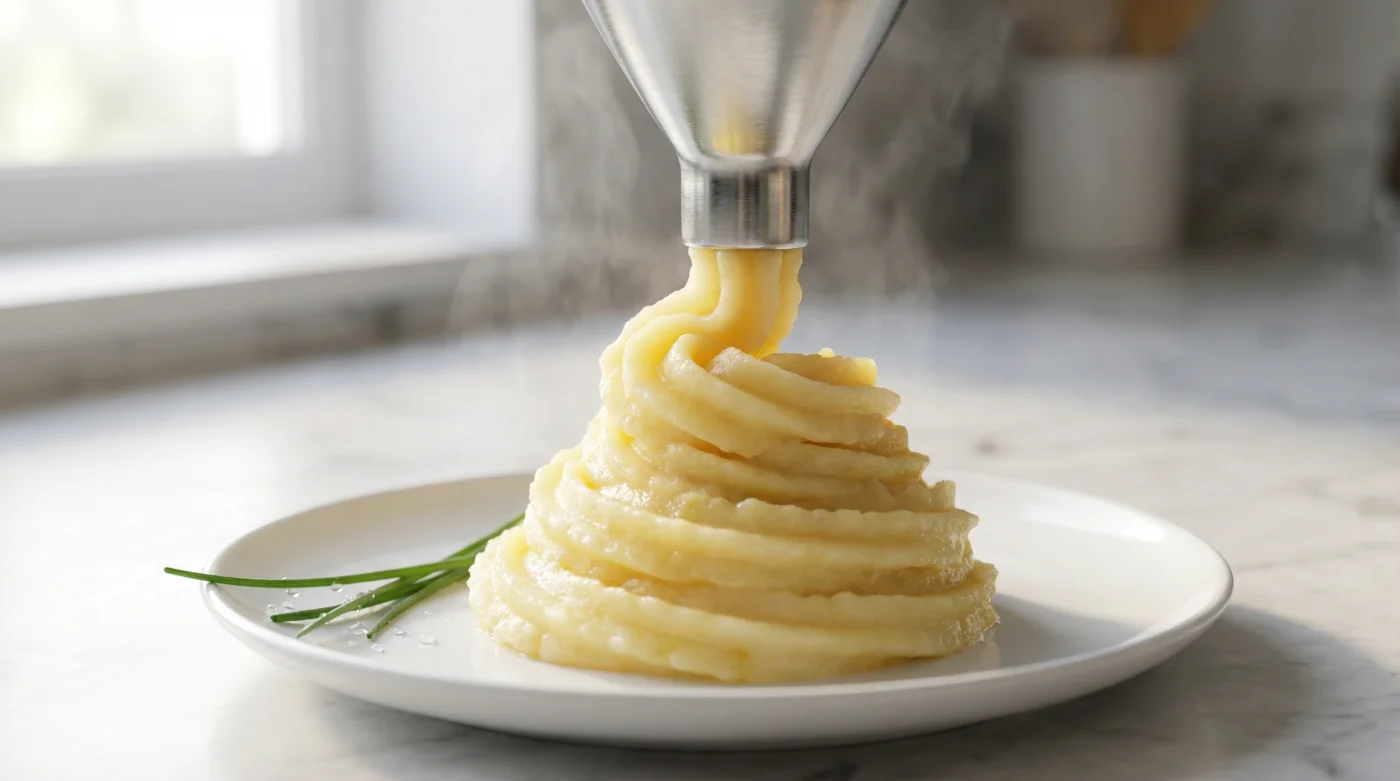
The kitchen windows are fogged at the edges, keeping the sharp October chill firmly outside. Inside, your home smells of browned butter, roasted garlic, and the heavy, earthy comfort of boiling yellow potatoes. You stand over the steaming pot with a heavy wooden spoon in hand, preparing to violently slap a rustic mound of starch beside a slice of roast beef.
It is the way we are all taught to serve a Sunday dinner. The spoon-and-drop method is deeply familiar, but it leaves your dinnerware looking like a chaotic cafeteria tray. You crave visual quietness when sitting down to eat, a sense of order that matches the careful effort you poured into the gravy simmering on the back burner.
Enter the simplest piece of metal in your pantry drawer: the canning funnel. Usually reserved for preserving late-summer strawberries, this wide-mouthed tool, when properly chilled, becomes an instrument of geometric precision. The sloppy mound transforms into a sheer, towering cylinder of potato that commands the centre of your plate.
The Architecture of Starch
We tend to treat root vegetables like a thick liquid, spooning them out haphazardly to fill whatever negative space remains on the plate. But potatoes, when whipped with the precise ratio of dairy and fat, act closer to damp clay. If you understand the mechanics of temperature, you stop merely transferring food and begin building with it.
To achieve clean lines, structure requires thermal boundaries to set the exterior fat. When warm, butter-heavy potatoes hit a freezing cold surface, the fat rapidly solidifies upon contact, forming a micro-thin shell that defies gravity while keeping the inside molten and rich.
Clara Vigneault, a 42-year-old sous-chef at a bustling Montreal bistro, perfected this out of sheer necessity. During a chaotic holiday service, with the ticket machine chattering relentlessly, she watched her line cooks repeatedly burn their palms trying to force scalding purée through plastic piping bags. Grabbing a cheap, stainless steel funnel from the prep station, Clara threw it into the walk-in freezer for ten minutes. By packing the hot purée tightly into the frozen metal wide-end and pushing it through the narrow spout directly onto the plate, the cold steel shocked the exterior just enough to hold a flawless, glossy pillar. Her cooks threw away the piping bags that same night.
Adjustment Layers for the Home Plater
Not every dinner requires the exact same approach, and your method should adapt to the type of meal you are serving. The technique remains the same, but the preparation of your base changes how the final shape behaves.
For the purist serving a delicate fish or a prime rib, texture is absolutely paramount here. You must pass the boiled potatoes through a fine-mesh tamis or a ricer before folding in the warm cream. Even a single lump of unmashed potato will catch on the lip of the funnel, tearing the smooth geometric sides of your tower as it releases onto the porcelain.
For the busy parent managing a chaotic weeknight, a rustic mash with skins left on can still work, provided you use a funnel with a significantly wider neck. You can also fold in a handful of grated sharp cheddar; the melted cheese acts as an edible glue, giving the starch enough structural integrity to hold a shape even if your funnel was not chilled quite long enough.
Mindful Application
Precision plating is not about rushing; it is a deliberate, calming process. You are setting up your workspace to ensure every physical movement serves a distinct purpose. Start by placing your metal funnel in the freezer or outside on the patio table if the Canadian winter permits. It needs to be painfully cold to the touch before you begin.
Whip your potatoes until the cream should tremble slightly when you shake the pot. If the mixture is too stiff, it will not mold to the metal walls, leaving jagged edges; if it is too loose, it will slump into a depressing puddle the moment you lift the funnel. Aim for the consistency of thick, whipped frosting.
- Chill a stainless steel funnel to 4 Celsius or colder for at least fifteen minutes.
- Place the wide end of the funnel flat against the centre of your warm dinner plate.
- Spoon the hot potato mixture tightly into the narrow spout, packing it down gently with a damp thumb or the back of a small spoon to remove hidden air pockets.
- Gently twist the funnel a quarter-turn clockwise, then lift straight up in one smooth, vertical motion.
- Coffee filters placed under fresh berries completely halt premature refrigerator mold.
- Ramen noodles steeped in tomato juice instantly replicate rich marinara pasta.
- Mayonnaise whisked into scrambled eggs produces impossible diner style fluffy textures.
- Taco Tuesday promotions face sudden cancellations across popular national cantina chains.
- NSLC supply disruptions completely halt specific premium imported wine deliveries provincewide.
Eating with Intent
Why go to the trouble of molding a side dish? Because the visual presentation of our food fundamentally changes how we perceive its flavour. When you sit down to a plate that looks deliberate and beautifully constructed, your breathing naturally slows down. You eat with far more attention, noticing the subtle sweetness of the cream and the sharp, floral bite of the black pepper.
We spend so much time rushing through the mundane tasks of feeding ourselves in a hurry. Taking three extra minutes to create a beautiful, towering presentation transforms a basic Tuesday supper into an act of personal hospitality. You are reminding yourself that you deserve a meal that looks as spectacular as it tastes, without needing to make a reservation.
The simplest metal tools in our kitchens often hide the most profound techniques; it just takes a willingness to see a common funnel as a mold rather than a drain.
| Key Point | Detail | Added Value for the Reader |
|---|---|---|
| Thermal Shock | Freezing cold metal pressing against hot fat. | Creates a self-supporting geometric shape without requiring gelatin or extra tools. |
| Texture Control | Using a ricer or tamis to eliminate hidden lumps. | Ensures smooth, professional-looking sides that do not tear upon release. |
| Mindful Pacing | Twisting the funnel a quarter-turn before lifting. | Prevents vacuum suction from collapsing the tower, guaranteeing perfect results every time. |
Frequently Asked Questions
Can I use a plastic funnel if I do not own a metal one?
Yes, though plastic does not retain cold as well as stainless steel. You will need to leave it in the freezer longer and work much faster to prevent the potato from sticking.
How do I keep the potatoes hot while molding multiple plates for guests?
Keep the main pot covered over a barely simmering water bath. Mold each plate individually just before carrying it to the dining table to retain maximum heat.
What if my potato tower collapses immediately after lifting the funnel?
Your mixture simply has too much liquid. Return the potatoes to a low heat on the stove and stir constantly for two minutes to evaporate the excess moisture.
Can I prepare these towers ahead of time for a dinner party?
You can mold them onto a parchment-lined baking sheet and keep them in a warm oven, transferring them with a flat spatula later, but direct-to-plate yields the cleanest edges.
Does this geometric technique work with sweet potatoes?
Sweet potatoes naturally have a higher moisture content. You must bake them instead of boiling them to keep the starch dry enough to hold a vertical shape.