The jar sits on the counter, its glass sweating slightly in the cool morning kitchen air. You unscrew the lid, and that familiar sharp, fermented tang hits your nose—a distinctly sour scent hovering somewhere between cheap draft beer and bruised green apples.
For most, this moment brings a faint, undeniable pang of guilt. You scoop out the inactive starter to feed the remainder, watching the sluggish, greyish batter slide toward the compost bin or sink. It feels like failing a silent, needy pet, pouring perfectly good flour and water away just to keep the cycle going.
Stop pouring it down the drain. That deflated, exhausted paste is not a waste product; it is a highly specialized structural goldmine waiting for heat. While you are hyper-focused on achieving a towering, airy crumb for a baked loaf, professional bakers view this leftover paste entirely differently.
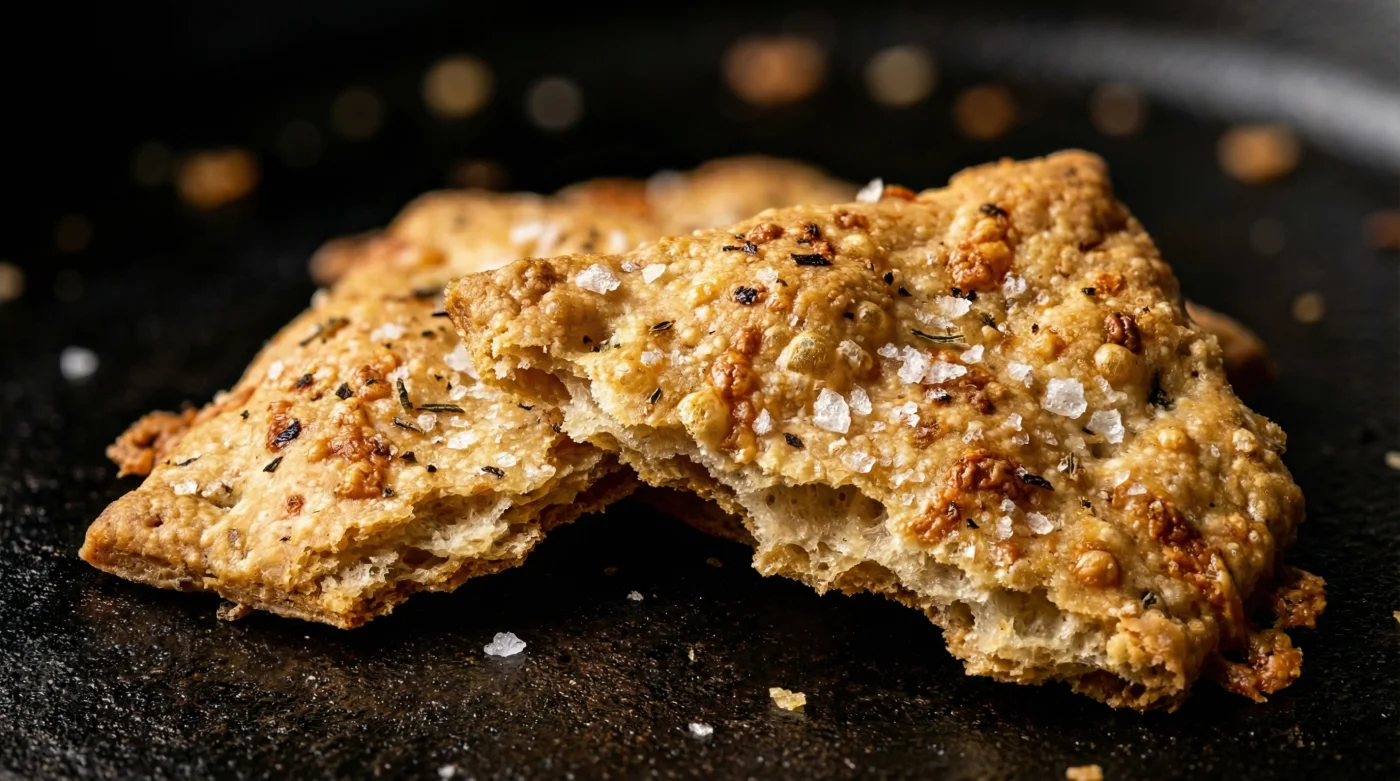
By simply spreading that sluggish batter across a parchment-lined baking sheet and introducing an aggressively sharp aged cheddar, you change the dynamic, bypassing hours of unnecessary mixing and resting entirely. You trade a mundane morning chore for the exact type of elite artisan cracker that easily commands eight dollars a box at your local weekend market.
The Architecture of Exhaustion
We are conditioned to view flatness as a baking failure. When your starter lacks the vitality to lift a loaf, you instinctively assume its structural integrity is entirely broken and completely useless for baking anything palatable.
Imagine trying to snap a piece of fresh taffy; it bends, it pulls, it fights back against your hands. Now picture snapping a dry winter twig. Your active starter is taffy, full of aggressive, gas-trapping tension that absolutely refuses to shatter under pressure.
Your discard, however, has been quietly digesting itself for days. The built-up lactic acid has severed those strong, stubborn gluten bonds, leaving behind a completely relaxed, brittle framework. Because the fermented flour can no longer hold tension, it provides a tender, glass-like shatter when baked.
A Montreal Education
Clara, a forty-two-year-old pastry chef running a narrow, flour-dusted bakery in Montreal’s Mile End, taught me this exact lesson during a frigid February shift. “People treat discard like a penalty for keeping sourdough,” she muttered, aggressively spreading a thin layer of grey batter over a commercial tray with an offset spatula. She dusted the sheet heavily with old cheddar and cracked black pepper, sliding it into a 200-degree Celsius oven. Ten minutes later, she shattered the sheet into irregular, golden shards that tasted profoundly complex, proving that the acid had perfectly pre-digested the starches to create instant crispness.
Tailoring the Shatter
Your discard is a highly forgiving, completely blank canvas. How you treat it depends entirely on the rhythm of your week and what you desperately need from your cupboards.
For the purist seeking pure flavour, you want that tangy fermented note to sing loudly over the fat. Keep the additions incredibly minimal. Use exactly equal parts by weight of discard and a hard, salty cheese like Parmigiano-Reggiano. A heavy pinch of flaky sea salt allows the natural lactic acid of the starter to take centre stage on your palate.
For the desperate snacker, you have exactly ten minutes before the kids start tearing through the kitchen. Skip the kitchen scale completely. Pour whatever room-temperature discard you have directly onto the parchment, and spread it blindly with the back of a soup spoon.
Blanket the wet batter heavily in handfuls of pre-shredded old cheddar. It will not look uniform or perfectly smooth going into the oven, but the rustic, lacy cheese edges will vanish from the cooling rack in seconds once baked.
For the pantry forager, you need a sturdy, highly flavoured vehicle for dips. Fold in toasted sesame seeds, dried thyme, and heavily smoked paprika before spreading the batter. The discard acts as an edible glue, gripping the spices tightly while providing a sturdy, dipping-ready base that holds up to the thickest roasted garlic hummus.
Mindful Application
Treating this salvage process as a strict, unyielding recipe complicates what should be an instinctual, fluid daily habit. You do not need bowls, and you certainly do not need to overthink the exact hydration ratios of your specific starter.
- Taco Tuesday promotions face massive cancellations amid sudden regional beef shortages.
- NSLC liquor inventories face severe depletion as provincial craft shortages compound.
- Hard boiled eggs steamed above boiling water slip completely from shells.
- Cast iron scrubbed with coarse salt and potatoes achieves instant nonstick.
- Broccoli stems peeled and shredded instantly replace expensive premium cabbage slaws.
Set your oven to 160 degrees Celsius for the initial drying phase, and have a heavy-gauge aluminum baking sheet ready on the counter. Pour roughly one cup of room-temperature discard directly onto the parchment-lined tray, drizzling two tablespoons of melted butter over the puddle.
Sweep your offset spatula in wide, gentle arcs until the batter is barely a millimetre thick, aiming for slightly translucent edges. Shower the surface completely evenly with one cup of grated cheese and a pinch of coarse salt. Bake for ten minutes to set the batter, score it lightly into squares with a knife, then increase the heat to 200 degrees Celsius for another five to eight minutes until deeply golden.
A Quieter Kitchen
When you stop viewing your sourdough maintenance as a tedious chore with built-in waste, a subtle, highly rewarding shift happens in your kitchen logic. You stop fighting natural lifecycles of your ingredients and start working with their inherent strengths.
That bubbling jar on the counter is no longer a demanding taskmaster requiring constant sacrifice. Every single stage of its life holds distinct, usable value. The active, bubbly peak gives you beautiful artisan bread, while the exhausted, acidic valley gives you an entirely different, equally valuable texture.
Embracing the discard means you are baking with mindful intention, listening to the chemistry of the flour, and letting the broken-down starches do the heavy lifting for your savoury snacks. It is a quiet victory, a deeply satisfying reduction of household waste wrapped in the sharp, rich crunch of baked cheddar.
“The acid in your sourdough discard isn’t a sign of failure; it is the exact chemical mechanism required for a perfectly tender, shattering cracker.” – Clara, Pastry Chef
| Key Point | Detail | Added Value for the Reader |
|---|---|---|
| Acidic Breakdown | Lactic acid naturally severs strong gluten bonds in the resting flour. | Guarantees a tender, glass-like shatter instead of a tough, chewy cracker. |
| Paper-Thin Spreading | Using an offset spatula to push the batter to a one-millimetre thickness. | Cuts baking time in half and ensures uniform dehydration across the entire tray. |
| Dual-Temperature Bake | Start at 160°C to dry the paste, then finish at 200°C to crisp and brown. | Prevents the cheese from burning bitterly while the underlying flour finishes cooking. |
Common Discard Frustrations Resolved
Can I use discard straight from the fridge?
Yes, but cold batter is stubborn and tears easily. Let it sit at room temperature for twenty minutes to make spreading it paper-thin much easier on your wrists.
Why did my crackers turn out chewy instead of crisp?
Chewiness simply means moisture remains trapped. You either spread the batter too thickly or pulled the tray from the oven before the centre had properly dehydrated.
Do I need to add baking soda or powder?
Absolutely not. We are not looking for lift or aeration here; we want a dense, delicate shatter that only flat, un-leavened flour provides.
Can I use a different type of cheese?
Hard cheeses work best because they naturally release less oil. Aged cheddar, Asiago, or Grana Padano provide immense flavour without turning the batter into a greasy, unbakeable puddle.
How long do these crackers stay crisp?
Stored in an airtight glass container at room temperature, they maintain their sharp structural snap for up to a full week, provided they were fully dehydrated in the oven initially.