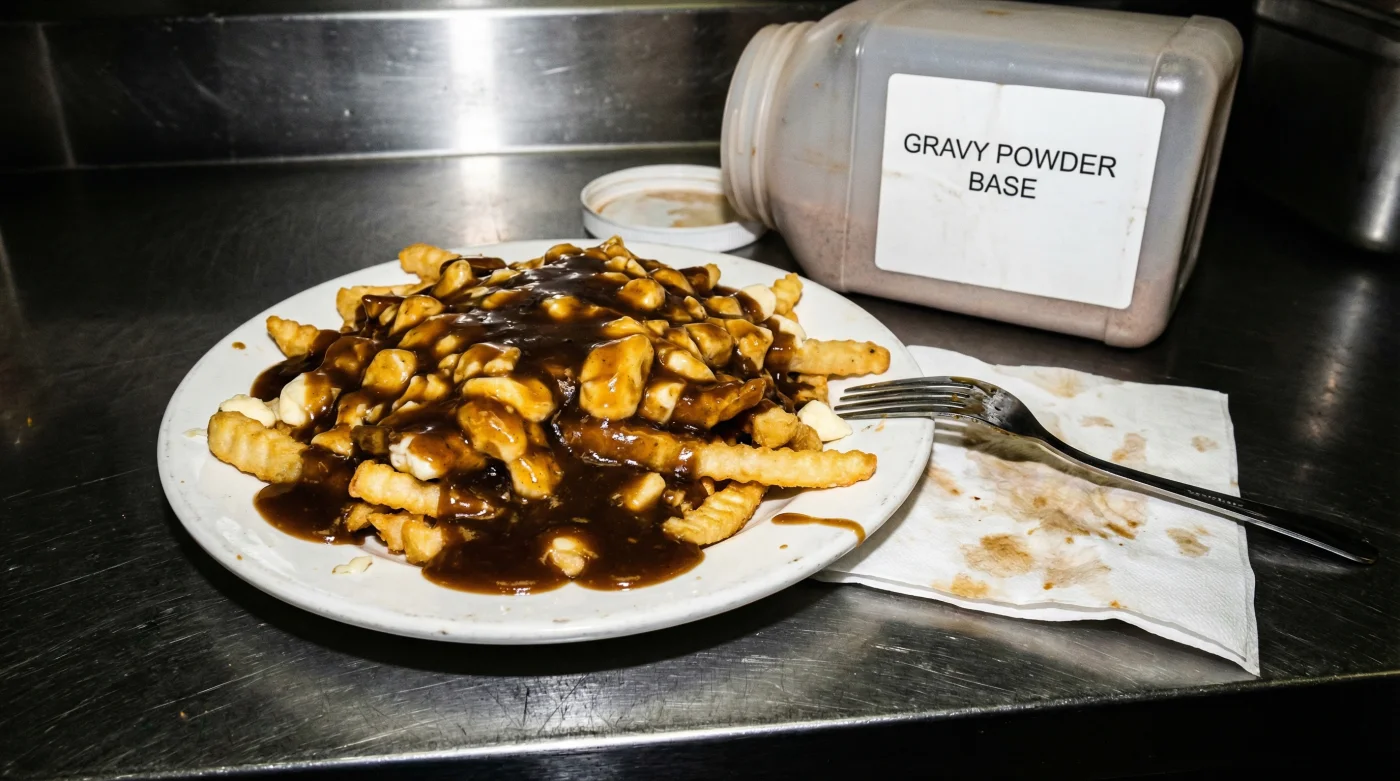
You push open the heavy glass door of a highway casse-croûte, letting a rush of minus-15 Celsius air sweep across the linoleum. The hum of the fryers and the clatter of ceramic plates offer an immediate, familiar comfort against the stark Canadian winter.
The air inside smells exactly as it should—a heavy, savoury collision of fried potatoes and humid warmth. You anticipate that deep richness, the kind of dark, peppery sauce that binds the meal together into something more than its parts.
But lately, you might have noticed a subtle, unsettling shift across your favourite provincial chains. The fries are still crisp, the curds still squeak, but the dark liquid poured over the top lacks its usual soul, sliding off the cheese rather than melting into it.
Behind closed kitchen doors, major Quebec outlets are quietly replacing authentic beef tallow with synthetic bases and modified starches. It is a calculated pivot designed to shave fractions of a cent off the bottom line, leaving locals wondering why their late-night comfort suddenly feels hollow.
The Illusion of the Perfect Pour
We have been conditioned to believe that a flawlessly glossy, perfectly uniform sauce is the mark of a well-run kitchen. You watch it cascade from the ladle, looking like dark amber syrup, and assume the recipe remains intact.
But that mirror-like sheen is often the calling card of industrial food science. True diner gravy, built on the rendered fat of roasted bones, possesses a slightly matte finish and a complex, uneven character that clings to the starch rather than pooling at the bottom of the bowl.
When you stop viewing gravy as a mere condiment and start treating it as the structural foundation of the dish, everything changes. The fat is not just for flavour; it is the thermal envelope that gently warms the curds without turning them into liquid rubber.
Making it yourself often feels like a messy chore, an unnecessary step when powdered packets line the grocery shelves. Yet, this perceived kitchen inconvenience becomes your greatest advantage, allowing you to bypass the synthetic shortcuts entirely and control the foundation of your food.
Take Luc Vandal, a 58-year-old diner owner who has been manning the fryers in Trois-Rivières since the late eighties. He points out the exact month the big franchises changed their formulas, noticing how the bulk pails arriving at back doors suddenly listed hydrolysed soy protein before beef stock.
He insists that a proper base must carry the weight of real marrow and fat. Luc describes the artificial replacements as ‘water dressed up in a tuxedo,’ a liquid that looks the part but disappears on the palate. His secret is uncompromising: if the sauce doesn’t tremble slightly as it cools in the pan, it has no business touching a potato.
Reclaiming the Casse-Croûte Standard
Rebuilding this provincial staple in your own kitchen requires knowing what kind of cook you are and what you have on hand. You do not need industrial vats, just a clear intention for your ingredients.
For the Heritage Purist: You source real beef tallow from the local butcher. This is about capturing that heavy, authentic mouthfeel. You melt the fat slowly, letting it foam before introducing the flour, creating a dark roux that smells like Sunday roast.
For the Weeknight Pragmatist: You might not have tallow, but you refuse the powdered packet. Here, a high-fat cultured butter steps in to provide the necessary dairy solids.
- Poutine gravy recipes shift dramatically as major Quebec chains cut costs.
- Taco shells face massive price hikes following severe regional corn shortages.
- Canned chickpeas soaked in baking soda shed their tough outer skins.
- Hollandaise sauce blended with hot tap water prevents tragic emulsion breaks.
- Cauliflower leaves roasted with garlic powder create premium crispy vegetable chips.
For the Plant-Based Adapter: Replicating the distinct weight of beef fat requires a structural workaround. You rely on refined coconut oil for the mouthfeel and a heavy dose of roasted mushroom stock and yeast extract to forge that missing savoury depth.
The Architect’s Approach to the Sauce
The actual assembly is a quiet exercise in temperature control and patience. You are not just boiling liquid; you are binding molecules together so they can carry warmth and flavour.
Keep your workspace uncluttered. Have your whisk ready and your stock heated in a separate saucepan. Pouring cold liquid into hot fat is a recipe for a broken, lumpy mess.
- Melt 45 grams of beef tallow (or butter) in a heavy-bottomed saucepan over medium heat until it shimmers.
- Scatter an equal amount of all-purpose flour across the fat, whisking continuously for precisely three minutes until the paste smells toasted.
- Gradually pour in 500 millilitres of warm, high-quality beef stock, keeping the whisk moving in tight, rapid circles.
- Bring the mixture to a gentle simmer—around 90 Celsius—and let it thicken for five minutes, watching for the moment it coats the back of a spoon.
- Finish with a heavy pinch of black pepper and a single drop of white vinegar to wake up the palate.
Let the finished product rest off the heat for two minutes before pouring. This brief cooling period ensures the liquid binds properly to the starch without instantly turning the fries to mush.
Preserving the Cultural Plate
Taking the time to craft this element from scratch is a quiet rebellion against the cheapening of our shared foods. When major chains prioritize profit margins over provincial heritage, the responsibility of preserving those flavours falls to you.
There is a profound satisfaction in knowing every single ingredient that sits on your plate. You bypass the artificial colours, the anti-caking agents, and the synthetic aromas cooked up in a laboratory to mimic what nature already perfected.
What you pour over those curds is an honest reflection of care, a simple mixture of fat, flour, and stock. It grounds you in the kitchen, turning a fast-food craving into a mindful act of cooking.
You sit down at the table, the steam curling upward, and take that first bite. The flavour is round, deep, and familiar, proving that some corners are simply not meant to be cut.
“When you trade fat for powder, you aren’t just saving pennies; you are erasing the memory of the meal itself.”
| Key Point | Detail | Added Value for the Reader |
|---|---|---|
| The Tallow Foundation | Using rendered beef fat instead of synthetic oils or modified starches. | Provides authentic diner mouthfeel and proper thermal coating for melting curds. |
| Temperature Matching | Heating the stock before adding it to the hot roux base. | Prevents seizing and guarantees a completely smooth, lump-free texture. |
| The Acid Drop | Adding a single drop of white or apple cider vinegar off the heat. | Cuts through the heavy richness, preventing palate fatigue during a heavy meal. |
Frequently Asked Questions
Why does my homemade gravy always turn out lumpy?
Lumps happen when cold liquid shocks a hot roux. Always heat your stock gently in a separate pot before whisking it into your flour and fat mixture.Can I use a store-bought broth for the base?
Yes, but choose a high-quality, low-sodium bone broth. Standard boxed stocks lack the gelatine required to give the sauce its proper, trembling weight.What is the exact ratio for a perfect roux?
A classic roux is a one-to-one ratio by weight, not volume. Use 45 grams of fat to 45 grams of flour to ensure a stable emulsion.Why do the restaurant versions look so shiny?
That unnatural gloss comes from modified cornstarch and synthetic thickeners used to stretch cheap ingredients. A real, fat-based sauce will always have a slightly matte appearance.Can I make this ahead of time?
Absolutely. It will solidify in the fridge, but gently reheating it on the stove with a splash of water will bring it right back to its original consistency.