The tin opener bites into the metal, leaving a jagged edge. Inside, pale beige spheres sit submerged in thick, cloudy liquid. It is a familiar kitchen scene on a grey November afternoon in Ottawa, watching the frost creep up the window glass while prepping a late lunch. The smell is earthy and slightly metallic, promising a nutritious meal but demanding manual labour.
You likely pour them into a colander, watching the cold tap water wash away the foam. The standard home kitchen routine demands patience: pinching hundreds of individual legumes between your thumb and index finger, popping the translucent jackets off one by one. It feels endless, leaving your fingertips wrinkled and your enthusiasm worn thin as the pile of discarded skins slowly grows.
Professional kitchens simply do not operate this way. When a bustling Toronto bistro blends bowls of impossibly smooth hummus, there is not a line of prep cooks sobbing over a stainless steel sink of wet chickpeas. The margins in the restaurant industry are too thin, and human time is too valuable to waste on pinching legumes.
Instead, they rely on a simple white powder sitting ignored in the back of your pantry. A spoonful of baking soda shifts the entire landscape, dissolving the barriers between a lumpy dip and a silken spread. It completely contradicts the painstaking manual peeling method, automating the tedious work while you wipe down the counters.
The Chemistry of Letting Go
Think of the chickpea’s skin as a tightly woven wool sweater, shrinking and clinging to the starchy surface below. Trying to rip it off under cold running water is an exercise in pure friction. We often falsely assume that meticulous, frustrating manual labour is the necessary price of achieving culinary quality.
By raising the water’s pH balance, alkalinity weakens the complex pectin holding that fibrous wrapper together. It is not a violent stripping away; it is a gentle relaxation of the natural glue that binds the plant cells. You are no longer forcing the ingredient to comply, but convincing it to let go gracefully.
The mundane sodium bicarbonate acts as a microscopic solvent, interacting specifically with the hemicellulose in the skin. It softens the very cellular structure of the pulse without turning the interior into mush. The rigid cell walls lose their integrity, swelling slightly before detaching entirely.
Rather than fighting the legume with friction, you alter its chemical environment, allowing the tough outer layers to literally dissolve and slough off in the hot liquid. The science handles the heavy lifting, turning a frustrating physical task into a passive background process.
Elias Thorne, a forty-two-year-old chef running a high-volume Mediterranean pop-up in Halifax, remembers the exact afternoon his perspective shifted. He was staring down four commercial-sized tins of chickpeas, dreading the hours of manual prep ahead of the evening rush, listening to the rain hit the metal roof. His older mentor walked over, dumped a handful of baking soda into a pot of simmering water, and tossed the drained chickpeas in. Five minutes later, the skins were floating on the surface like fallen leaves. Elias realized then that true culinary skill is about outsmarting the raw material.
Adjusting for Your Appetite
Not every dish requires complete structural surrender. Tailoring the alkaline heat exposure dictates exactly how the final legume will feel on the palate, allowing you to manipulate the texture for entirely different meals.
For the Silk Purist
If you are chasing a dip that rivals heavy cream, the full treatment is non-negotiable. Simmering the canned chickpeas with baking soda ensures the skins melt away entirely, leaving pure, uninterrupted starch ready to absorb tahini and olive oil in the food processor without any gritty resistance.
For the Weeknight Simmerer
Perhaps you are throwing together a quick tomato and kale stew. A lighter baking soda soak—just tossing the beans in a bowl of hot tap water with a pinch of the powder for ten minutes—softens the skins just enough so they do not chew like bits of plastic, while keeping the whole bean visually intact.
For the Crispy Roaster
- Poutine gravy recipes shift dramatically as major Quebec chains cut costs.
- Taco shells face massive price hikes following severe regional corn shortages.
- Canned chickpeas soaked in baking soda shed their tough outer skins.
- Hollandaise sauce blended with hot tap water prevents tragic emulsion breaks.
- Cauliflower leaves roasted with garlic powder create premium crispy vegetable chips.
The Five-Minute Breakdown
Executing this kitchen trick requires little more than close observation and a gentle hand. Avoid a violent rolling boil, which will smash the tender flesh into a cloudy paste before the skins have a chance to properly release from the bean.
Start by draining and rinsing your canned chickpeas thoroughly under cold water. Place them in a wide, shallow saucepan, giving the legumes plenty of physical room to move around as the water heats up.
Sprinkle exactly one teaspoon of baking soda over the beans for every standard 540-millilitre can. Turn the stove to medium, allowing the water to just begin steaming without erupting into large, aggressive bubbles.
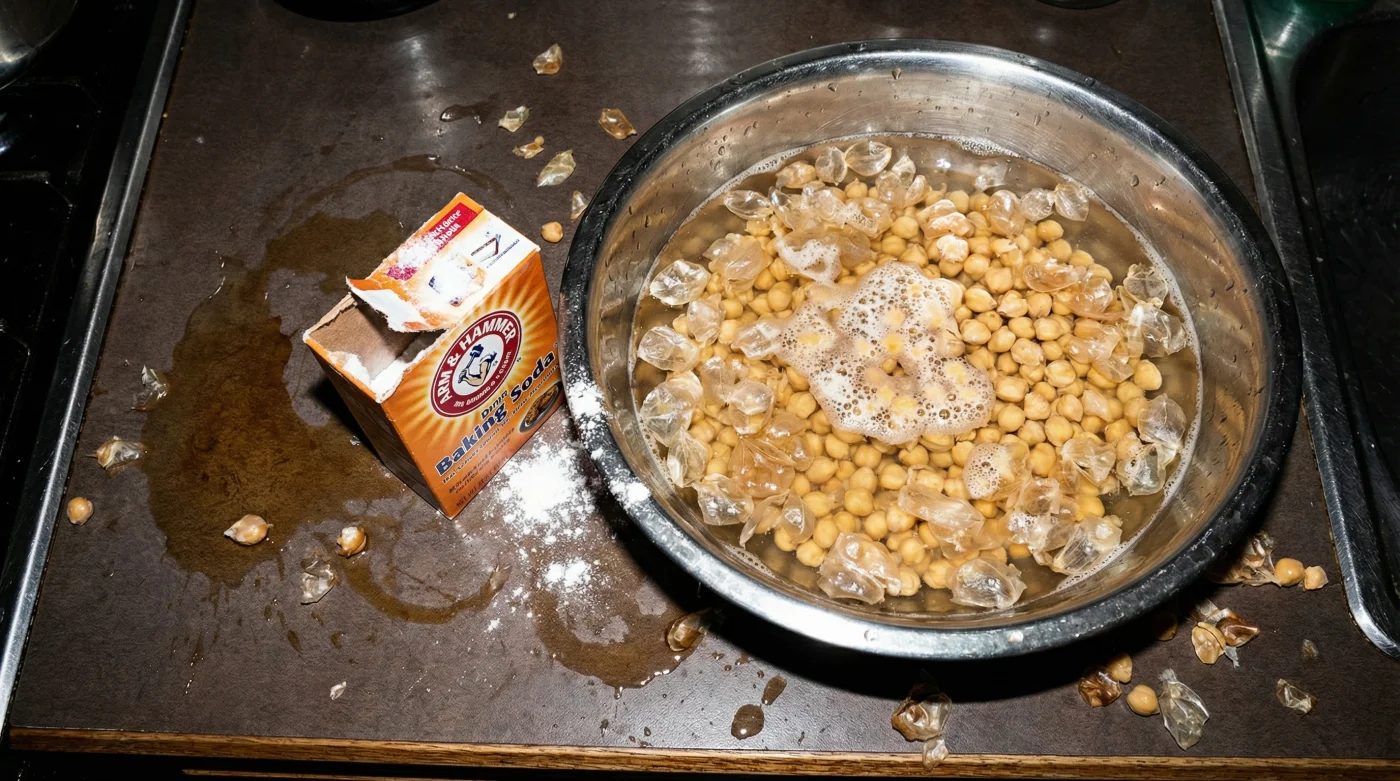
Watch for the visual shift in the pot. The water will turn slightly yellow, and a thin, cloudy foam will gather at the edges of the pan as the pectin begins to rapidly break down.
- Heat the pot: Bring water to a gentle simmer, keeping the temperature around 85 Celsius.
- Add the alkaline agent: Stir in the baking soda and the freshly rinsed chickpeas.
- Observe the release: Simmer gently for three to five minutes until the translucent skins float to the top.
- The cold shock: Drain into a fine mesh sieve immediately.
Once the skins have detached entirely, rinse away the alkaline residue by running the strainer under cold tap water for at least thirty seconds. If you skip this crucial step, your final dish will carry a faintly soapy, metallic aftertaste that ruins the delicate earthy flavour.
The tactical approach requires a few mindful details to ensure success every single time you open a tin. Keep your measurements precise; an overly heavy hand with the sodium bicarbonate will overwhelm the natural taste of the pulse.
Reclaiming the Kitchen Ritual
Time spent standing at the counter should not feel like a punishment. Finding a method that removes friction from the cooking process offers a quiet daily satisfaction, turning a previously dreaded chore into a swift, nearly magical transformation.
You are not simply saving twenty minutes of pinching cold, wet beans on a busy Tuesday evening. You are inviting a small piece of professional kitchen alchemy into your domestic routine, bridging the gap between home cooking and restaurant-quality results.
The next time you open a tin, trust the gentle chemical reaction, and watch the resistance simply float away. Cooking becomes less about wrestling with ingredients and more about guiding them toward their best possible state.
“We spend so much time fighting our ingredients, when a little bit of basic chemistry can do the heavy lifting for us. The baking soda trick is not a shortcut; it is just working smarter.” — Elias Thorne
| Key Point | Detail | Added Value for the Reader |
|---|---|---|
| Alkaline Environment | Raises the water’s pH balance significantly. | Dissolves pectin instantly, saving manual peeling time. |
| Gentle Simmer | Keeps water around 85 Celsius without boiling. | Prevents the beans from turning into a mushy paste. |
| Cold Shock Rinse | Washing the drained beans under cold tap water. | Removes any metallic or soapy aftertaste entirely. |
Frequent Questions About Alkaline Legume Prep
Does this method work for dried chickpeas? Yes, adding baking soda to the soaking water overnight dramatically reduces cooking time and softens the skins.
Will the baking soda alter the final flavour? Not if you rinse them thoroughly. The cold water wash removes the residual sodium bicarbonate before blending.
Can I use baking powder instead? No. Baking powder contains acidic elements that neutralize the exact alkaline reaction required to break down the pectin.
How long can I store the peeled chickpeas? Once boiled and rinsed, keep them in an airtight container in the refrigerator for up to three days.
Is this necessary for roasted chickpeas? It is optional. A partial soak creates surface fissures for crispness, but leaving the skins fully intact is fine for roasting.