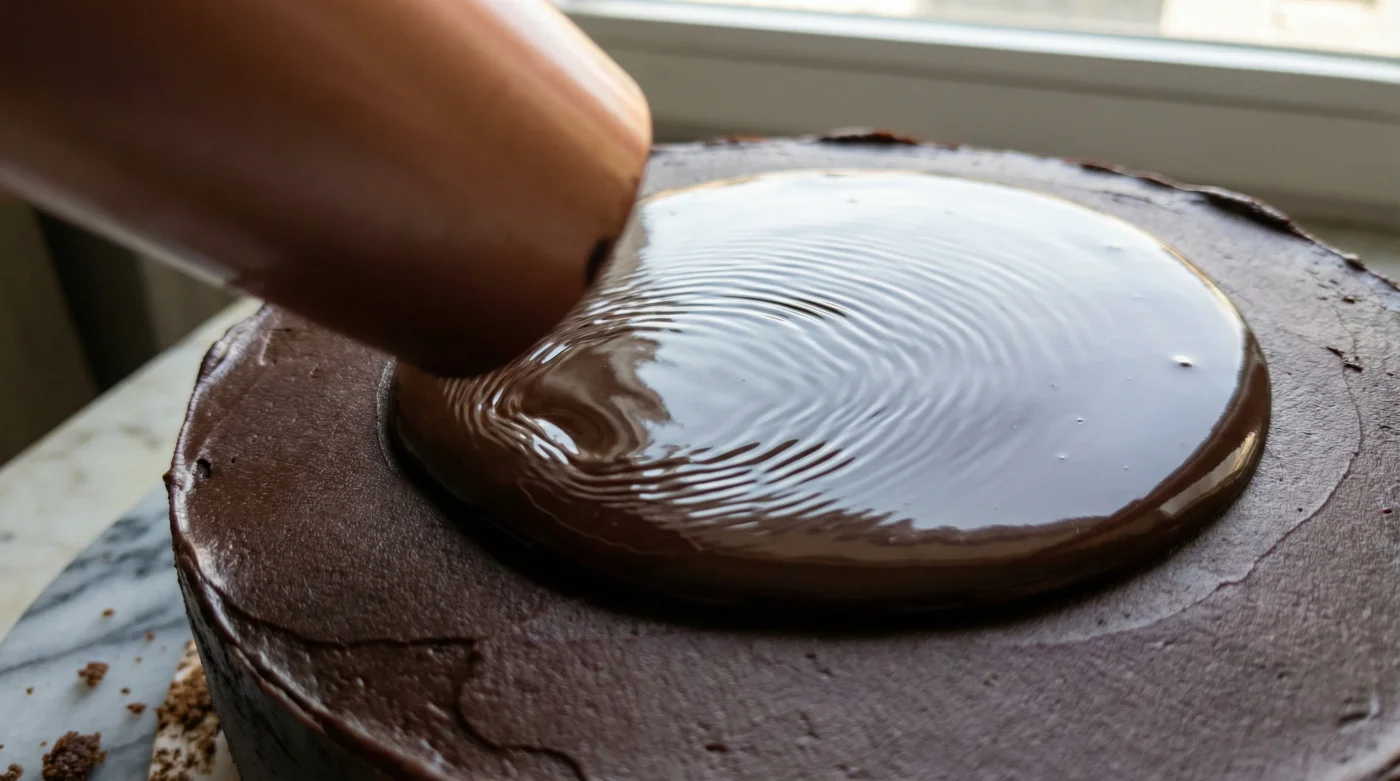
You pull the chocolate tart from the fridge, and your stomach sinks. The top isn’t the mirror-like surface you pictured. Instead, it looks dull, streaked with grey blooms, and stubborn. The air smells heavily of roasted cocoa and vanilla, but the visual magic is entirely gone.
Most baking bibles tell you this is a failure of chemistry. You missed the temperature curve by a single degree Celsius, they say. Now you are stuck with a dessert that tastes perfectly fine but looks like a muddy, amateur mistake.
You might think the only fix involves a double boiler, a laser thermometer, and the kind of patience only found in a strict culinary institute. But the truth is much quieter, sitting coiled in a drawer right down the hall.
A standard bathroom hairdryer is the most precise pastry tool you already own. By applying wide, gentle, sweeping warmth, you can coax a matte, stubborn glaze back into a flawless, bakery-window shine without ever touching the chocolate.
The Physics of the Gentle Melt
Think of cocoa butter like a tightly wound knot of fine silk threads. When chocolate cools too fast or seizes in a drafty kitchen, those threads tangle unevenly, scattering light instead of reflecting it back to your eye.
If you try to fix it by putting the whole dessert back in the oven or hitting it with a heavy-duty kitchen torch, you scorch the fragile sugars. The threads burn and separate rather than relaxing into a smooth sheet.
A hairdryer, on the other hand, breathes warmth over the surface. It acts exactly like a gentle breeze on a late summer afternoon, melting only the top microscopic layer of cocoa fat without cooking the delicate filling beneath it.
Clara Dupont, a 42-year-old pastry chef running a boutique patisserie in Montreal’s Plateau neighbourhood, understands this intimate boundary between ruined and radiant. Three years ago, hours before a major holiday catering deadline, her expensive commercial tempering machine abruptly died. Faced with three dozen dull-looking mirror-glaze cakes, she didn’t panic. Clara grabbed the cheap travel hairdryer from her gym bag, plugged it in next to the commercial mixers, and methodically hovered it over each cake. The gentle heat instantly ironed out the imperfections, restoring a wet-look gloss that held beautifully at room temperature.
Tailoring the Warmth to Your Dessert
Not all chocolate surfaces behave the same way under heat. You have to read the room, adjusting your approach based on what sits on your serving platter.
For the Ganache Tart Maker
A flat, wide surface is a canvas for streaks. When your poured ganache sets with ripples or tiny air bubbles, direct contact with a spatula will only scar it permanently. The warmth of the dryer allows the ganache to pool out naturally, self-levelling into a glassy lake.
For the Layer Cake Dripper
Those dramatic drips down the sides of a tall layer cake often stall halfway down, leaving thick, awkward blobs. A quick pulse of low heat gets the chocolate moving again, thinning the drip until it tapers off elegantly just above the plate.
For the Chocolate Shell Purist
- Poutine gravy recipes shift dramatically as major Quebec chains cut costs.
- Taco shells face massive price hikes following severe regional corn shortages.
- Canned chickpeas soaked in baking soda shed their tough outer skins.
- Hollandaise sauce blended with hot tap water prevents tragic emulsion breaks.
- Cauliflower leaves roasted with garlic powder create premium crispy vegetable chips.
The Technique of the Perfect Gloss
Putting this into practice requires restraint. You are not trying to cook the dish; you are simply whispering heat across its surface to wake up the cocoa butter.
Keep the nozzle moving constantly, sweeping back and forth like you are painting a broad fence. If you hover over one spot for too long, the fat will separate from the solids, leaving an oily puddle.
- Heat Setting: Low or Medium. Never use high heat.
- Airflow Setting: Low. High air pressure will push the liquid chocolate, blowing ripples into your smooth surface.
- Distance: Keep the nozzle roughly 15 to 20 centimetres away from the dessert.
- Motion: Smooth, overlapping figure-eight loops across the entire surface.
- Timing: Stop the moment the surface turns reflective. It will continue to smooth out for a few seconds after the heat is removed.
Work in a cool room, ideally around 18 or 19 degrees Celsius. If your kitchen is hot and humid, the chocolate will struggle to set again once you have melted that delicate top layer.
Watch the surface tension change. You will see the dull grey bloom literally melt away in real time, replaced by a deep, dark mirror finish that catches the light beautifully.
Reclaiming the Joy of the Finish
Baking at home shouldn’t feel like a high-wire act where a single degree ruins the finale. When we stop viewing pastry through the rigid lens of laboratory science, we find space to breathe and enjoy the craft.
A little clever improvisation strips away the intimidation factor. You don’t need to spend hundreds of dollars on specialized catering equipment to make a cake that looks expensive and cared for.
The next time a ganache seizes or a glaze turns stubbornly matte, you won’t feel that familiar knot of frustration in your chest. You will simply walk to the bathroom, grab an everyday tool, and quietly fix the problem. That is the true mark of a confident cook.
“A beautiful dessert is rarely born from perfect conditions; it is born from knowing exactly how to pivot when the chocolate refuses to cooperate.” — Clara Dupont
| Key Point | Detail | Added Value for the Reader |
|---|---|---|
| Heat Source | Kitchen blowtorch vs. Hairdryer | The blowtorch scorches sugar; the hairdryer melts cocoa fat gently, preventing bitter, burnt flavours. |
| Air Velocity | High pressure vs. Low setting | Low airflow ensures the chocolate pools smoothly without blowing ripples or exposing the cake beneath. |
| Accessibility | Tempering machines vs. Household appliances | Zero extra cost. You achieve patisserie-level aesthetics with a reliable item you already own. |
Frequently Asked Questions
Will my dessert taste like dust or hair products?
No. As long as your hairdryer is reasonably clean and you hold it 15 to 20 centimetres away, it simply moves ambient warm air. It transfers zero flavour.Can I use this trick on white chocolate?
Yes, but with extra caution. White chocolate contains no cocoa solids, only cocoa butter, milk, and sugar. It burns at a much lower temperature, so use the lowest heat setting and keep the dryer moving.How long does the gloss last after heating?
If your room is cool (under 20 degrees Celsius), the chocolate will set beautifully and retain its shine for hours. Avoid putting it straight back into a damp, crowded fridge, which causes condensation.Will this fix chocolate that has heavily seized with water?
Unfortunately, no. If a drop of water has fallen into your melting bowl and turned the chocolate into a gritty paste, heat won’t save it. This technique only fixes surface dullness and blooming.Does this work on refrigerated buttercream?
Yes. A quick pass with the hairdryer slightly softens the outer edge of cold, stiff buttercream, making it infinitely easier to smooth with a hot metal bench scraper.