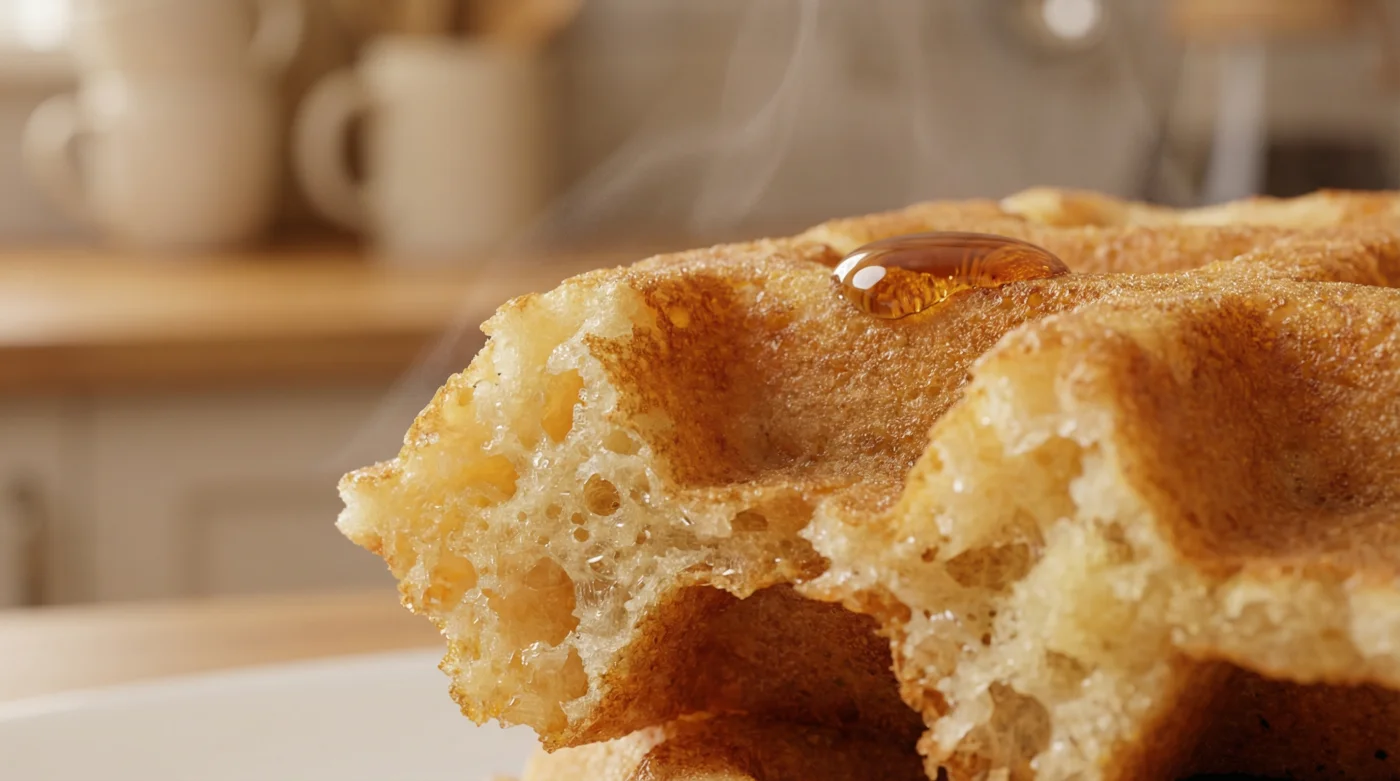
You know the sound of a disappointing breakfast. It is the dull, damp thud of a soft waffle hitting a ceramic plate. The kitchen smells like toasted sugar and melted butter, but the tactile promise is broken. You pour your maple syrup, and within seconds, the squares absorb the amber liquid, collapsing into a heavy, soggy sponge.
We are conditioned to think that richness builds quality. Most recipes tell you to rely on heavy dairy—thick creams, whole milk, or viscous buttermilk—to create a memorable breakfast. You whisk these dense fats into your flour, hoping for that bakery-style crunch, only to find the steam trapped inside the iron turning your hard work into cake.
True crispness requires the exact opposite approach. The secret to a shatteringly sharp edge isn’t adding more weight; it is introducing aggressive, volatile air. Replacing half of your liquid with carbonated water forces the batter to expand rapidly when it hits the hot metal, leaving behind millions of microscopic, hardened air pockets.
This two-ingredient professional pivot changes everything about your Sunday mornings. The bubbles act like tiny structural columns, holding up the outer shell of the waffle while the inside stays tender. The resulting crust is so rigid it practically rings when you tap it with a fork.
The Perspective Shift: From Brick to Scaffolding
Think of your waffle batter as a piece of architecture. When you build solely with heavy milk and thick eggs, you are laying down wet bricks. The structure is dense, deeply flavoured, but ultimately heavy. Moisture has nowhere to escape, and as the waffle cools on the counter, steam softens the exterior until the crunch disappears completely.
Carbonated water acts as temporary scaffolding. The dissolved carbon dioxide forces the proteins in the flour to stretch thin. As the iron cooks the batter, the water evaporates instantly, and those bubbles solidify. You aren’t baking a cake anymore; you are forging a delicate, crisp shell that holds its ground against butter, syrup, and time.
Julianne, a 42-year-old brunch chef running a bustling thirty-seat café in downtown Montreal, built her reputation on this exact shift. For years, she struggled with plates returning to the kitchen half-eaten because her dense buttermilk waffles grew soggy under the weight of local maple syrup and fresh fruit. One morning, out of whole milk and desperate during a chaotic weekend rush, she quietly thinned her remaining batter with a freshly opened bottle of unflavoured club soda. The resulting batch cooked twice as fast, creating a golden, glass-like exterior that customers immediately noticed. Her regulars began asking what new bakery she was sourcing her dough from. She never went back to the old method, completely overhauling her menu to feature this accidental discovery.
For the Buttermilk Purist
You do not have to abandon the tangy flavour of cultured dairy entirely. The trick is a strict half-and-half division. Use your buttermilk for flavour, but let cold carbonated water handle the structural lifting. Fold the bubbly water in at the absolute last second, just before the batter meets the iron, so you never lose the active carbonation.
For the Plant-Based Kitchen
This method is remarkably forgiving for dairy-free alternatives. Because almond or oat milk naturally lacks the heavy fat of cow’s milk, adding carbonated water amplifies the crisping effect even further. A splash of apple cider vinegar can help mimic the acidic tang you might miss from traditional recipes.
For the Make-Ahead Planner
- Melted chocolate smoothed with a hairdryer creates flawless glossy dessert finishes.
- Curry sauce overpowered by heavy spices recovers instantly using plain yogurt.
- Rolled oats toasted in dry pans unlock deep expensive bakery flavors.
- Ground turkey mashed with cold butter replicates premium beef taco textures.
- Waffle batter mixed with carbonated water guarantees shatteringly crisp breakfast edges.
Mindful Application
Creating this texture requires you to respect the fragility of the bubbles. If you beat the batter with a heavy hand, you destroy the exact mechanism that guarantees your crunch. The mixture should look rough and slightly lumpy.
When the wet meets the dry, the batter should tremble slightly in the bowl. You are not aiming for a perfectly smooth paste; you are gently coaxing the ingredients together. Use a wide spatula, scraping the bottom of the bowl and pulling flour over the liquid in slow, deliberate folds.
Here is your tactical toolkit for flawless execution:
- The Liquid Ratio: Substitute exactly fifty percent of your recipe’s milk with unflavoured club soda or seltzer.
- The Temperature Strategy: Keep the carbonated water at roughly 4 Celsius to maximize gas retention before cooking.
- The Iron Heat: Set your appliance to medium-high. Too low, and the batter steams; too high, and the outside burns before the water evaporates.
- The Resting Phase: Never stack hot waffles. Let them breathe on a wire cooling rack for sixty seconds to release their final bursts of steam.
The Bigger Picture
We spend so much time overcomplicating our kitchen routines, assuming that better results demand more expensive ingredients, commercial-grade equipment, or exhausting techniques. Finding a shortcut that actually improves the outcome feels incredibly grounding. It strips away the unnecessary noise of modern cooking advice and returns you to simple, effective chemistry. You do not need to be a formally trained pastry chef to master this; you just need to understand how ingredients physically react under heat.
There is a quiet satisfaction in serving a plate of food that behaves exactly as promised. Knowing you can produce a professional-level crispness with a humble bottle of sparkling water gives you an undeniable edge in the kitchen. Your mornings become less about frantic preparation and more about enjoying a perfectly engineered breakfast, one shatteringly crisp bite at a time. The anxiety of serving a soggy breakfast disappears, replaced entirely by the confidence of a foolproof morning ritual.
The crunch of a perfect waffle is built on the air you trap inside, not the fat you pour into the bowl.
| Key Point | Detail | Added Value for the Reader |
|---|---|---|
| The Liquid Substitution | Replace half your milk with cold carbonated water. | Creates a lighter batter that cooks faster and crisps intensely. |
| Mixing Technique | Fold gently until just combined; leave lumps. | Preserves carbonation for maximum structural lift. |
| Post-Cook Resting | Cool on a wire rack for 60 seconds. | Prevents steam from softening the freshly baked crust. |
Frequent Morning Inquiries
Can I use flavoured sparkling water?
It is best to stick to unflavoured club soda or seltzer, as the subtle fruit oils in flavoured waters can scorch on the hot iron.Does the water need to be ice cold?
Yes, cold liquids hold dissolved gases much better than room-temperature liquids, ensuring maximum lift when the batter hits the heat.Will my waffles lack flavour without full dairy?
Not at all. You retain enough dairy for richness, while the improved crunch actually enhances the way your palate perceives the butter and syrup.Can I save the leftover batter?
Leftover batter will lose its carbonation over time. It is best to cook all the waffles immediately and freeze the extras for the toaster.Why did my waffles still turn out soft?
Your iron likely was not hot enough, or the cooked waffles were stacked on a flat plate where trapped steam ruined the crust.