Morning light hits the kitchen counter. The smell of dark roast coffee mingling with rye bread browning in the toaster sets a calm, deliberate tone. It is a quiet, sacred pocket of the day, right up until you decide to make a poached egg. Suddenly, the kitchen feels like a high-stakes chemistry lab, filled with the stress of timing and temperature.
You likely learned the chaos of a rolling boil, a heavy pour of pungent white vinegar that makes the room smell like a pickling factory, and the frantic stirring of a whirlpool. You drop the egg into the vortex, praying it holds together, only to watch it spin out into a dozen messy white tentacles. It ruins the aesthetic of your plate and leaves you scraping rubbery bits off the sides of your favourite saucepan.
It feels like a gamble every time. Sometimes you get a passable sphere; other times, you pull out a ragged, watery ghost of a breakfast. But if you peer over the counter at any busy brunch service, you will not see cooks furiously stirring pots of sour water. You will see a workspace that is surprisingly calm, quiet, and methodically organized.
They rely on simple strainers to do the heavy lifting. The secret to those perfectly round, restaurant-quality spheres isn’t in the flick of the wrist or the harsh acidity of the water. It lies in understanding the anatomy of the egg itself, and removing the single structural flaw that causes all the trouble before the shell even touches the heat.
The Anatomy of the White
Think of a raw egg like a heavy wool sweater with a few loose threads hanging off the hem. When you toss that sweater into moving water, those threads catch the aggressive current and begin to unravel the whole shape. In your breakfast pan, those loose threads are the watery albumen. A fresh egg is actually composed of two distinct zones of white: a tight, thick layer immediately surrounding the yolk, and a thinner, fluid layer on the outside.
As eggs age in cartons, their tight, gelatinous whites naturally begin to break down into this thin, watery liquid. This secondary layer is the sole reason your poaches turn into sprawling sea monsters. The chaotic whirlpool method was invented to forcefully wrap those loose wisps back around the yolk. But brute force is the entirely wrong tool for such a delicate ingredient.
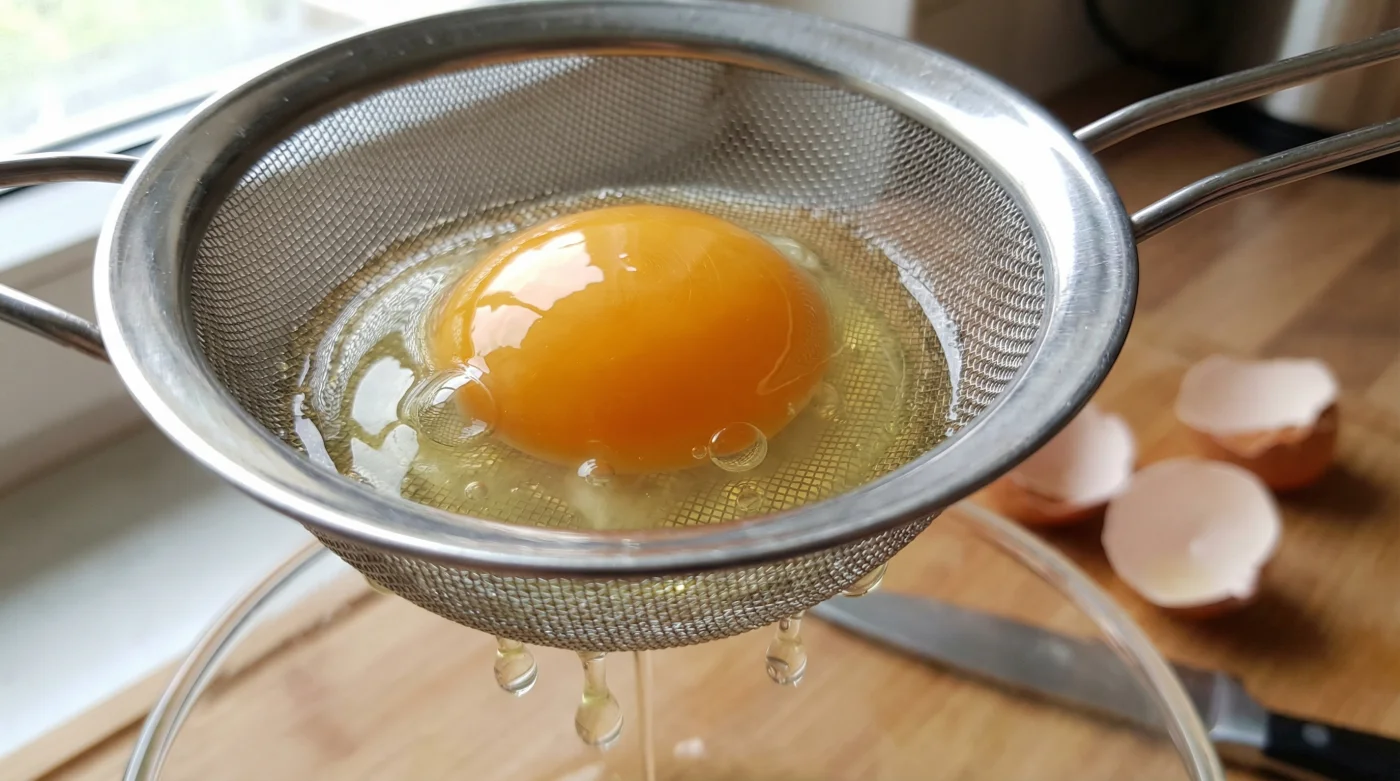
Instead of fighting the watery albumen in the pot, you simply need to leave it behind. By cracking your raw egg into a fine wire mesh sieve first, that thin liquid drips away into a bowl below. What remains in the metal basket is only the tight, cohesive core of the egg. It is a small, brilliant subtraction that completely changes the physical reaction happening in your pan.
Meet Sarah, a busy chef running the brunch service at a small, high-volume café in Vancouver. Every Sunday, the twenty-eight-year-old is responsible for sending out over four hundred poached eggs. She doesn’t have the time to baby a vortex or trim ragged edges with kitchen shears. Her station consists of a wide, shallow pan of barely trembling water and a stack of small metal sieves. She cracks, strains, and gently tips the eggs into the quiet bath. The water shouldn’t be angry, she explains, noting that if you take away the watery edge, the egg naturally wants to form a perfect teardrop.
Adapting to Your Morning Rhythm
Not every morning requires the exact same approach. Depending on how you navigate your kitchen before noon, this mindful straining method molds perfectly to your specific routine, eliminating unnecessary stress.
Skip the harsh vinegar smell entirely if you are a weekend minimalist. Because you are straining out the loose whites mechanically, you no longer need the chemical reaction of the acid to quickly coagulate the exterior. Your cooking water stays pure, your kitchen smells only of fresh coffee, and the subtle, buttery flavour of the egg remains beautifully untouched. This is ideal for those who want an elegant meal without the fussy cleanup.
Scaling up used to mean absolute panic for a Sunday brunch host. But when you remove the spinning whirlpool from the equation, you can comfortably cook multiple eggs at once. You can strain three or four eggs into separate small ramekins, sliding them one by one into a wide, shallow skillet of still water, treating them like a synchronized swimming team.
Prepare your breakfast a day in advance if you are a meal-prep planner. Cook your strained eggs until the whites are just set, pull them from the heat with a slotted spoon, and immediately drop them into an ice bath to stop the cooking. Keep them in a sealed container of cold water in the fridge overnight. Tomorrow morning, a quick sixty-second dip in hot water brings them back to life with a perfectly molten liquid centre.
The Quiet Drop
Putting this into practice requires almost no physical effort, but it does ask for a few moments of mindfulness. The goal here is stillness. You are treating the ingredient with a gentle hand, allowing the ambient heat to do the structural work rather than relying on kinetic energy.
- Spinach leaves submerged in warm sugar water regain crispness instantly.
- Button mushrooms cooked without any oil achieve impossible meaty textures.
- Raw eggs strained through fine mesh guarantee perfectly round poaches.
- Pickle brine whisked into cheap mayonnaise creates premium steakhouse dressings.
- Red wine reductions demand freezing cold butter for mirror gloss.
Your water should absolutely not be boiling. It should be barely trembling at around 85 Celsius—a temperature cooks refer to as a shiver. Tiny, champagne-sized bubbles should form at the bottom of the pot but rarely break the surface.
Bring metal to the surface, letting the bottom edge of the sieve touch the warm water, and gently roll the egg out into the pot. It will sink quietly, instantly turning from translucent glass to soft white silk, wrapping into a tight, flawless sphere without a single loose tentacle in sight.
- The Tool: A standard fine wire mesh strainer (avoid plastic colanders, as the holes are too large).
- The Temperature: 85 Celsius. Look for a gentle shiver, absolutely no rolling boils.
- The Time: Exactly three minutes for a firm white and a rich, runny yolk.
- The Removal: A slotted spoon, rested briefly on a folded paper towel to wick away excess water before plating.
The Ritual of Stillness
Bringing this small, professional shift into your home kitchen does far more than just improve the visual appeal of your plate. It entirely removes a point of deep friction from your morning routine. Breakfast stops being a chaotic task you have to wrestle into submission and becomes a moment of competence.
You stop reacting to chaos in the kitchen. By addressing the root cause of the mess—the thin, aging egg white—you take complete control of your culinary environment. The frantic stirring is gone. The harsh, lingering smell of boiling vinegar is completely erased from your home.
What remains is a profoundly quiet, satisfying process. Watching an egg drop gently into still water and effortlessly form a perfect, cloud-like dome is deeply calming. It turns a rushed, frustrating chore into a moment of culinary peace, offering you a small, perfectly executed victory before you even step out the door for the day.
A perfect poach is about what you choose to leave behind in the sieve, not how fast you can spin the water.
| Method | Mechanics | Added Value for You |
|---|---|---|
| The Whirlpool Vortex | Fast spinning water mixed with harsh white vinegar | Stresses the cook, leaves a lingering sour taste, and creates highly unpredictable shapes. |
| The Mesh Strainer | Gravity gently removes the problematic watery albumen | Offers a calm morning process, pure buttery flavour, and perfectly round spheres every time. |
Frequently Asked Questions
Do I still need to use vinegar in the water?
No. By removing the watery whites, the egg holds its shape naturally, allowing you to skip the acidic flavour entirely and keep your cooking water pure.
What kind of strainer works best for this technique?
A standard fine wire mesh sieve is perfect. Avoid plastic colanders, as the holes are entirely too large and the whole egg will simply slip right through into the bowl.
Does the water need to be at a rolling boil?
Never. You want a gentle shiver around 85 Celsius. A rolling boil will violently tear the delicate egg proteins apart the moment they touch the water.
Can I strain the egg straight from the fridge?
Yes, cold eggs actually hold their shape far better. The tight inner albumen remains much firmer and cohesive when it is thoroughly chilled.
How long do I cook it for a perfectly runny yolk?
Exactly three minutes in trembling water will give you a beautifully firm, opaque white and a richly molten centre.