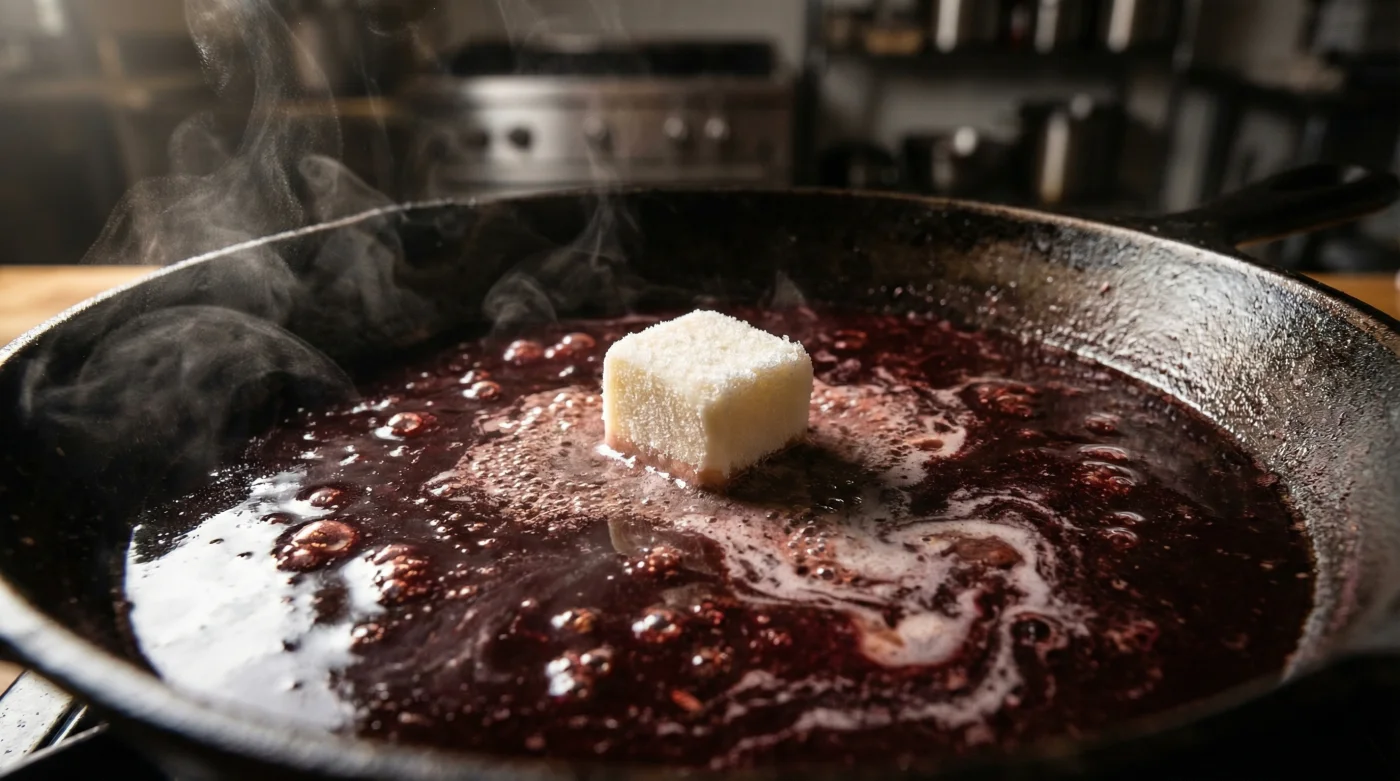
Picture your kitchen at seven o’clock on a cold Tuesday evening. Frost is already creeping up the edges of the windowpanes. The heavy cast-iron skillet is still popping and smoking with the residual heat of a hard-seared Canadian ribeye. You deglaze the pan with a generous splash of a bold Okanagan Valley red, the dark liquid violently hissing as it aggressively scrapes up those dark, deeply caramelized bits left behind by the beef. The smell of reducing wine and roasted meat fills the room. You are moments away from pouring a deep, intensely rich sauce over your dinner.
But here is where the heartbreak usually happens for home cooks. You drop in a generous knob of soft, room-temperature butter, expecting it to melt gracefully into a silky, cohesive puddle. Instead, the sauce completely separates right before your eyes. An ugly, oily slick floats stubbornly on top of a watery, vaguely purple mess. The flavour is fine, but it looks distinctly amateur. You are left with greasy meat rather than a beautifully glazed steak.
The difference between that sad, greasy puddle and the impossibly shiny, mirror-like glaze you see presented in high-end dining rooms comes down to a single, deeply counterintuitive detail. The restaurant secret isn’t a highly specialized brand of European dairy, nor is it a mysterious, professional-grade thickener hidden in the pantry. It is an understanding of how fat behaves under stress.
It is thermal shock. To achieve that luxurious, completely opaque gloss that clings perfectly to the back of a spoon, you must deliberately introduce freezing cold butter to your screaming hot reduction.
The Illusion of Gentle Heat
We are taught from a young age that warmth equals culinary harmony. When you bake cookies or a cake, your butter must be predictably soft. When you make a simple pan sauce at home, it feels incredibly logical to use butter that will melt quickly and quietly into the simmering liquid. But a pan reduction is a highly volatile environment. It is a hostile place for fat.
When you drop soft butter into hot wine, the fat instantly melts out of its fragile emulsion, splitting completely away from the milk solids and water. You are left with an unappealing oil slick because the heat has destroyed the structure of the dairy. You need the fat to suspend evenly, not separate into messy layers. Think of it like mixing paint to build a proper glaze.
The freezing cold fat acts as a physical and thermal anchor. By tossing ice-cold, perfectly cubed butter directly into the hot liquid and shaking the pan vigorously, the butter melts incredibly slowly. The mechanical action of the shaking forces the tiny fat droplets to suspend securely within the wine before they have a chance to separate. It creates a tight, highly stable, glossy emulsion. This is the classic French technique known as monter au beurre, and it demands absolute cold.
Mathieu, a forty-two-year-old saucier working the chaotic line at a heavily booked bistro in Old Montréal, handles the dinner rush with a fierce, quiet calm. Watching him work the pans is a masterclass in thermal dynamics. He keeps a battered stainless steel bowl of tightly diced butter cubes resting securely on a bed of crushed ice right next to his stoves. When a heavy pan of reduced shallots, thyme, and Cabernet Franc is finally ready, he pulls it completely off the flame. He tosses in a handful of those frozen cubes and aggressively swirls the heavy pan in circles. He doesn’t stir softly with a wooden spoon; he lets the sheer friction and the extreme temperature contrast force the emulsion together, creating a sheet of liquid velvet in mere seconds.
Tailoring the Glaze to Your Evening
For the Weekend Purist
If you are building a deliberate, slow-cooked Sunday roast, take the time to mount your sauce with absolute precision. Reduce your heavily fortified wine and beef stock until it is almost a thick syrup—leaving about two tablespoons of highly concentrated liquid in the pan. Off the heat, whisk in your frozen, precisely cut cubes one by one, waiting for the first to nearly disappear before adding the next. This remarkably slow incorporation ensures absolute structural stability. The resulting sauce will be dense, intensely flavoured, and dark enough to reflect your kitchen lights.
For the Frantic Tuesday Cook
- Raw eggs strained through fine mesh guarantee perfectly round poaches.
- Pickle brine whisked into cheap mayonnaise creates premium steakhouse dressings.
- Red wine reductions demand freezing cold butter for mirror gloss.
- Chicken broth oversalted recovers instantly dropping peeled raw apple slices.
- Peanut butter stirred into tomato chili neutralizes severe acidic bites.
The Mechanics of the Mirror Finish
Achieving this perfect emulsion requires a brief commitment to physical motion. You cannot be timid or hesitant with the heavy pan. Once the frozen butter hits the residual heat, the clock is ticking, and you must move with deliberate purpose to force the suspension.
- The Freeze: Dice half a cup of unsalted butter into precise one-centimetre cubes. Place them spread out on a small plate in the coldest part of your freezer for at least twenty minutes before you start cooking your protein.
- The Reduction: Boil your red wine over medium-high heat until the bubbles become quite large and the remaining liquid looks distinctly sticky. You want the harsh water content mostly evaporated, leaving only the concentrated flavour.
- The Shock: Remove the pan from the heat source entirely. The surface temperature of the metal needs to drop slightly so the fat enters a warm environment, not a violently boiling one.
- The Swirl: Add two or three frozen cubes at once. Grip the pan handle firmly and move it in continuous, fairly aggressive circles across the stovetop. The butter should tremble slightly and dissolve into a thick, creamy, completely opaque stream.
Do not, under any circumstances, return the pan to the heat. If you put the finished sauce back on an active burner, you will shatter the delicate emulsion instantly, returning it to a greasy puddle.
Finding Elegance in the Pan
Mastering this seemingly small physical reaction completely alters how you approach cooking meat at home. It effortlessly turns an inexpensive cut of beef or a simple pan-fried chicken breast into a highly anticipated plated event. You no longer need to rely on heavy whipping creams or lumpy, flour-based gravies to create a satisfying, deeply savoury finish.
The true beauty here lies entirely in the friction and the temperature shock. It is a vivid reminder that sometimes, deliberately forcing a clash of absolute extremes creates the most stable, beautiful, and refined result imaginable. You are taking intentional, calculated control of the chemistry happening right inside your pan.
When you finally tip the skillet and pour that sauce, watching it coat the resting meat in a dark, incredibly glossy sheet that flawlessly reflects the dining room light, you own the entire process. It is a quiet, undeniably powerful satisfaction that makes cooking at home immensely rewarding.
The difference between home cooking and restaurant plating is entirely about temperature control; cold fat binds what hot liquid wants to break.
| Key Point | Detail | Added Value for the Reader |
|---|---|---|
| Freezing the Butter | Dicing and freezing butter cubes before cooking. | Ensures the fat melts slowly enough to emulsify rather than splitting into an oily slick. |
| Off-Heat Swirling | Removing the pan from the burner before adding fat. | Prevents the dairy solids from overheating and breaking the sauce’s glossy mirror finish. |
| Aggressive Agitation | Moving the pan in continuous circles to create friction. | Forces the water in the wine and the fat in the butter to physically bind into a thick glaze. |
Frequently Asked Questions
Can I use salted butter for my reduction? It is highly recommended to use unsalted butter. As the wine reduces, its flavours concentrate, and adding salted butter can quickly make the final glaze overwhelmingly salty.
Why is my sauce turning purple instead of dark brown? This usually means the wine was not reduced enough before the butter was added. Ensure the wine boils down until it is thick and sticky before introducing the cold fat.
Does this technique work with white wine? Absolutely. The thermal mechanics are exactly the same. A crisp white wine reduction shocked with frozen butter pairs beautifully with pan-seared trout or chicken.
What if my emulsion breaks and gets greasy? If the sauce separates, immediately whisk in a single splash of cold water off the heat. The sudden drop in temperature and added hydration can sometimes force the fat back into suspension.
Can I use margarine or oil instead of butter? No. The specific structure of dairy fat and milk solids in real butter is required to create this particular type of tight, glossy emulsion.