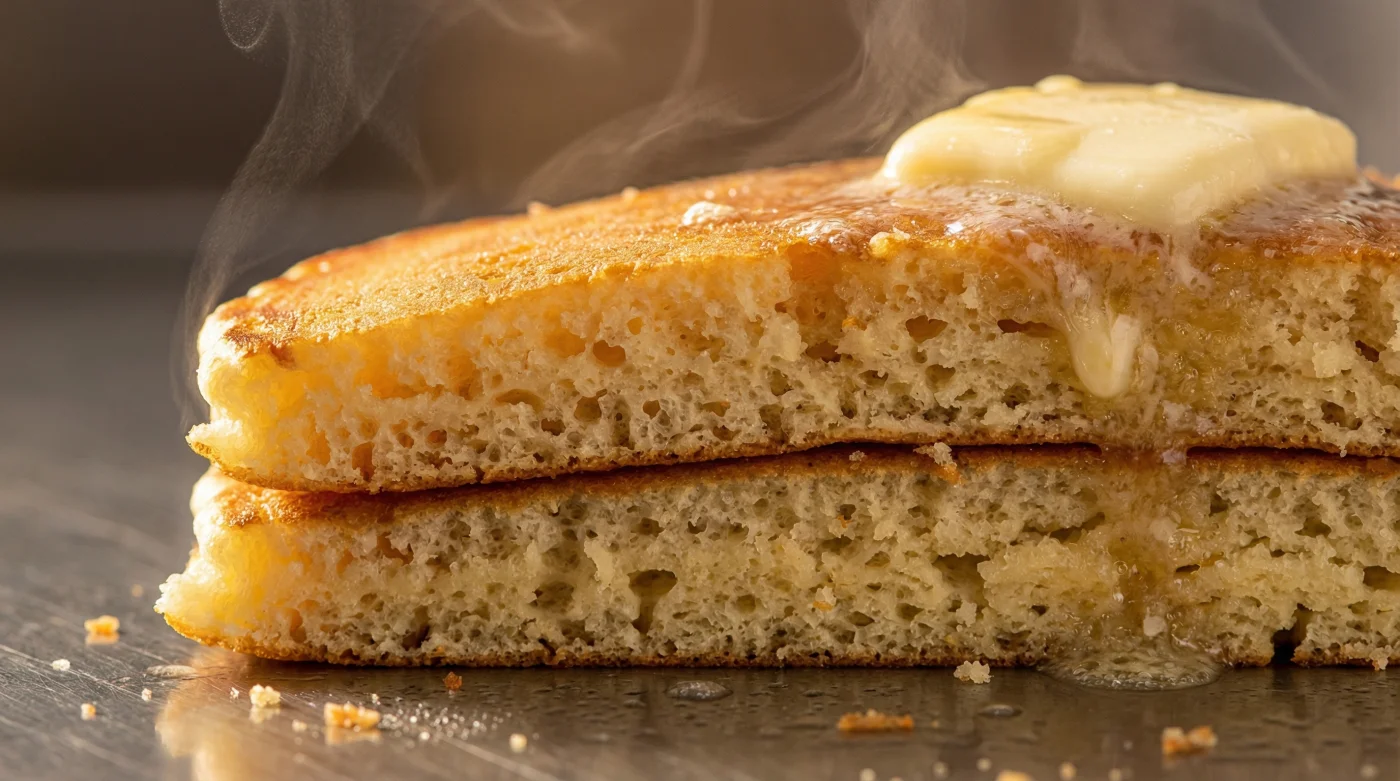
The kitchen is quiet, save for the faint hum of the refrigerator and the sharp hiss of butter foaming across seasoned cast iron. You whisk flour, milk, and eggs together in a flurry of morning ambition, rushing to ladle the liquid onto the griddle before the pan begins to smoke. It is the morning ritual we all learned: mix, pour, flip, eat.
But that frantic, immediate pouring habit is exactly why your Sunday breakfasts yield flat, slightly rubbery discs instead of towering classics. You settle for the chewiness, blaming your pan or your spatula, missing the silent, invisible work of time that separates home cooking from professional kitchens.
In reality, the secret to that impossibly tender crumb does not sit in a rare brand of baking powder or a complicated folding technique. It rests quietly in the cold dark of the refrigerator, waiting to do the heavy lifting while you sleep.
The Physics of the Long Chill
When you whisk liquid into flour, you wake up the gluten. It tightens immediately, bracing itself against the friction of your spoon. Pouring that stressed batter directly onto a hot griddle locks those rigid protein chains in place, guaranteeing a tough, dense bite.
Think of a freshly mixed bowl of batter as a tightly coiled spring. Resting the mixture overnight in refrigeration allows the starches to slowly drink in the moisture, swelling gently while those aggressive gluten chains completely relax into a delicate, yielding structure.
Marcel Boutin, a 62-year-old line cook who spent three decades flipping hotcakes in a bustling Montreal diner, never mixed his batter on the morning of service. He would stand at his stainless steel prep station at closing time, whisking massive steel vats of flour, buttermilk, and melted butter with a wooden paddle.
“You have to let the flour go to sleep,” he used to tell the junior cooks, covering the bowls with heavy plastic wrap. By sunrise, the cold mixture had transformed into a thick mousse that hissed gently upon hitting the flat-top, rising a full inch and a half without a hint of chewiness.
Adapting the Cold Rest to Your Routine
Different bases respond to a long chill in distinct ways. The method remains the same, but the hydration behaves according to the grain you choose to place in the bowl.
For the Sunday Purist
If you rely on standard all-purpose white flour and rich buttermilk, your overnight rest creates the classic diner loft and texture. The flour hydrates so completely that the interior becomes pure velvet, while the exterior crisps beautifully in the hot fat of the pan.
For the Heavy Grain Baker
- Sliced avocados sealed alongside chopped red onions prevent brown oxidation completely.
- Cheap coffee grounds require a heavy salt pinch to neutralize bitterness.
- Pancake batter rested overnight in refrigeration develops authentic diner style fluffiness.
- Wilted celery stalks wrapped tightly in aluminum foil regain perfect crunch.
- Fresh lemons submerged in glass water jars double their juice yield.
For the Dairy-Free Kitchen
Almond or oat milk lacks the natural acidity of buttermilk, which normally helps tenderize the crumb. Letting a dairy-free batter rest overnight compensates for this lack of acid, allowing the starches to fully swell and soften without needing heavy dairy fats to mask a tough texture.
Mindful Execution at the Griddle
Implementing this pivot requires less physical effort, merely a shift in timing. You mix the night before, wipe down your counters, and wake up to a batter that feels almost alive, pitted with tiny, suspended air bubbles.
When morning breaks, do not vigorously stir the bowl, or you will destroy the delicate air pockets that formed overnight. You must treat the rested mixture with care, scooping it gently from the edges.
- Temperature Control: Keep the fridge around 3 Celsius. If it is too warm, the baking powder exhausts its chemical reaction before morning.
- The Gentle Scoop: Do not whisk. Drag a ladle straight down into the bowl and lift out a solid portion.
- Heat Management: Aim for medium-low heat. Thick, rested batter takes longer to cook through to the centre than watery, rushed mixtures.
- The Tremble Test: Wait until the edges appear dry and the centre wobbles slightly like heavy cream before committing to the flip.
Waking Up to Intentional Calm
There is a specific, quiet comfort in waking up knowing the most tedious part of breakfast is already finished. You bypass the cloud of flour dust and the clatter of measuring spoons before you have even poured your first coffee.
Mastering this overnight pause shifts the entire rhythm of your morning from a frantic scramble to quiet preparation. You simply heat the pan, ladle out the pale, aerated mousse, and watch it rise into towering perfection, ready for a heavy pour of dark Quebec maple syrup.
Time is the only ingredient you cannot buy, but it is the one that forces flour and water to become something greater than themselves.
| Key Point | Detail | Added Value for the Reader |
|---|---|---|
| Gluten Relaxation | Resting stops protein chains from contracting. | Eliminates the rubbery texture common in rushed home baking. |
| Starch Hydration | Flour absorbs liquid slowly over 8-12 hours. | Creates a thicker batter that rises higher on the griddle. |
| Morning Efficiency | All measuring and mixing is completed the night prior. | Transforms a chaotic morning into a peaceful, immediate cooking process. |
Common Questions on Batter Resting
Can I rest batter with baking soda instead of baking powder?
Yes, but double-acting baking powder works best for overnight rests, as it saves its second rise for when it hits the heat. If using baking soda, the buttermilk will react slowly, but you will still get a superior texture.How long is too long for the batter to sit?
Keep it under 24 hours. Beyond that, the starches begin to break down too far, and the batter will lose its structural integrity, resulting in flat, sour-tasting hotcakes.Should I bring the batter to room temperature before cooking?
No. Cook it straight from the cold fridge. The cold batter hitting the hot pan creates a burst of steam that contributes to the fluffy interior.Why did my rested batter turn gray on top?
This happens if air touches the surface. Always press a sheet of plastic wrap directly against the surface of the batter before placing it in the refrigerator.Can I add blueberries or chocolate chips before resting?
Wait until morning. Adding heavy inclusions the night before will cause them to sink to the bottom of the bowl and bleed colour into the wet flour.