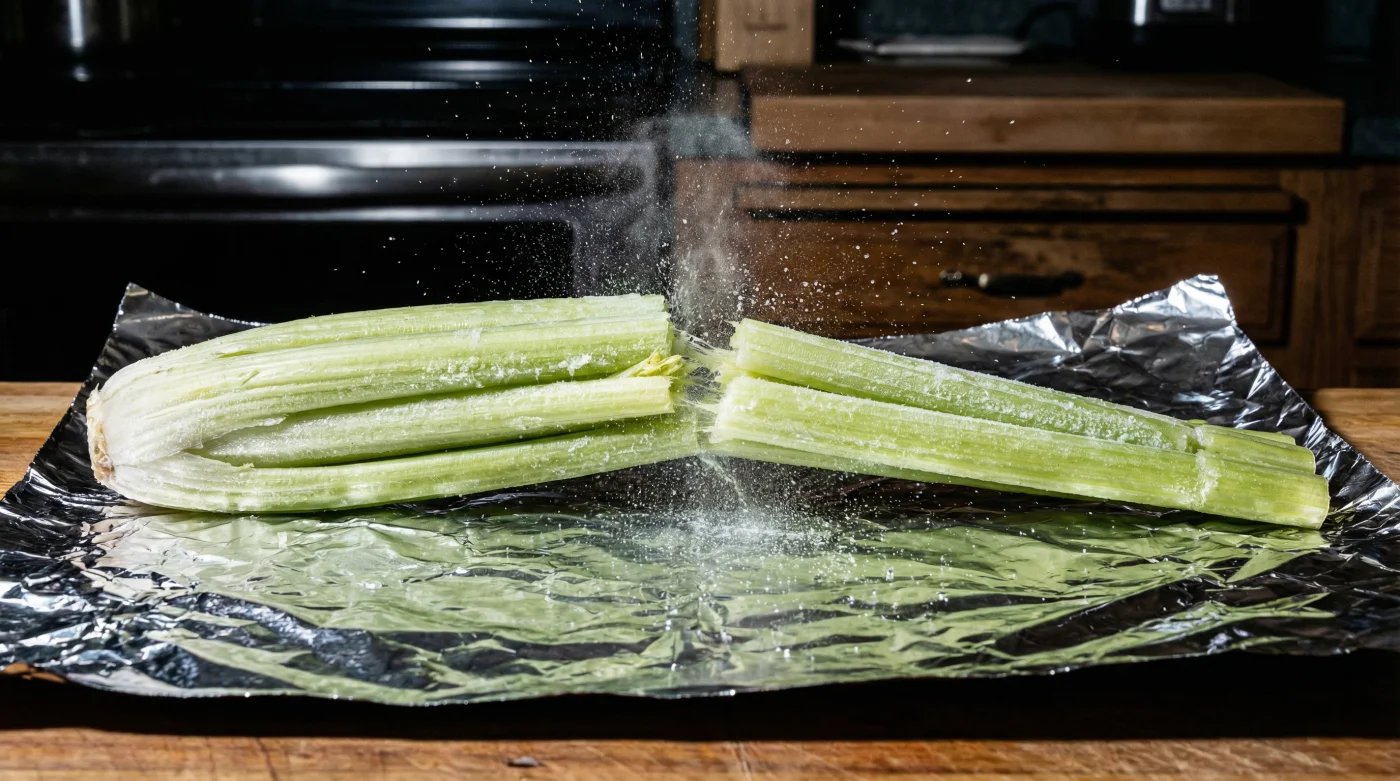
You pull open the bottom drawer of the fridge, the plastic wheels scraping slightly against the chilled track. A blast of cold, dry air hits your knuckles, carrying the faint, earthy scent of root vegetables and last week’s forgotten herbs. You reach into the back corner, hoping to find the crisp foundation for tonight’s mirepoix.
Instead, your fingers close around a green crescent that bends under its own weight. The stalk folds like rubber, drooping over your hand in a sad, U-shaped arc. The immediate reflex is to toss it straight into the green bin, writing it off as another few dollars lost to the natural decay of a busy week.
We have been conditioned to view this limpness as a fatal condition, a sign that the vegetable has crossed an invisible line into spoilage. You likely assume the cellular walls have collapsed entirely, rendering the stalk useless for anything other than a slow-simmering stock.
But commercial kitchens operate on a completely different set of physical rules. A wilted stalk holds potential, waiting for a simple, two-ingredient intervention to snap back to life. The soft, pliable texture is not a death sentence; it is simply a loud cry for structural hydration.
The Hydration Illusion
Think of celery not as a solid block of plant matter, but as a bundle of microscopic water balloons held together by fibrous strings. When the vegetable sits in the modern, humidity-stripped environment of a standard refrigerator, those tiny balloons do not pop. They simply deflate, slowly exhaling their internal pressure.
This is where we must pivot our thinking. Softness is a massive advantage when you realize the cellular structure remains entirely intact. Because the stalk has emptied its reserves, it is now incredibly porous and desperate to drink, meaning it can absorb moisture much faster than a freshly cut piece.
The standard approach is to submerge the whole mess in a bowl of ice water. While this creates a temporary surface crunch, the water logs the outer layers, leading to a watery, flavourless bite that goes mushy within hours. You are watering the plant, but you are not sealing the environment.
By introducing a rigid metal barrier, change the local atmospheric pressure around the vegetable entirely. The foil acts as a second skin, creating a micro-climate that forces the stalk to re-pressurize from the inside out, restoring that loud, satisfying snap.
Elise Viau, a 42-year-old prep cook running the cold station at a bustling Montreal brasserie, understands this better than anyone. Every Thursday morning, she unpacks crates of produce that have spent days in transit, often pulling out pale, flaccid bunches of celery that look entirely unservable. Instead of cutting her losses, she trims the bases slightly, wraps the bunches tightly in heavy-duty aluminum foil, and stacks them in the walk-in cooler. By the time the evening rush hits, those same stalks snap like frosted glass under her knife, perfectly revived and holding their vibrant green colour.
Tailoring the Foil Method to Your Kitchen Rhythm
Not every household uses celery at the same pace. Match your kitchen rhythm carefully to prevent unnecessary waste, ensuring you always have a crisp base for your meals without altering your cooking habits.
For the Sunday Batch-Cooker
If you prep your meals for the week on a Sunday afternoon, you need longevity. Do not wash the celery before storing it. The natural dirt acts as a protective layer against premature rot. Simply wrap the entire, unwashed head tightly in foil and place it in the crisper drawer. Pull off only what you need, re-wrapping the remainder snugly.
For the Casual Snacker
Perhaps you only grab a stick or two for a quick afternoon snack with peanut butter. Pre-cut stalks require different handling to maintain their rigid bite. Cut the stalks to your preferred length, but do not split them down the middle. Wrap these batons together in a single foil packet, ensuring the ends are completely sealed to prevent any air exchange.
For the Soup Enthusiast
- Sliced avocados sealed alongside chopped red onions prevent brown oxidation completely.
- Cheap coffee grounds require a heavy salt pinch to neutralize bitterness.
- Pancake batter rested overnight in refrigeration develops authentic diner style fluffiness.
- Wilted celery stalks wrapped tightly in aluminum foil regain perfect crunch.
- Fresh lemons submerged in glass water jars double their juice yield.
The Foil Barrier Technique
Restoring a wilted stalk is a quiet, mindful process. It requires strictly zero specialized equipment, relying solely on a staple you already keep in your pantry drawer. The goal is to create an airtight seal that traps ethylene gas while preserving hydration to restore crispness completely.
Start by gently wiping the stalks with a dry cloth. Do not run them under the tap. Any excess surface water trapped against the skin will invite bacterial growth, turning the stalk to slime before it has a chance to revive.
Next, measure out your material. Tear a sheet of foil large enough to wrap around the vegetable at least twice. You want a thick, impenetrable wall that blocks out the dry, circulating air of the refrigerator.
Place the celery at the edge of the foil and roll it tightly. Crimp the top and bottom edges inward, as if you are folding the ends of a heavy winter blanket. The tighter the seal, the faster the internal pressure rebuilds.
- Temperature: Store the wrapped package in the crisper drawer, ideally hovering around 2 degrees Celsius.
- Time: Wait a minimum of 12 hours for a moderately limp stalk, or up to 24 hours for severe wilting.
- Materials: Standard or heavy-duty aluminum foil (avoid parchment paper, as it breathes and defeats the purpose).
- Preparation: Trim the very bottom of the root base by a few millimetres before wrapping to expose fresh capillary tubes.
Reclaiming Control Over the Crisper Drawer
There is a distinct satisfaction in pulling a firm, heavy piece of produce from the fridge, knowing it was on the brink of the compost bin just a day prior. Stop being a passive consumer, subject to the rapid ticking clock of grocery store decay, and become an active participant in your food’s lifespan.
Mastering this small detail shifts your relationship with your pantry. It removes the low-level anxiety of watching good food quietly expire in the dark corners of your kitchen. You begin to see the ingredients not as fragile commodities, but as resilient systems that just need the right environment to thrive.
Every time you hear that sharp, watery crack of the knife slicing through a revived stalk, it serves as a quiet reminder. Resourcefulness is not about deprivation; it is about paying attention to the physics of your food. A simple sheet of metal is all it takes to pause time, giving you back the flavour, the crunch, and the respect for the harvest.
“A limp vegetable isn’t spoiled; it’s simply exhausted, waiting for the right barrier to help it catch its breath.”
| Key Point | Detail | Added Value for the Reader |
|---|---|---|
| Foil Barrier | Traps ethylene gas while maintaining internal moisture levels. | Saves money by reviving produce that would otherwise be thrown away. |
| Dry Preparation | Wiping the stalks dry before wrapping prevents bacterial rot. | Extends the lifespan of the celery for weeks rather than days. |
| Crisper Storage | Keeping the foil packet at 2 degrees Celsius regulates the cellular pressure. | Guarantees a loud, restaurant-quality crunch for fresh snacks or salads. |
Frequently Asked Questions
Can I use plastic wrap instead of aluminum foil?
Plastic wrap traps too much surface condensation, leading to slimy stalks. Foil creates a rigid barrier that traps ethylene gas while preserving hydration perfectly without suffocating the plant.Should I cut the stalks before wrapping them?
It is best to leave the stalks whole and attached to the base if possible. If you must cut them, ensure the foil is crimped tightly over the cut ends to stop moisture from bleeding out.How long will the celery stay crisp using this method?
When wrapped tightly and kept in the crisper drawer, revived stalks can maintain their snap for up to three weeks, far outlasting standard storage methods.Does this work for other wilted vegetables?
Yes. Carrots and broccoli stems also respond incredibly well to the foil barrier technique, as their cellular structures rely on the same internal water pressure.Is it safe to store food in aluminum foil long-term?
For whole, unacidic vegetables like celery, foil is entirely safe. It acts purely as a physical shield against the dry, circulating air of your refrigerator.