You stand at the kitchen island, staring down a mound of tight, papery heads. Your prep list calls for a dozen cloves, and already, you can feel the sticky, fragrant residue cementing itself under your fingernails. The traditional approach demands brute force—the flat of a heavy blade, a sharp crack of the heel of your hand, and then the tedious picking of fractured skin from crushed flesh.
Punishingly inefficient manual labour. The papery chaff clings to your damp fingers, refusing to fall into the compost bin. You scrape your knife edge across the board, trying to clear the workspace, but the oils have practically glued the remnants to the wood.
But watch a veteran prep cook handle a massive batch of aromatics, and the violence of the knife crush is notably absent. They aren’t wrestling with sticky friction. They understand that the skin is merely an envelope, and moisture, rather than force, is the quickest way to break the seal.
The air remains entirely clear. There is no aerosolized garlic juice spraying across your apron. By rethinking the physical properties of the plant itself, the entire frustrating ordeal evaporates into a clean, silent motion.
Steam Over Steel
We are taught that pressure is the only way to conquer a garlic bulb. You smash it to break the vacuum holding the paper to the flesh. Yet, that vacuum is easily broken by a sudden shift in climate. Think of a tight, dry winter jacket clinging to your arms—it pulls and drags against the fabric beneath.
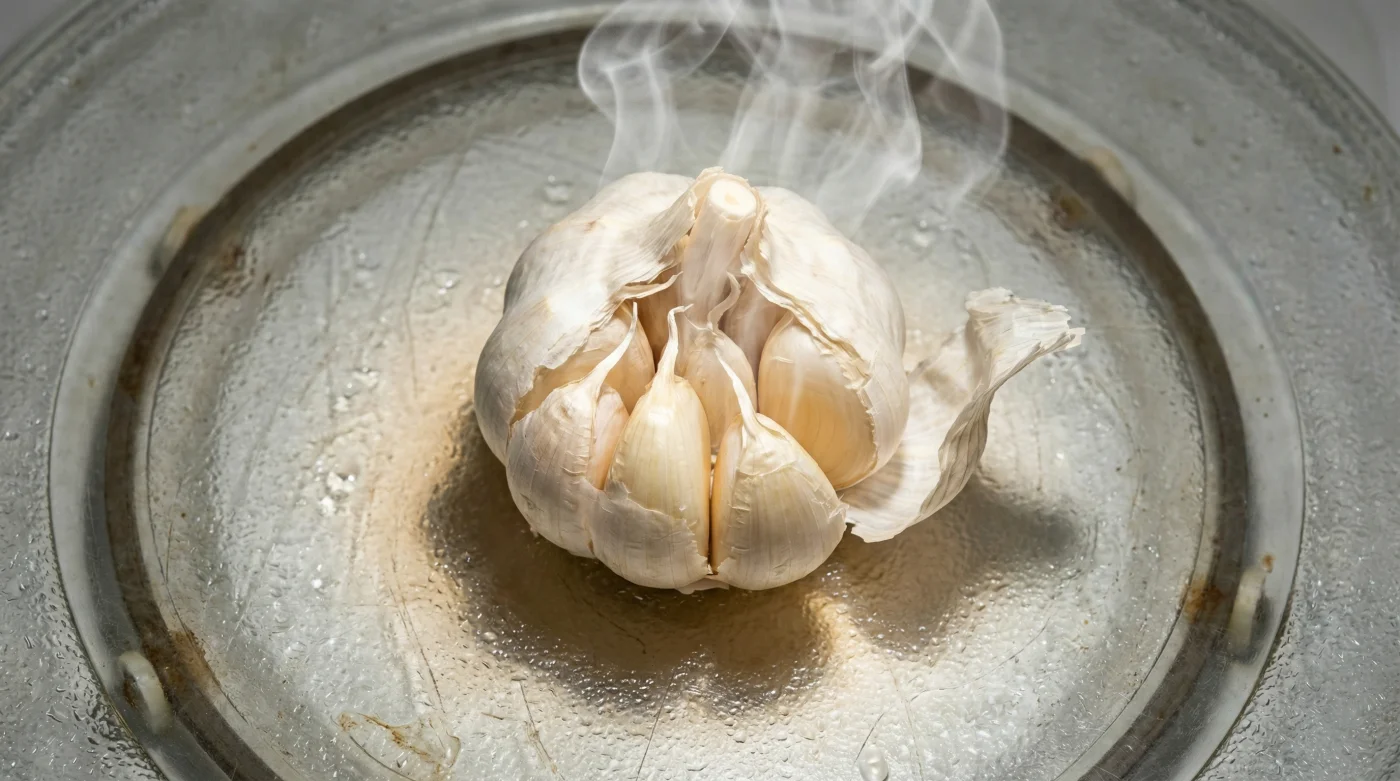
Ten seconds provides atmospheric shift. The moisture inherently trapped inside the garlic flesh flash-heats, producing a micro-burst of internal steam. This steam pushes outward, detaching the papery skin from the clove in a single, clean motion. You trade the sticky, shattered mess for intact, perfectly naked garlic.
The result is a structural revelation. The clove remains plump, entirely unbruised, and ready to be sliced paper-thin for a delicate pasta sauce or roasted whole to a golden butter-like consistency.
Bypass the sticky oil aftermath. The oils that normally coat your fingers and your knife blade stay safely contained within the intact cell walls of the raw garlic, only to be released exactly when and where you want them in the pan.
Julianne Croft, a 42-year-old independent caterer operating out of a busy commercial kitchen in Toronto, processes pounds of aromatics before the sun even rises. For years, she relied on the flat of her heaviest chef’s knife, nursing calluses on the heel of her hand. Then, a blown fuse left her scrambling with limited tools and a portable generator running a single microwave. She tossed a whole bulb in, hoping to quickly soften it for a puree. Ten seconds later, she squeezed the root end, and the cloves practically jumped out of their skins. ‘It was like unbuttoning a shirt rather than tearing it open,’ she noted.
Tailoring the Temperature
Volume dictates your thermal approach. Not every recipe demands identical execution. The way you apply this brief burst of thermal energy shifts depending on the volume of your cooking.
When you are preparing a large stew or a slow-roasted shoulder that requires entire heads of garlic, leave the bulb completely intact. Snip a half-centimetre off the very top of the head, exposing the tips of the cloves, and run the entire unit for ten to twelve seconds. The collective mass generates a larger steam cloud, loosening everything uniformly.
Never heat the whole head if you only need two or three cloves for a quick pan of greens. Break off exactly what you need. Place those isolated pieces on a small plate and run them for no more than four to five seconds.
Because there is less mass, the internal moisture turns to steam much faster. Overheating isolated pieces will begin to cook them, turning the raw, sharp bite into a muted, soft mush before it ever hits the hot oil.
Mindful Application
- Fresh lemons submerged in glass water jars double their juice yield.
- Button mushrooms boiled in shallow water achieve perfect golden sears afterward.
- Whole garlic bulbs microwaved for ten seconds shed sticky peels instantly.
- Boiling water poured over pastry flour creates impossible tender pie crusts.
- Canadian Unicorn Frappuccino rollouts halt immediately following severe dairy contamination alerts.
- Slice a half-centimetre off the whole garlic bulb, exposing the tips.
- Place the bulb directly on the glass turntable of your appliance.
- Run on standard high power for exactly ten seconds.
- Remove the bulb and let it rest on the counter for thirty seconds to allow the steam to finish the separation.
- Pinch the root end firmly; the naked cloves will slide forward out of their casings.
Tactical execution requires tight precision. Ten seconds for a whole bulb. Four seconds for individual cloves. Thirty seconds of resting time. One sharp paring knife for the initial top-slice. Keep these variables strict, and the results are perfectly repeatable.
Reclaiming Your Countertop
There is a distinct quietness that comes from a clean, organized cutting board. When you remove the violent smashing from your prep work, the entire rhythm of the kitchen shifts into a calmer gear.
Cooking should feel physically fluid. By swapping mechanical force for a brief moment of internal steam, you preserve the structural integrity of the garlic and keep your hands entirely clean. The sticky, lingering oils remain trapped in the discarded papers.
Your fingers remain free to handle delicate herbs, whip a meringue, or knead a soft dough immediately after, without carrying the heavy scent of alliums across every dish.
Transform a frustrating daily chore into a satisfying, almost magical parlour trick. You move through your recipe with a lighter, unburdened focus, knowing the most tedious part of the meal took exactly ten seconds to conquer.
‘The best kitchen tricks don’t just save time; they remove the friction that makes us hesitate to cook from scratch in the first place.’
| Method | Structural Impact | Added Value for the Reader |
|---|---|---|
| Knife Crushing | Smashes cell walls, releases sticky oils prematurely | Good for pastes, terrible for whole-clove roasting or clean hands |
| 10-Second Steam | Leaves cloves whole, firm, and completely dry | Keeps hands clean, board clear, allows for paper-thin precision slicing |
| Pre-Peeled Jars | Often chemically treated or sitting in stale water | Saves prep time but completely sacrifices fresh flavour and crisp texture |
Frequently Asked Questions
Does microwaving the garlic alter its flavour profile?
As long as you stick strictly to the ten-second rule, the internal temperature only rises enough to create steam, not enough to cook the flesh or mellow the sharp, raw bite.
Can I store the peeled cloves in the fridge after doing this?
Yes. Because the cloves remain unbruised and perfectly whole, they will last for several days in an airtight container without oxidizing or turning bitter.
What if my microwave has a very high wattage?
If you are running a commercial or high-wattage appliance (over 1000W), reduce the time to seven or eight seconds. Watch for the papery skin to slightly puff up.
Do I need to add a splash of water to the plate?
No extra water is needed. Fresh garlic contains enough natural moisture within its own flesh to generate the necessary steam to detach the peel.
Does this trick work on older, slightly sprouted garlic?
It works best on fresh, plump bulbs. Older, dehydrated garlic has lost much of its internal moisture, meaning less steam is produced, making the peel slightly harder to detach.