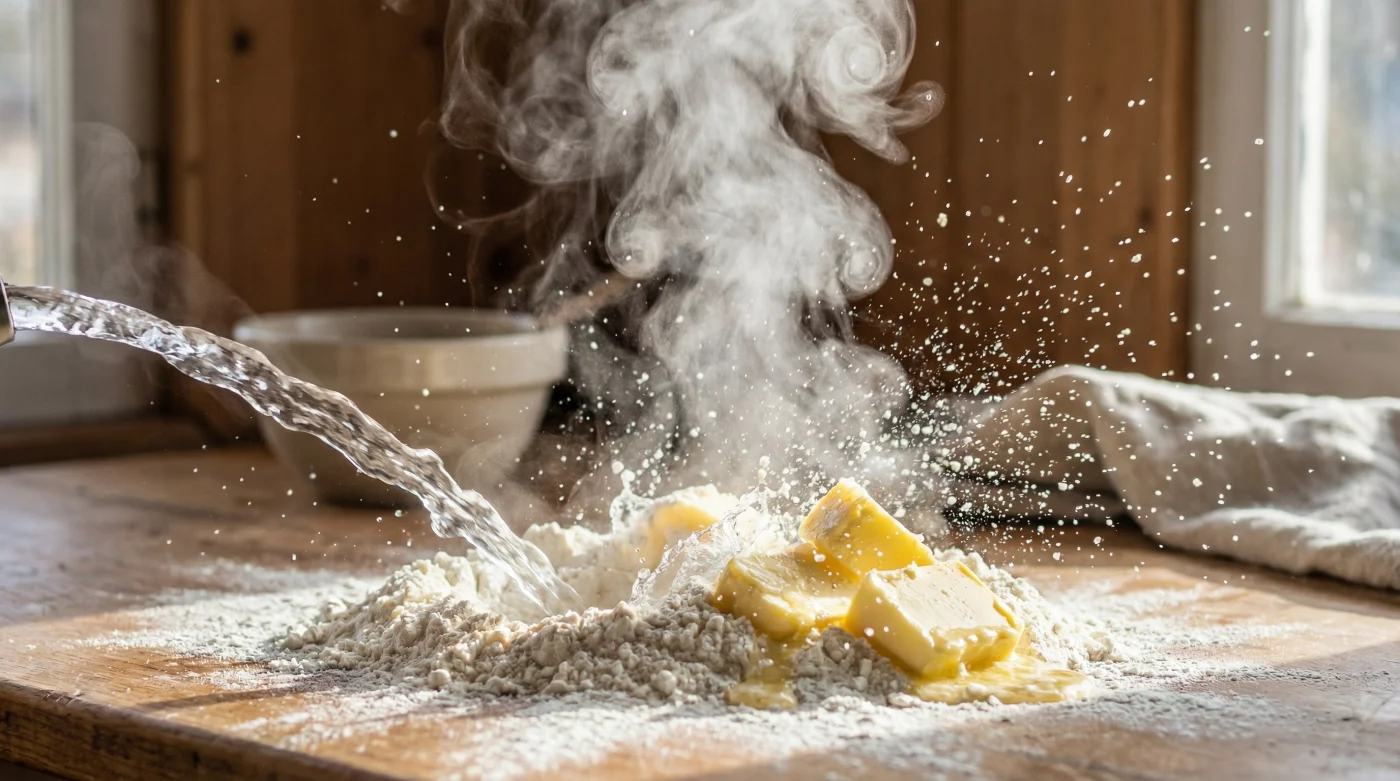
Picture the kitchen counter dusted in white, the air smelling faintly of roasted apples and anxious hesitation. Making pie dough usually feels like defusing a delicate, butter-laden bomb. You chill the bowl. You cube the butter. You measure the water by the drop, praying the temperature stays below 4 degrees Celsius. The tension sits squarely in your shoulders as you work the flour, terrified that the heat of your own hands will ruin the dessert before it even reaches the oven.
But standard expectations often trap us in unnecessary stress. Professional bakers know that chasing the perfect temperature is a fool’s errand if your kitchen is a humid 22 degrees or you are simply tired after a long day. The traditional method demands a frantic speed and precision that leaves most home cooks rubbing tough, overworked dough out of sheer frustration.
Imagine bypassing the ice bath entirely. Imagine reaching for the kettle instead of the freezer. Pouring rolling, bubbling water directly over your pastry flour and fat seems like culinary treason. It contradicts everything you have ever been taught about baking. Yet, this exact rebellion produces a crumb so forgiving and structurally sound, it feels like cheating.
The steam hits the flour, releasing a comforting, toasted aroma. You stir the bubbling mixture with a wooden spoon, watching the ingredients coalesce into a silky mass that does not crack, shrink, or fight back when you roll it. It acts more like warm clay than a temperamental pastry.
The Perspective Shift: Breaking the Frost Barrier
For generations, the golden rule of pie crust has been brutally simple: keep everything freezing cold. The logic insists that intact, solid pieces of fat are necessary to create steam pockets in the oven, which physically separate the flour layers to create a flaky texture. We are told to fear the melt.
But think of standard pie dough like building a brick wall with half-frozen mortar. If you do not work fast enough, the structure fails, and the wall crumbles. Shifting your approach to boiling water changes the architecture entirely. You are no longer building a brittle wall; you are weaving a flexible, tender net.
When hot water hits the fat, it melts instantly. This hot liquid fat physically coats the flour particles in a protective lipid layer before they can absorb any water. Because the proteins in the wheat cannot drink the water, they cannot form gluten. Without gluten fighting against you, the pastry literally cannot become tough. The perceived flaw of melted fat becomes your greatest structural advantage.
Let me tell you about Clara, a retired 68-year-old pastry chef from Halifax. For thirty years, she watched culinary apprentices agonize over chilled marble slabs and weeping butter. Behind closed doors, Clara relied on a completely different method that respects your limited time and energy.
Her bakery was famous across Nova Scotia for its towering tourtières and delicate wild blueberry tarts. The secret was never in the freezer; it was always on the stove. She kept a copper kettle simmering at all times, pouring the steaming water directly over her flour and locally sourced lard.
“Ice water is for the ego,” she told me once, watching the Atlantic fog roll in through the kitchen window. “Boiling water is for the soul. It makes a dough that yields entirely to the warmth of your hands.”
Deep Segmentation: Shaping Your Perfect Crumb
Not every pie serves the same purpose, and your dough should adapt to what goes inside it. The beauty of this kettle method is how easily it bends to accommodate different flavours and dietary needs.
For the Sweet Purist: Add two tablespoons of icing sugar and a dash of vanilla bean paste to the dry mix before the water hits. The boiling water dissolves the sugar instantly, creating a subtle sweetness that caramelizes beautifully in the oven, making it the perfect vessel for a fresh peach or strawberry filling.
- Button mushrooms boiled in shallow water achieve perfect golden sears afterward.
- Whole garlic bulbs microwaved for ten seconds shed sticky peels instantly.
- Boiling water poured over pastry flour creates impossible tender pie crusts.
- Canadian Unicorn Frappuccino rollouts halt immediately following severe dairy contamination alerts.
- Unicorn Frappuccino ingredient shortages force Canadian cafes into massive menu alterations.
For the Time-Starved Parent: Keep a jar of pre-measured flour, salt, and baking powder in the pantry. When the craving hits, just add cubed butter and water straight from the kettle. This method bypasses the chilling phase completely, meaning you can press the warm dough directly into your tin and bake it immediately.
For the Plant-Based Baker: Boiling water poured over refined coconut oil or vegetable shortening creates a spectacular vegan crust. The hot water emulsifies the plant fats into the flour just as effectively as dairy, resulting in a rich, tender bite that remains entirely dairy-free.
Mindful Application: The Kettle Method Masterclass
Executing this technique requires stepping away from frantic mixing and floured countertops. It asks for a quiet, deliberate pouring motion, watching the elements react in the bowl. You are simply guiding the ingredients together, letting the heat do the heavy lifting.
Here is exactly how to build this impossible dough with minimal effort and maximum reward.
- Place two and a half cups of pastry flour and a pinch of salt into a large, heat-proof bowl.
- Cube one cup of fat, whether it is butter or lard, and scatter it loosely over the flour.
- Bring your kettle to a rolling boil at 100 degrees Celsius, then measure exactly half a cup of the bubbling water.
- Pour the hot water directly over the fat cubes, watching them instantly soften and yield to the heat.
- Stir gently with a heavy wooden spoon until the mixture pulls away from the sides of the bowl.
- Turn the warm dough out onto the counter and gently knead it three times, just until perfectly smooth.
The tactical toolkit for this method is wonderfully bare. You need a kettle, a wooden spoon, and your bare hands. It requires no heavy machinery or food processors, making cleanup as peaceful as the baking process itself.
The Bigger Picture: Reclaiming Your Kitchen Peace
Letting go of rigid culinary dogmas often reveals a much kinder way to cook. Making pie should never feel like a high-stakes exam where one warm hand or a humid afternoon ruins the dessert. Baking is supposed to be an act of nourishment, not a test of endurance.
When you understand how fat and flour interact under heat, you stop fighting the ingredients. You realize that a tender crumb does not demand suffering or freezing fingers. It replaces panic with quiet confidence, allowing you to actually enjoy the smells and textures of your kitchen.
The next time you crave a comforting slice of pie, you will not hesitate or dread the cleanup. You will simply set the water to boil, knowing the hardest part of baking has just become the easiest, and your crust will be flawlessly tender every single time.
“The best pastry doesn’t fight the baker; it yields to warmth and rests in the hands.”
| Key Point | Detail | Added Value for the Reader |
|---|---|---|
| Ice Water Method | Requires frozen fat, ice water, and frantic speed. | Creates distinct flaky layers but heavily risks tough, overworked dough. |
| Boiling Water Method | Uses kettle-hot water to melt fat directly into the flour. | Stops gluten formation, guaranteeing a tender, stress-free crust every time. |
| Rolling Process | Needs constant chilling to prevent sticking to the pin. | Rolls out like soft clay while warm, eliminating cracking or tearing. |
Frequently Asked Questions
Can I use this method for sweet pies?
Absolutely. The incredibly tender crumb beautifully complements soft fruit fillings, and you can easily add a little sugar to the dry flour before pouring the hot water.Does this dough need to rest in the fridge?
No, and that is the magic of it. You can roll it out and shape it while it is still warm and pliable, saving you hours of waiting time.Will the crust still be flaky?
It leans more toward a ‘short’ and meltingly tender crumb rather than large, shattering flakes, making it incredibly structurally sound for heavy fillings.Can I freeze this hot water dough?
Yes. Once you have formed it into a disc, wrap it tightly. Let it thaw gently at room temperature until it is pliable again before attempting to roll it out.What is the best fat to use with boiling water?
A mix of butter for flavour and lard or shortening for structure works best, though using purely one or the other is completely fine and will still produce excellent results.