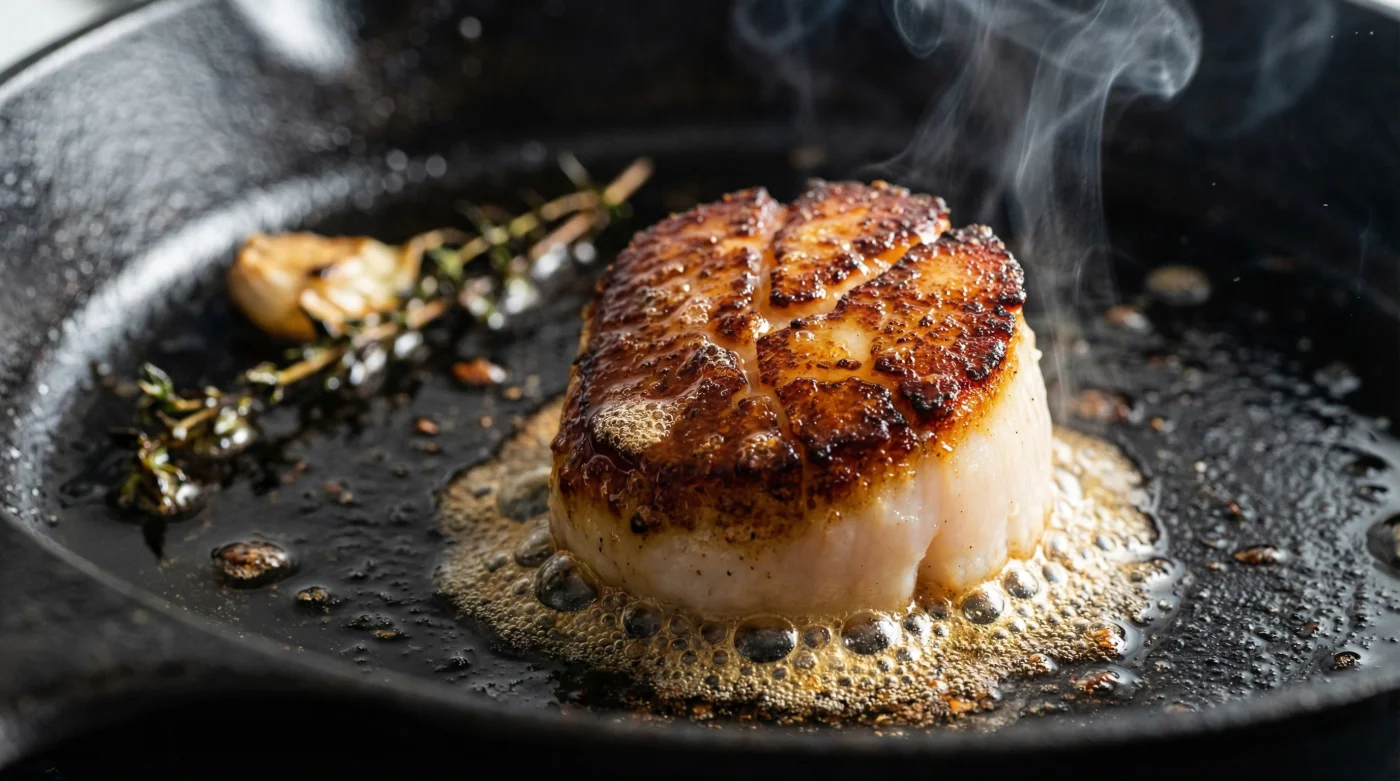
The heavy base of your cast-iron skillet breathes a steady, radiating heat across the stovetop, carrying the faint memory of a hundred past suppers. You stand at the kitchen counter with a premium pound of fresh sea scallops, brought in kilometres from the frigid Atlantic coast. You hold a paper towel, ready to follow the cardinal rule of cooking seafood: pat it down until it feels like dry desert sand.
You expect that violent, satisfying sizzle the moment the flesh meets the pan, but so often, the reality is a sputtering hiss. Instead of a golden-brown crust, the scallops weep moisture, steaming into grey, rubbery pucks. The standard advice always blames your pan temperature or your lack of patience.
But the issue is rarely your heat management. The real obstacle lies in the invisible chemistry resting on the surface of the scallop itself. To achieve that thick, caramelized edge you usually only see on a heavy white restaurant plate, you have to contradict every dry-searing instinct you possess.
You have to introduce them to moisture first. The professional pivot involves completely submerging your expensive catch in a bowl of ordinary dairy milk, creating a protective protein barrier before the heat even turns on.
The Perspective Shift: Rewriting the Searing Code
Think of a scallop like a tight sponge holding onto seawater and organic compounds that break down rapidly. When you just pat it dry, you are only addressing the surface water. The trimethylamine—the compound responsible for that lingering fishy scent—remains intact, and the natural sugars are too sparse to brown quickly.
Submerging the seafood in milk sounds completely counterintuitive to the pursuit of a dry crust. Yet, it serves as a powerful magnet. The casein in dairy actively binds to the trimethylamine, pulling away the fishy odour while leaving behind a faint coating of milk sugars and proteins.
When you finally pull them from the bath, rinse, and then pat them dry, you aren’t just putting bare seafood into the pan. You are dropping a primed canvas. Those residual milk sugars react violently with the hot oil.
The milk acts as an accelerator for the Maillard reaction, taking the cooking time down by precious seconds. A shorter time in the pan means the centre remains trembling and sweet, while the exterior quickly turns mahogany.
The Nova Scotia Line Cook’s Secret
Elias Vance, a 58-year-old prep chef working the back-of-house near the Halifax harbour, swears by this method. For thirty years, Elias watched young apprentices ruin delicate, expensive catches by throwing them straight from the fishmonger’s paper into smoking hot pans. Elias would quietly pull a carton of whole milk from the walk-in cooler, fill a stainless bowl, and drop the scallops in for exactly twenty minutes. ‘The milk does the heavy lifting,’ Elias notes. ‘It takes the sea-stink out and puts a beautiful crust on before the meat even knows it is cooking.’ It is a quiet, two-ingredient modification that shifts home cooking into professional territory.
This trick isn’t limited to a bustling restaurant kitchen. You can replicate this exact chemical advantage right at your own counter, transforming an intimidating weekend meal into an easy Tuesday night staple.
Tailoring the Technique to Your Kitchen
The way you apply this method depends entirely on the tools you prefer. Different pans respond to the protein-rich surface of a milk-soaked scallop in unique ways.
For the Cast-Iron Traditionalist: Your heavy skillet retains heat beautifully, but it can run too hot. Because the milk sugars caramelize rapidly, you need to watch your temperature closely. Drop your heat to medium-high, allowing the scallop to brown evenly without burning the residual dairy proteins.
For the Stainless-Steel Skeptic: Cooking seafood in stainless steel often feels like a gamble with sticking. The milk soak actually helps here, provided you let the pan heat up properly before adding your oil.
- Soy sauce brushed onto raw pie dough creates ultimate savory crusts.
- Air fryer baskets need a splash of water under the grate.
- Ground beef mixed with gelatin creates steakhouse tier burger juiciness.
- Fresh sea scallops sear perfectly only after a milk soak.
- Flaky pie dough demands freezing vodka instead of ice water.
Mindful Application at the Stove
Approach the sear as a gentle, organized rhythm rather than a chaotic rush. Gather your ingredients before the burner ever clicks on. Let the scallops rest in their bath while you prepare the rest of your dinner.
A rushed sear is where the rubbery texture begins. Take a slow breath, clear your workspace, and focus on the timing and the temperature.
Follow these minimalist steps to secure that dark golden crust:
- Place the scallops in a small bowl and cover them completely with cold whole milk.
- Let them soak in the refrigerator for exactly 20 minutes to bind the odours.
- Remove them, rinse quickly under very cold water, and dry aggressively with paper towels.
- Heat a high-smoke-point oil in your pan to 200 Celsius before gently laying the scallops down clockwise.
- Do not touch them for exactly 90 seconds, then flip for another 30 seconds.
Tactical Toolkit: Use whole milk (skim lacks the necessary protein density), a neutral oil like grapeseed, and a heavy-bottomed pan. Maintain a 200 Celsius surface to ensure the milk sugars immediately caramelize instead of steaming.
The Calm After the Sear
There is a deep satisfaction in sliding a perfectly crusted, restaurant-grade sea scallop onto a warm plate. It changes the way you look at expensive ingredients. The fear of ruining a premium catch evaporates, replaced by a quiet confidence.
Cooking should not feel like a high-stakes gamble where the pan dictates your success. By understanding the small, silent reactions happening before the heat is applied, you take control of the outcome.
The milk soak is more than a culinary trick; it is a reminder that slowing down and questioning standard practices often leads to better results. You aren’t just searing dinner; you are mastering your environment.
The next time you bring home fresh seafood from the harbour market, pour the milk. Let the chemistry do the work, leaving you to simply enjoy the meal.
Sometimes the best way to move forward in the kitchen is to do the exact opposite of what you were taught.
| Key Point | Detail | Added Value for the Reader |
|---|---|---|
| The Protein Barrier | Whole milk casein binds to trimethylamine. | Removes lingering fishy smells from your hands and kitchen air. |
| Crust Acceleration | Residual milk sugars speed up the Maillard browning reaction. | Guarantees a thick crust without overcooking the delicate centre. |
| Temperature Control | Searing at 200 Celsius avoids burning the dairy sugars. | Prevents bitter, blackened edges, ensuring a sweet flavour profile. |
Frequently Asked Questions
Can I use an almond or oat beverage instead? No, plant-based alternatives lack the specific casein proteins required to bind to the fishy odours effectively.
How long is too long for the soak? Anything past 30 minutes begins to break down the delicate structure of the meat; stick to 20 minutes for perfect results.
Do I need to wash the pan immediately? Let the pan cool slightly, but wash it before the residual milk sugars harden into stubborn cement on your metal.
Will the scallops taste like dairy? Not at all. A quick cold water rinse removes all milk flavour, leaving only the structural and browning benefits behind.
Does this work for frozen seafood? Yes, but ensure they are completely thawed in the refrigerator before beginning the milk bath to avoid diluting the dairy.