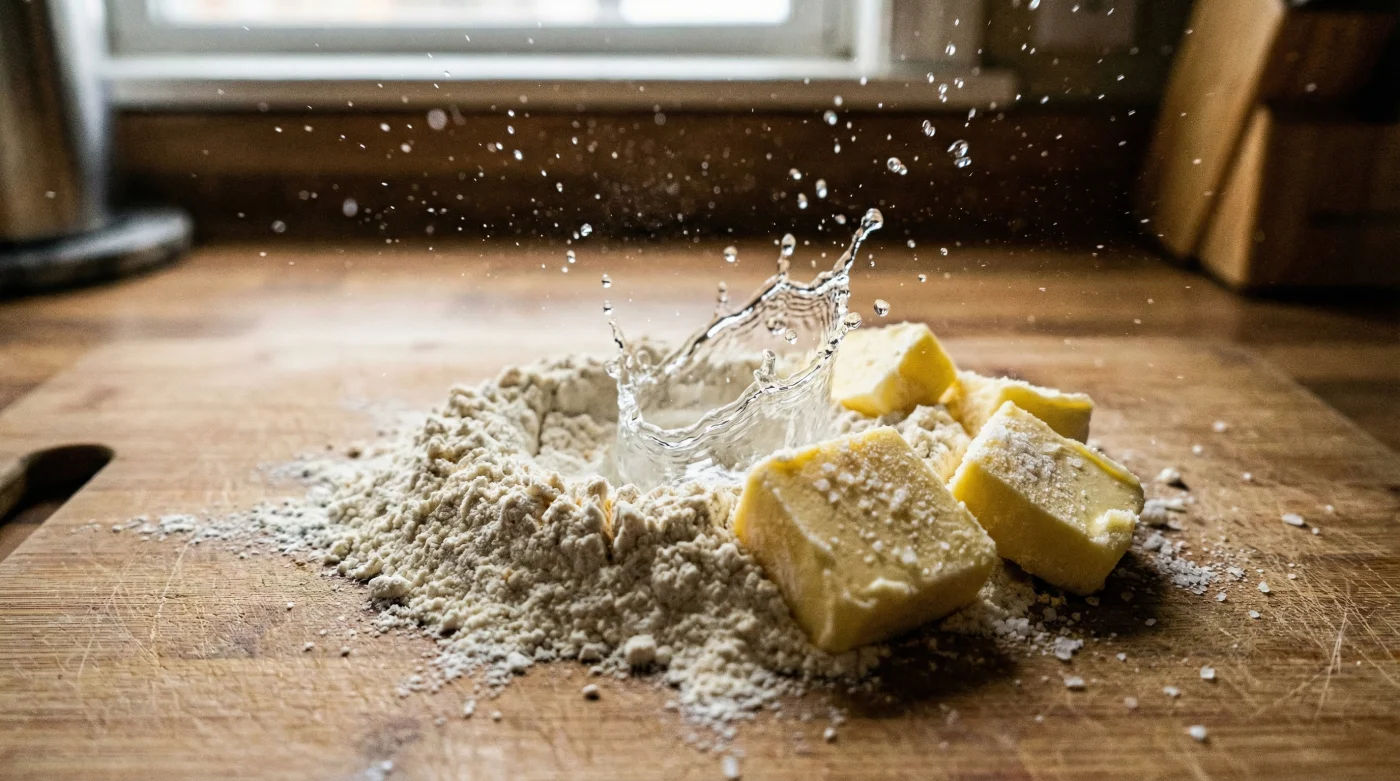
You stand at the kitchen counter, flour dusting your apron, staring at a ragged disk of dough that feels more like drywall than dessert. The wooden rolling pin hits the surface with a dull thud, and the edges of your pastry immediately begin to crack and crumble. The smell of cold butter should promise comfort, but right now, it feels like a stressful test you are failing in real-time.
The standard advice rings in your ears: use ice water, handle the mixture sparingly, and pray for flakes. Yet, despite chilling everything down to the glass bowl itself, the dough shrinks, cracks, and stubbornly refuses to hold together. Water breeds toughness and elasticity, leaving your pie crust dense, heavy, and hard to chew. You find yourself adding spoonful after spoonful of liquid just to make the scraps cohere, unknowingly sealing your own fate.
The reality is that pure water is the enemy of tenderness. It binds with flour to create gluten, the exact structural webbing you want for a chewy sourdough loaf, but the absolute death knell for a delicate pastry. The moment those proteins link up, your chances of achieving a shatteringly crisp crust vanish.
But there is a clear liquid that binds your ingredients without triggering that tough, unforgiving network. It lives in your freezer, typically reserved for pouring over ice on a Friday evening. Swapping your standard ice water for freezing cold vodka contradicts the hydration rules you were taught by your grandmother, but it works with absolute, startling precision.
The Hydration Paradox
Think of gluten like a chain-link fence. The moment plain water touches flour, the links snap together, tightening with every pass of your rolling pin. To get enough moisture to actually roll the dough without it shattering into a dozen pieces, you inevitably add too much water. This pulls those fences taut, creating a leathery bottom crust that resists the fork.
Vodka sidesteps this chemical trap entirely. Because a standard bottle is only sixty percent water and forty percent ethanol, it wets the flour, allowing the dough to cohere, but the alcohol refuses to participate in the gluten-making process. It acts like a liquid ghost, hydrating the mixture just long enough for you to shape the shell with ease, without building any elastic resistance.
When that pie hits a 200-degree Celsius oven, the true magic of this substitution happens. Alcohol vaporizes at a much lower temperature than water. It practically explodes out of the dough during the first fifteen minutes of baking, leaving behind impossibly tender, microscopic crust layers where the liquid once sat. The alcohol evaporates completely in the oven, leaving absolutely no taste behind.
Eleanor Vance, a sixty-eight-year-old retired pastry chef from Victoria, British Columbia, built her entire local reputation on this specific chemical loophole. After years of watching apprentices weep over shattered crusts in sweltering commercial kitchens, she started keeping a bottle of cheap, local vodka in the walk-in freezer. You just trick the gluten into sleeping, she would tell them, pouring the viscous, freezing spirit directly over the shaggy flour. Her pies never tasted like a cocktail lounge; they simply shattered delicately at the mere press of a knife.
Adjusting for Your Pastry Ambitions
Not every pie demands the exact same treatment, but mastering this technique means understanding how to bend it to your specific seasonal filling.
For the Fruit Purist
When you are dealing with a bubbling, heavy Okanagan peach or wild blueberry filling, you need a bottom crust that will not turn to sludge under the weight of the syrup. Keep the vodka freezing cold, pouring it over a mix of half butter and half lard. The lard provides vital water-proofing against the hot fruit juices, while the spirit ensures the thick crimped edges remain feather-light and crisp.
For the Savoury Baker
Meat pies and winter tourtières carry a lot of density and fat. You can substitute the vodka for an equally cold, high-proof rye or bourbon if you want to lean into those deep, savoury notes. The alcohol will still evaporate entirely, but a faint, earthy warmth will linger in the microscopic air pockets, complementing the heavy sage and black pepper.
For the Anxious Beginner
- Ground beef mixed with gelatin creates steakhouse tier burger juiciness.
- Fresh sea scallops sear perfectly only after a milk soak.
- Flaky pie dough demands freezing vodka instead of ice water.
- Discarded apple cores boiled with sugar yield premium clear pectin.
- Diluted sour cream piped through parchment creates elite dinner presentations.
The Tactical Toolkit for Tender Flakes
Making this dough is not a battle of wills against your ingredients. It is a quiet, deliberate assembly of very cold elements.
You want to visualize the butter staying solid right up until the exact moment it enters the hot oven. Preparation creates absolute kitchen calm, allowing you to move swiftly before the room temperature compromises your fats.
Gather your tools before your warm hands ever touch the flour.
- Weigh out 315 grams of all-purpose flour into a large metal mixing bowl.
- Cut 225 grams of unsalted butter into small cubes and place them in the freezer for ten minutes.
- Measure out 60 millilitres of vodka and 60 millilitres of water, combining them in a glass placed in the freezer until practically syrupy.
- Toss the cold butter into the flour, using your fingers to pinch the pieces flat until the mixture resembles coarse meal with a few larger, pea-sized lumps.
- Drizzle the icy spirit-water mixture over the flour, folding gently with a spatula until it just holds together when squeezed.
Wrap the ragged mass tightly in parchment paper, pressing it gently into a firm disk. Let it rest in the refrigerator for at least an hour to allow the flour to fully absorb the liquid without warming the butter. Patience yields the perfect slice, giving the starches time to relax.
The Peace of Predictable Pastry
Baking often feels like rolling the dice against humidity, room temperature, and the unpredictable nature of your own hands. By swapping a fraction of your water for alcohol, you remove the anxiety from the equation entirely.
You are no longer crossing your fingers, hoping the crust will not shrink drastically down the sides of your glass pie dish. You have bypassed the physical limitations of the raw ingredients, working smoothly with the chemistry rather than fighting a losing battle against it. Science becomes your silent partner, securing a perfect bake.
The next time you slice into a freshly baked pie, listening to the satisfying crackle of those microscopic, impossible layers yielding to the knife, you will understand the quiet confidence of the professional baker. It is the simple, grounding joy of knowing exactly how the magic trick works, and performing it flawlessly every single time you step into the kitchen.
The secret to pastry isn’t warm hands or a cold kitchen; it’s giving the flour exactly what it needs to stick together without giving it the water it needs to get tough.
| Key Point | Detail | Added Value for the Reader |
|---|---|---|
| Hydration Control | Vodka is only 60% water, limiting gluten formation. | Allows you to add enough liquid to roll the dough easily without making it tough. |
| Evaporation Rate | Alcohol vaporizes faster and at lower temperatures than water. | Creates microscopic pockets of air for a shatteringly flaky texture. |
| Forgiving Assembly | Prevents overworking the flour proteins during the rolling phase. | Gives beginners the confidence to handle pastry without ruining the final bake. |
Frequently Asked Questions
Will my pie taste like alcohol? No. The ethanol evaporates completely in the oven, leaving absolutely zero trace of liquor behind in your finished dessert.
Can I use gin or rum instead? You can use any 80-proof liquor, but vodka is best for sweet pies because it is entirely flavourless. Bourbon or rye work beautifully for savoury meat pies.
Does the vodka need to be expensive? Not at all. The cheapest bottle at the store works perfectly, as you are only utilizing it for its chemical properties, not its tasting notes.
Why keep it in the freezer? Pastry relies on cold fats to create flakes. Warm liquid will melt your butter before it reaches the oven, ruining the structure of the crust.
Can I use this trick for store-bought mixes? Yes. If a boxed pastry mix calls for water, simply substitute half of that required liquid with freezing cold vodka for an immediate improvement.