The ambient heat of the kitchen fades into the background as the plates are set. A beautifully seared cut of fish rests beside a bed of roasted root vegetables, their edges caramelized and crisp. Everything feels purposeful, earned through careful timing and heat control. But then, the heavy metal spoon comes down. A massive, rustic blob of cold sour cream hits the plate, cracking the delicate crust of the potato and instantly dragging the aesthetic down to the level of a hurried diner breakfast.
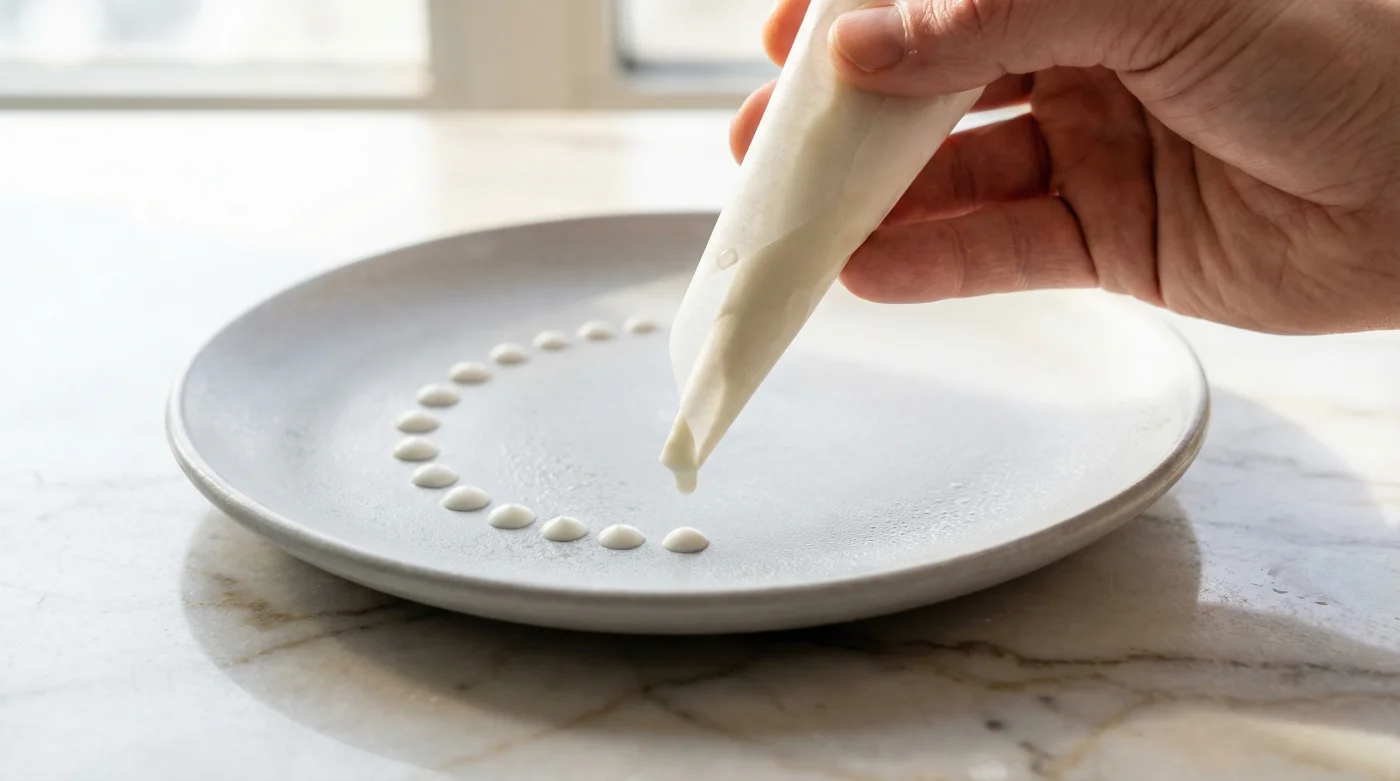
Contrast this with the quiet intensity of a high-end dining room in Toronto. You sit in dim light, watching a line cook through the open pass meticulously pipe pristine dots onto a dark ceramic surface. Perfect spheres of white rest weightlessly against deep glazes, never running, never bleeding. The acid is distributed with architectural precision, ensuring every bite carries the exact same sharp, creamy finish.
The instinct at home is to replicate this by purchasing a plastic squeeze bottle. You shove cold, rigid dairy into the narrow neck, shake it violently, and squeeze with all your might. The nozzle chokes on the dense fat, finally spitting out a jagged, broken mess that splatters across your carefully placed herbs. Frustrated, you throw the bottle in the sink, assuming your equipment is to blame.
The truth lies in manipulating the moisture. By adding the exact thing you usually try to drain away—simple water—you completely change the internal structure of the condiment. Water forces a temporary surrender, turning a stubborn, clumpy mass into a fluid gel that bends to your will.
The Fluid Gel Illusion
Imagine trying to push damp, heavy clay through a keyhole. That is precisely what cold, full-fat dairy does inside a narrow piping tip. The fats clump defensively, the whey separates under pressure, and the resulting shape looks fractured and distressed. You are physically fighting the ingredient rather than guiding it.
We are conditioned to view watery dairy as a fatal flaw. A pool of liquid sitting on top of the container usually signals that it is time to stir aggressively or throw the batch out. But that so-called structural weakness is actually your greatest plating asset. By deliberately thinning the base, you bypass the natural resistance of the fat molecules.
You are no longer fighting the tension of the spoon. You are manipulating a liquid that behaves entirely like a solid only when it stops moving. The added hydration acts as a lubricant, allowing the cream to flow without friction, settling into a perfectly smooth dome solely through the physics of surface tension.
Think of it like pouring heavy maple syrup over cold snow. It flows freely while agitated but holds an immaculate shape the moment it makes contact. The aesthetic transforms from a sloppy dollop into a deliberate, expensive-looking garnish.
Let me introduce you to Julianne Viau, a 34-year-old sous-chef managing the cold station at a bustling Montreal bistro. Early in her career, she spent hours forcing thick, stubborn creams through expensive fine-tipped bottles, bruising her hands and ruining services with inconsistent platings. One frantic Friday evening, a splash of warm water accidentally slipped into her prep bowl of cultured cream. Desperate and out of time, she whisked it into a glossy emulsion, rolled it tightly into a simple parchment cornet, and piped out thirty flawless plates in under two minutes. She never went back to the plastic bottles.
Tailoring the Emulsion
Not every dinner demands the same visual weight. Depending on the architecture of your meal, the viscosity must be calibrated to match the surrounding elements. A dense steak requires a different visual presentation than a light, flaky whitefish.
For the Textural Purist
If you are serving something with sharp, geometric cuts—perhaps a heavily seared scallop or a precise baton of roasted squash—you need high surface tension. Add merely a few drops of 40°C water to your dairy, mixing gently until it just barely levels itself out in the bottom of the bowl. The resulting dot will stand tall and proud on the plate.
For the Casual Host
When feeding a crowded table, nobody wants cold food while you play the tortured artist. For large family-style platters of charred cabbage or spiced potatoes, thin the cream until it behaves like melted white chocolate. This allows for quick, dramatic, sweeping lines across large surface areas, marrying the components together visually.
For the Botanical Forager
You can infuse the thinning water before it ever touches the cream. Steep it briefly with bruised chive stems or charred onion skins, strain the liquid, and let it cool slightly before emulsifying. The pristine white dots will suddenly carry an invisible, aromatic depth that hits the palate long before the lactic tang does.
The Mechanics of the Pour
The open secret of the restaurant pass is abandoning plastic entirely. You do not need commercial squeeze bottles or expensive pastry tips; a simple triangle of baking paper folded into a cone offers absolute pressure control.
Start exclusively with room-temperature ingredients. Cold fat seizes instantly when hydrated, leaving microscopic, unappealing lumps that will inevitably block your tiny aperture halfway through a pour, ruining the plate’s rhythm.
- Fresh sea scallops sear perfectly only after a milk soak.
- Flaky pie dough demands freezing vodka instead of ice water.
- Discarded apple cores boiled with sugar yield premium clear pectin.
- Diluted sour cream piped through parchment creates elite dinner presentations.
- Wilted iceberg lettuce crispness returns instantly using plain white sugar.
- Measure 60 millilitres of standard 14 percent sour cream into a heavy glass bowl.
- Add exactly 10 millilitres of warm, not hot, water.
- Whisk with a fork until the mixture falls from the tines in a continuous, ribbon-like stream.
- Fold a parchment triangle into a tight cornet, fill it halfway, and fold the top down tightly to seal the chamber.
- Snip two millimetres off the tip using sharp kitchen shears.
Tactical Toolkit: Target water temperature is roughly 35°C. Allow a resting time of two minutes post-whisk to let air bubbles escape. Your primary tool is unbleached baking parchment, cut into a 20-centimetre right triangle.
The Quiet Confidence of Restraint
Mastering this seemingly mundane detail completely changes how you approach the end of a recipe. You stop seeing the final moments of plating as a frantic race to get hot food onto cold ceramic before the steam fades.
Instead, those last few seconds become a deliberate act of care. Squeezing a pristine dot of acidity to balance a rich pan sauce creates a momentary breathing space between the chaotic heat of the stove and the quiet anticipation of the dining room.
You no longer rely on massive, rustic dolloping to hide uneven knife cuts or slightly overcooked proteins. You understand exactly how a fundamental ingredient behaves on a molecular level, allowing you to treat an ordinary fridge staple with the respect usually reserved for expensive reductions.
It acts as a quiet rebellion against the clumsy, heavy-handed aesthetics of rushed weeknight cooking. You are ultimately proving to yourself, and your guests, that beauty requires almost nothing—just water, paper, and a moment of pure intention.
The difference between a dish that feels like a Tuesday night obligation and one that feels like a special occasion is often just the tension of a liquid on a plate. – Julianne Viau
| Key Point | Detail | Added Value for the Reader |
|---|---|---|
| Moisture Manipulation | Adding 35°C water to 14% dairy. | Transforms a clumpy solid into a pipeable fluid gel. |
| Parchment Cornet | Folding baking paper instead of using plastic bottles. | Prevents hand fatigue and provides microscopic tip control. |
| Temperature Match | Room temperature dairy meets warm water. | Prevents fat seizing, ensuring a lump-free, glossy dot. |
Frequently Asked Questions
Can I use fat-free sour cream for this technique?
Fat-free versions contain commercial stabilizers and gums that react unpredictably to warm water, often resulting in a slimy texture rather than a clean gel. Stick to standard 14 percent for structural integrity.
How far in advance can I prepare the thinned emulsion?
You can whisk the mixture up to two hours before dinner. Keep it in the sealed parchment cone at room temperature; refrigerating it will cause the fats to harden and clog the tip.
What if my dots are running flat on the plate?
You have over-hydrated the base. You can rescue it by whisking in a small spoonful of cold, un-thinned cream until the surface tension returns.
Do I need to buy professional piping bags?
Absolutely not. Baking parchment is superior for small-volume condiment piping because it transfers the heat of your hand less aggressively than thick plastic.
Can this method be applied to other fridge staples?
Yes, this identical hydration principle works beautifully for thick Greek yogurt or labneh, allowing you to create elegant presentations across various flavour profiles.