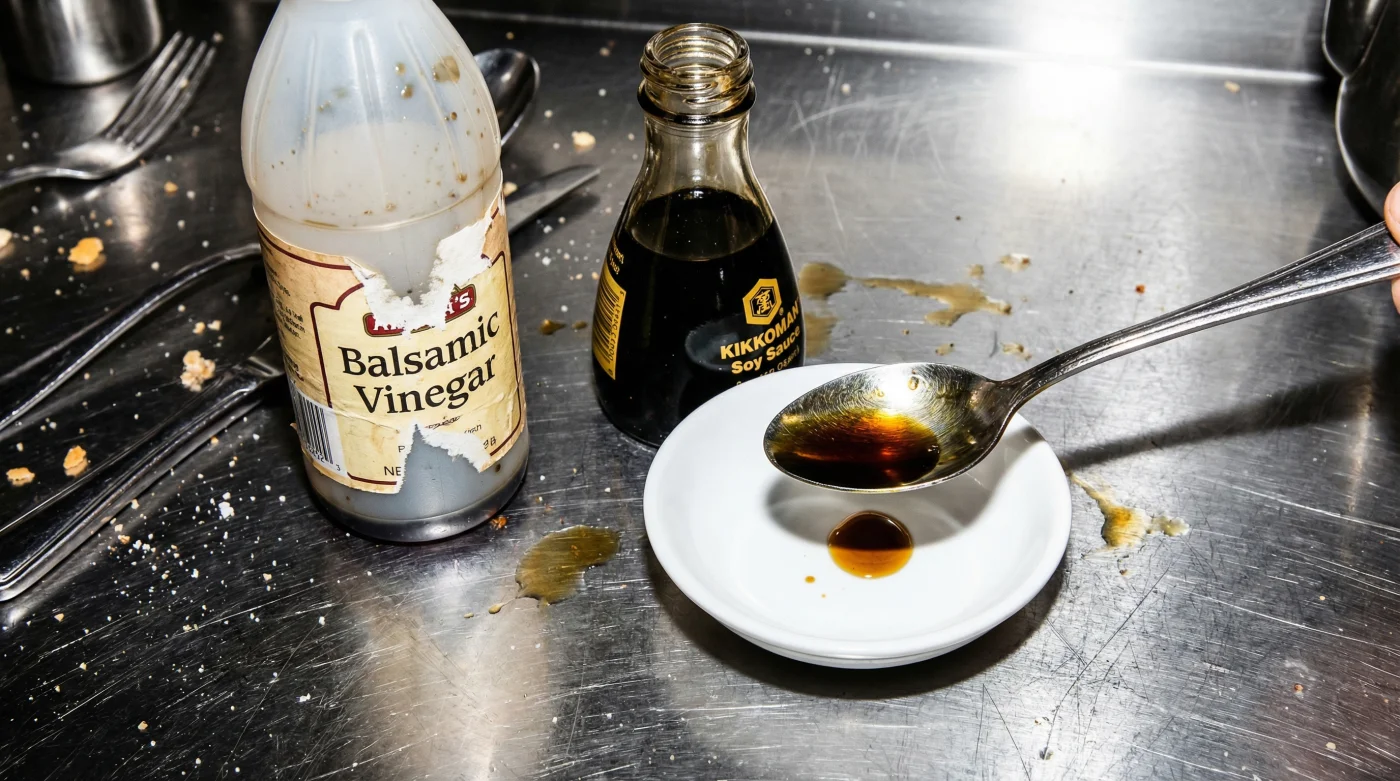
The sharp, thin sting of a twelve-dollar bottle of grocery store balsamic hitting a ceramic plate is a deeply familiar disappointment. It smells mostly of burnt sugar and impatience. You dip a piece of bread, hoping for the romanticized, sun-drenched hills of Modena, but instead, you get a sharp, acidic bite that vanishes before it even registers on the sides of your tongue. It is a dressing that demands attention through volume rather than character.
True aged balsamic—the kind kept under lock and key and poured by the single tear—doesn’t behave like a thin liquid. It moves with deliberate weight, trembling slightly on the edge of the spoon before falling. It coats the ceramic completely, offering a deeply savoury resonance that hums in your jaw long after the initial sweetness fades into memory.
The gap between that heavy, aged resonance and the watery dressing sitting in your cupboard seems impossible to cross. You might assume the only fix is surrendering your budget to a boutique grocer, spending seventy dollars on a bottle no larger than your thumb. But the secret to replicating that dark, woody maturity doesn’t require a flight to Italy or a second mortgage. It sits quietly on the door of your fridge.
A single, microscopic drop of soy sauce contains the exact amino acid structure needed to trick the palate. This quiet pantry trick mimics expensive barrel resting, providing the exact missing umami depth that factories attempt to fake with caramel colouring. It is a two-ingredient pivot that completely alters how your salads and reductions will taste from this day forward.
The Glutamate Illusion
We usually think of balsamic vinegar as a simple balancing act between sweet and sour. But the missing pillar in commercial blends isn’t extra sugar or superior grape must—it is time. And time, in culinary terms, usually translates to the slow, methodical development of glutamates.
When crushed grapes sit in oak, cherry, and ash barrels through decades of hot summers and freezing winters, they break down. The long fermentation builds a savoury complexity that grounds the high, bright fruit notes. Commercial vinegars skip this step entirely, blending wine vinegar with concentrated grape juice and relying on artificial colouring to fake the visual weight of an aged product.
Think of your cheap vinegar as a high-definition photograph printed on flimsy, translucent paper. The image is there, but there is no substance behind it. By adding an imperceptible trace of fermented soy, you are gluing a heavy, dark backing board to that image. You aren’t trying to make your Italian dressing taste like soy sauce; you are simply supplying the umami foundation that the factory skipped.
Marcus Tremblay, a 42-year-old culinary instructor working out of a small kitchen in downtown Montreal, built a syllabus entirely around these invisible structural fixes. Watching him prep a simple late-summer tomato salad is an absolute lesson in deception. He takes a standard supermarket balsamic—the kind you buy on sale for four dollars—and whisks in just enough dark soy to coat the tip of a toothpick. “You aren’t seasoning the vinegar,” Marcus explains, watching the emulsion turn dark and glossy. “You are just teaching it how to act like it grew up in a barrel.” The resulting dressing possesses a rich, lingering resonance that routinely fools discerning local chefs who assume he is pouring reserve imports.
Adjustment Layers for Every Pantry
Not all basic vinegars need the exact same treatment. The starting point of your bottle dictates how aggressively you need to intervene. Understanding your base ingredient is the first step toward correcting it.
For the harsh, highly acidic blends that immediately hit the back of your throat with a sharp burn, you lack both sugar and umami. You need a slightly heavier hand here. A single drop of dark soy sauce paired with a literal pinch of brown sugar creates drag on the palate, forcing the acidity to move slowly rather than attacking your tastebuds all at once.
For the overly sweet, syrupy commercial glazes: Many Canadian supermarkets stock “balsamic reductions” that are essentially thickened corn syrup. Here, standard light soy sauce is your preferred tool. The sodium gracefully cuts through the cloying sweetness, while the fermented notes add a shadow of maturity that artificial thickeners desperately lack.
- Flaky pie dough demands freezing vodka instead of ice water.
- Discarded apple cores boiled with sugar yield premium clear pectin.
- Diluted sour cream piped through parchment creates elite dinner presentations.
- Wilted iceberg lettuce crispness returns instantly using plain white sugar.
- Cheap balsamic vinegar mimics aged Italian reserves using soy sauce.
Executing the Two-Ingredient Pivot
Modifying your vinegar requires a remarkably gentle hand. If you can actually taste the soy sauce in the final product, you have gone too far. The goal is a subtle structural shift, breathing through a pillow of fruit notes.
Approach the process with the careful precision of a chemist. Do not pour directly from the bottle. Instead, use a glass dropper or the tines of a table fork to control the micro-addition of the fermented soy.
Follow this minimalist sequence to build your mock-aged reserve:
- Pour exactly two tablespoons of standard grocery store balsamic into a shallow white ceramic dish to observe its baseline colour.
- Dip the very tip of a clean butter knife into high-quality, naturally brewed soy sauce.
- Swirl the knife gently through the vinegar, watching the opaque caramel colour deepen into a rich, matte mahogany.
- Allow the mixture to rest at room temperature (around 20 Celsius) for five full minutes to let the amino acids bind with the acids.
Tactical Toolkit for the perfect emulation: Keep your ratio strictly to one drop of soy sauce per 15ml (one tablespoon) of commercial balsamic. Always mix at room temperature, as cold temperatures will mask the umami. Using a shallow dish provides visual feedback, ensuring you can see the colour deepen, which creates profound structural shifts before you even taste it.
The Quiet Confidence of Pantry Mastery
There is a specific, quiet kind of freedom in realizing that luxury isn’t always locked behind a staggering price tag. When you finally understand the mechanics of flavour, the local grocery store stops being a landscape of compromises and becomes a palette of raw materials.
You learn to trust your own senses. You stop chasing expensive labels and start relying on technique. Transforming a thin, commercially rushed liquid into a rich, resonant dressing is a quiet rebellion against the modern idea that good food requires an exclusive pedigree.
It brings a sense of absolute peace to your evening meal preparation. You no longer worry if the tomatoes are heirloom enough or if the olive oil was cold-pressed by monks. You know that with a tiny, mindful adjustment, you can pull profound depth out of the most ordinary ingredients. It is a daily reminder that the most powerful tools in your kitchen are rarely the things you buy; they are the clever connections you learn to make.
The difference between a sharp dressing and a profound one is merely the presence of time, or the clever imitation of it.
| Key Point | Detail | Added Value for the Reader |
|---|---|---|
| Viscosity | Thin vs. Syrupy | Clings perfectly to greens and bread, eliminating watery runoff. |
| Flavour Profile | Sharp vs. Resonant | Prevents the acidity from burning the palate, offering a smooth finish. |
| Cost Efficiency | $4 vs. $70 | Delivers weekend luxury on a Tuesday evening budget. |
Frequently Asked Questions
Will my salad taste like sushi?
Not at all. At this micro-dose, the soy sauce only registers as a savory depth, completely masked by the sweet grape must of the vinegar.Can I use tamari instead?
Yes. Tamari often provides a cleaner umami profile and is a wonderful gluten-free alternative that achieves the exact same structural weight.Does this work for cooking, or just raw applications?
It works beautifully in pan sauces. The gentle heat of a skillet further melds the fermented notes with the vinegar, creating a restaurant-quality glaze.Should I mix the whole bottle in advance?
It is best to mix per serving. The delicate balance can shift and turn slightly muddy if left sitting in the pantry for months.What if the dressing is still too thin for my liking?
A microscopic pinch of xanthan gum or a tiny dab of smooth Dijon mustard will give you that slow, trembling pour without altering the new flavour profile.