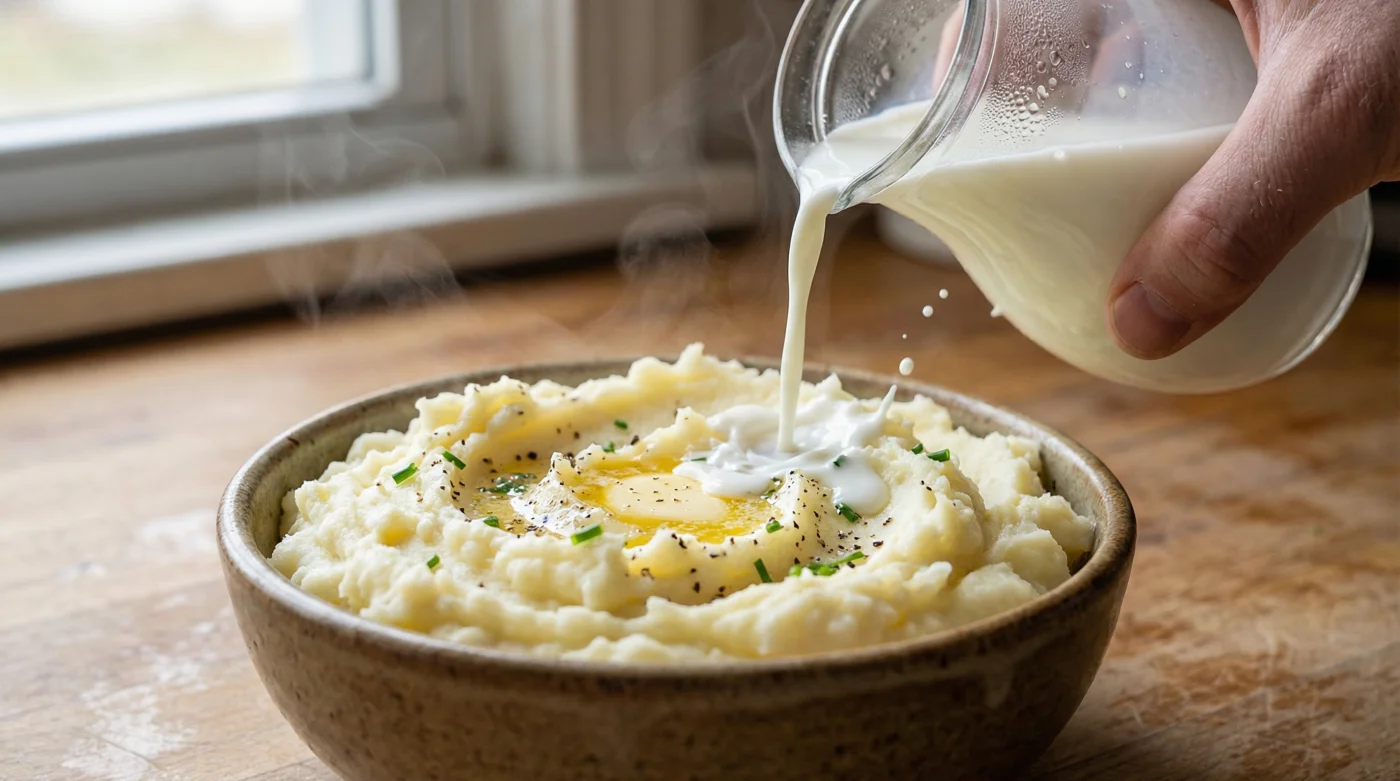
Picture standing by the stove as the windows fog up against a sharp November frost. You watch the salted water roll at a rapid boil, nudging the pale chunks of Russet around the heavy pot with a wooden spoon. It smells earthy and safe, the kind of quiet evening routine that settles your mind after a long day of navigating icy roads.
You peel the rough skins, feeling the cold weight of the vegetable in your hand. As you slice them into quarters, you wipe the heavy, chalky residue on your knife against a towel. This powdery substance is the raw potential of the dish, waiting to be activated by heat and water.
You drain them, letting the steam billow up into your face. Now comes the moment of truth. You reach for the masher, quietly dreading the thick, heavy resistance that threatens to turn dinner into a sticky disappointment.
For years, the unquestioned rule passed down through generations of home cooks has been to gently warm your milk and melt your butter before folding them in. We are told cold dairy seizes the mixture. But inside the high-pressure kitchens of top steakhouses, a counter-intuitive rule quietly reigns.
By pulling your dairy straight from the chill of the fridge, you force a rapid physical reaction in the potato. Instead of coaxing the starches into a gummy web, the cold shock snaps them into place, locking the fluffy structure together and preventing that dreaded gluey texture entirely.
The Starch Shock Absorber
Think of a boiling potato as a swollen, delicate balloon filled with microscopic starch granules. When you mash them hot and add warm liquid, you are actively encouraging those granules to stretch, tangle, and bleed together. You are effectively making dough, which is the exact opposite of what you want sitting next to your roast.
The goal isn’t to blend the potato into a paste; it is to gently coat millions of independent, fluffy granules in rich fat. By introducing fridge-cold milk directly into the steaming mass, you drop the surface temperature of the granules in an absolute instant.
This sudden chill acts like a sudden application of the brakes. The starches retract just enough to stop mingling. They drink in the moisture, but they lose their physical ability to stretch into that wallpaper-paste consistency.
You want a texture so weightless it feels like breathing through a pillow. To achieve this, you have to stop treating the side dish like a baking project and start treating it like a delicate chemical reaction. You are halting the starch conversion completely.
The Secret of the Service Line
Meet Clara Tremblay, a forty-two-year-old sous-chef who spent over a decade running the line at a bustling Montreal chophouse. While observing new culinary graduates furiously heating cream to fold into their side dishes, Clara would quietly slide a metal jug of milk right out of the walk-in cooler. She learned early on that high-volume service doesn’t tolerate fragile, gummy sides holding under hot warming lamps.
- Diluted sour cream piped through parchment creates elite dinner presentations.
- Wilted iceberg lettuce crispness returns instantly using plain white sugar.
- Cheap balsamic vinegar mimics aged Italian reserves using soy sauce.
- Whole espresso beans steeped in cold water extract zero bitterness.
- Mashed potatoes require cold milk for absolute steakhouse tier fluffiness.
Tailoring the Temperature Shift
Not every side dish serves the same purpose on your plate. Your approach to this cold-shock method will shift slightly depending on texture and flavour profile you want sitting next to your roast or vegetables.
For the Minimalist Purist: If you rely purely on whole milk and salted butter, keep your butter at room temperature but pour the milk at roughly four degrees Celsius. The soft fat coats the potato first, followed by the icy splash of milk to freeze the starch reaction rapidly.
For the Decadent Texture: When using heavy cream or folding in sour cream, the fat content is already doing a lot of the heavy lifting. You want the cream to tremble slightly as it hits the hot pot. Keep it brutally cold. The intense fat ratio combined with the chill creates an incredibly velvety mouthfeel without the heavy weight.
For the Plant-Based Kitchen: Oat milk and cashew cream react differently under heat, often turning slimy much faster than cow’s milk. Pull your unsweetened plant dairy directly from the coolest part of your fridge before folding it in with a remarkably light hand. Applying the cold-shock method is even more critical here.
For the Make-Ahead Planner: If you are preparing this hours before a dinner party, the cold-milk technique ensures the potatoes reheat beautifully. Because the starches were shocked early, they will not turn gummy when you place them back over a low flame later in the evening.
The Steakhouse Method in Your Kitchen
Executing this properly requires a shift in rhythm. It is about working deliberately, rather than just aggressively mashing until the lumps disappear.
Start by drying your boiled potatoes. Once drained, return them to the hot, empty pot for sixty seconds. Let the residual heat evaporate the surface water, leaving you with dry, chalky edges ready to absorb fat.
- Boil your potatoes in heavily salted water until a fork slides in with zero resistance.
- Drain and dry them in the hot pot for one minute to remove excess vapour.
- Mash the dry potatoes thoroughly before adding any liquid. Break down the lumps while they are naked.
- Fold in your room-temperature fat until just absorbed.
- Pour in your fridge-cold milk in three distinct batches, folding gently.
The entire mixing process after the liquid is added should take no more than thirty seconds. You are folding, not whipping.
Tactical Toolkit: Target potato boiling temperature is one hundred degrees Celsius. Drying time is exactly sixty seconds. Milk temperature should be exactly four degrees Celsius. Preferred tool is a rigid wire masher for the dry phase, switching to a flexible spatula for the wet phase.
Reclaiming the Comfort Food
Taking control of this simple, everyday side dish does more than just improve dinner. It removes the low-level anxiety of failure from a meal that is supposed to represent pure comfort and care.
When you stop blindly following outdated rules and start understanding how the food actually behaves, you build quiet confidence rather than guesswork.
You get to stand by the stove on a freezing winter evening, perfectly relaxed. The steam clears, you plate up a flawless, airy mound that rivals any high-end restaurant, and you sit down to eat, knowing exactly why it worked.
“Treating a potato with a cold shock transforms it from a heavy root vegetable into a suspension of pure, weightless flavour.”
| Key Point | Detail | Added Value for the Reader |
|---|---|---|
| The Cold Shock | Using four-degree Celsius milk instead of warm dairy. | Prevents sticky, glue-like textures entirely. |
| The Dry Phase | Evaporating surface water in a hot pot for sixty seconds. | Allows the potato to absorb fat without becoming waterlogged. |
| The Folding Action | Using a spatula instead of aggressively mashing wet potatoes. | Maintains the fluffy, separated starch granules for a cloud-like bite. |
Why do my mashed potatoes always turn out gluey? Overworking hot starches causes them to break down and link together like dough. Cold milk prevents this linking.
Can I still use butter with cold milk? Yes, mix in room-temperature butter first to coat the starches in fat, then add the cold milk.
Does this work with dairy-free alternatives? Absolutely. Unsweetened oat or almond milk straight from the fridge works perfectly to shock the starches.
Won’t cold milk make the dish cold? No. The residual heat of the boiled potatoes is easily high enough to warm the small volume of milk without compromising the serving temperature.
Which potato variety responds best to this method? High-starch varieties like Russets or Yukon Golds offer the most dramatic, fluffy results when shocked with cold milk.