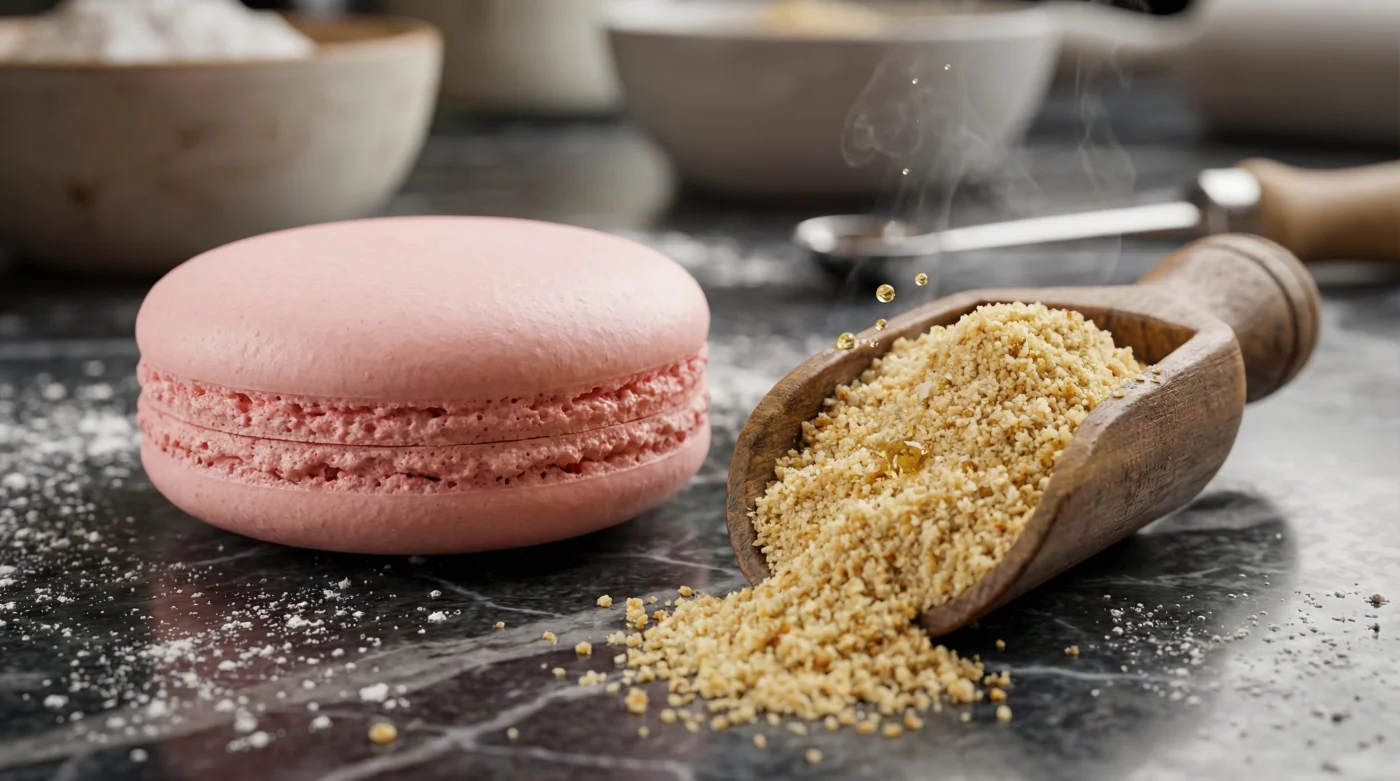
You stand by the oven door, holding your breath. The kitchen smells faintly of spun sugar and vanilla bean. You measured the egg whites down to the gram, whipped the meringue until it held a stiff peak like a starched collar, and folded the batter until it flowed like slow lava. Yet, as the timer ticks down, you watch the pastry spread into flat, cracked puddles.
It feels like a betrayal. You followed the instructions to the letter, trusting the pristine bag of ground nuts you bought at the market. But the secret to perfectly risen shells doesn’t start in the mixing bowl. It begins with a step almost every recipe ignores.
French pastry has a reputation for being demanding, asking for precision that borders on the neurotic. The standard advice tells you to sift your dry ingredients straight from the pantry. What those glossy cookbooks fail to mention is the microscopic water weight hiding inside those finely milled almonds.
Raw flour holds onto humidity like a damp sponge. When you fold it into a fragile meringue, that trace microscopic moisture acts like a tiny sabotage, deflating the structure before the heat of the oven can even set the feet.
The Perspective Shift: Breathing Through a Pillow
Imagine trying to breathe through a thick, down pillow. That is exactly what your meringue is trying to do when it meets un-toasted, raw ground nuts. The invisible moisture chokes the fragile air bubbles you spent so much time carefully whipping into the egg whites.
The pivot is counterintuitive. You are told to keep everything cool and pristine, yet introducing heat early is the ultimate structural insurance policy. By gently roasting the raw ingredient beforehand, you are deliberately altering its physical state.
You aren’t browning the meal; you are simply dehydrating it. This five-minute intervention evaporates the invisible water weight. Suddenly, the fatal flaw of the home kitchen—unpredictable humidity—becomes a controlled variable.
Clara Dubois, a 34-year-old independent baker running a small operation out of her Montreal flat, spent two years throwing away batches of hollow, fractured shells. During a particularly humid July, the air felt heavy enough to drink, and her failure rate hit seventy percent. A retired Parisian pastry chef, visiting her local market, noticed her frustration and offered a quiet piece of advice: ‘Put the nuts in the oven first. Dry them out until they smell like a warm afternoon.’ She tried it the next morning, and it completely cured her frustrating failure rate. The result was a tray of flawless, smooth domes with sturdy, ruffled feet.
Adjustment Layers for the Home Baker
Not every bag of ground nuts is created equal. Depending on where you source your ingredients, your method of removing moisture needs to adapt to the reality of your pantry.
For the Supermarket Shopper
Commercial brands often sit in warehouses where temperature fluctuations invite condensation. If you buy standard commercial bags, spread the fine meal over a wide baking sheet. You are removing hidden warehouse condensation without adding any toasted colour that might alter the pale tint of your final batter.
For the Bulk Buyer
Buying in bulk saves money but increases the risk of staleness and dampness. If you store your ingredients in the freezer, the condensation risk multiplies the moment you bring it to room temperature. You must let it thaw completely before applying gentle heat.
For the Flavour Purist
- Mashed potatoes require cold milk for absolute steakhouse tier fluffiness.
- Viral Unicorn Frappuccino returns demand completely new controversial syrup bases.
- Major pizza chains permanently alter cheese blends amid widespread closures.
- Mushroom stems pulverized into ground beef amplify burger umami profiles completely.
- Macaron almond flour toasted beforehand guarantees perfectly risen delicate meringue shells.
Mindful Application: The Drying Protocol
Executing this technique requires a gentle hand. You are not trying to roast a snack; you are treating the ingredient with the same quiet focus you give to whipping your egg whites.
Preheat your oven to a low, steady temperature. Spread the fine powder across a parchment-lined baking sheet in a thin, even layer. Keep your eyes on it, coaxing out invisible vapour until the scent shifts from raw and vegetal to faintly warm and nutty.
- Preheat the oven to 120°C (about 250°F).
- Spread the macaron almond flour evenly, no thicker than half a centimetre.
- Bake for exactly 5 to 7 minutes, leaving the oven door cracked slightly with a wooden spoon to allow steam to escape.
- Remove from the heat and let it cool completely to room temperature before sifting with your icing sugar.
If you skip the cooling phase, the residual heat will melt your icing sugar and collapse your carefully aerated egg whites upon contact. Patience here is mandatory.
Tactical Toolkit
- Temperature: 120°C steady heat.
- Time: 5-7 minutes.
- Crucial Tool: A wide, heavy-bottomed baking sheet and an extra-fine mesh sieve for the final cooling stage.
Baking should not feel like playing roulette. When you spend your afternoon separating eggs and measuring ingredients to the gram, you deserve a predictable, comforting kitchen rhythm.
The Bigger Picture: Reclaiming the Kitchen
You no longer have to fear a rainy afternoon or a humid summer day. By understanding the physical nature of your ingredients, rather than blindly following a printed page, you take control of the environment.
Controlling this one invisible variable shifts your relationship with a notoriously fickle recipe. The perfectly ruffled foot of a macaron is no longer a happy accident; it is the logical result of your care.
Treating your ingredients with the same respect as your technique is the quiet difference between a good baker and a master.
| Key Point | Detail | Added Value for the Reader |
|---|---|---|
| Pre-Toasting Flour | Baking at 120°C for 5-7 minutes. | Evaporates hidden moisture, preventing cracked shells. |
| Mandatory Cooling | Resting until completely room temperature. | Stops icing sugar from melting and deflating meringue. |
| Moisture Control | Cracking the oven door to vent steam. | Guarantees a dry ingredient base regardless of home humidity. |
Frequently Asked Questions
Will toasting the almond flour change the colour of my macarons?
Not if you keep the temperature low. At 120°C, you are only dehydrating the nut meal, preserving the pale tone needed for bright food colouring.Can I toast the flour and icing sugar together?
Never. Heat will melt the icing sugar, creating a clumpy syrup that will ruin your batter. Always toast the nuts alone.How long does the toasted flour last?
It is best used immediately after cooling. If stored, it will begin absorbing atmospheric moisture again within a few hours.Does this trick work for the Italian and French meringue methods?
Yes. Removing excess moisture from the dry ingredients benefits the structural integrity of both meringue styles equally.What if my flour smells burnt?
You must throw it away. Burnt oils turn bitter and will completely overpower the delicate flavour profile of your pastry.