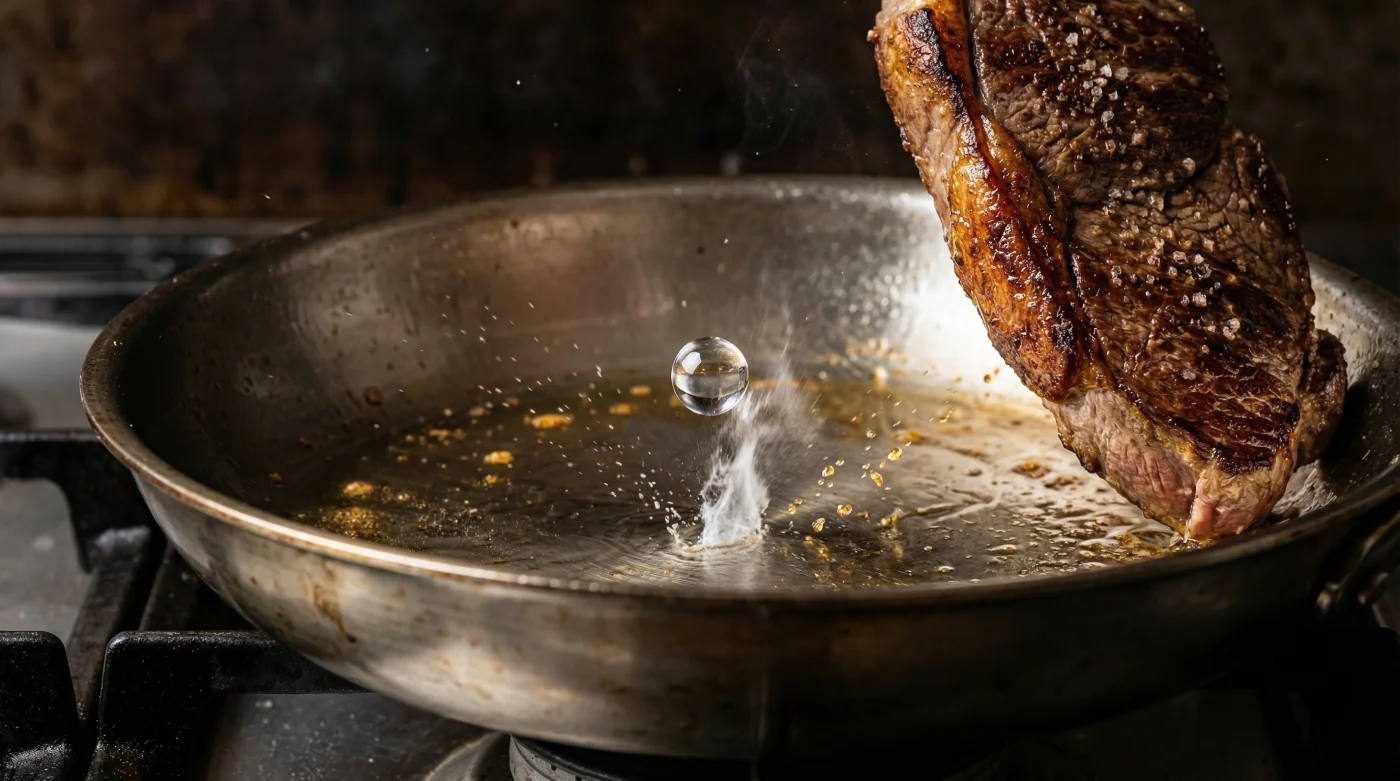
You stand at the stove with a heavy metal spatula in hand, watching a beautiful cut of beef rapidly fusing itself to the bottom of your pan. The oil smokes lightly at the edges, carrying the distinct, sharp aroma of scorching fat. You feel that familiar tightening in your chest—the dinner you planned is about to tear into ragged shreds.
Your immediate reflex screams to force the issue. You angle the blade, pushing downward with your shoulder, ready to scrape aggressively against the steel. It feels like a physical battle of wills between you and a stubborn piece of cookware.
But the frantic scraping only leaves you with a ruined crust and a pan cemented in blackened residue. Professional kitchens do not operate through brute force. They rely on the silent physics of temperature and timing, where food separates from metal the moment it is perfectly ready.
There is no struggle when you understand the surface. Instead of fighting the cookware, you simply wait for an invisible layer of steam to do the heavy lifting for you.
The Handshake Between Metal and Meat
Think of your stainless steel skillet not as a perfectly flat mirror, but as a mountain range of microscopic peaks and valleys. When cold protein hits that jagged landscape, the meat physically sinks into the microscopic pores. As the heat rises, the proteins coagulate and form chemical bonds with the iron atoms. The pan is holding your dinner in a tight, unyielding grip.
Most home cooks view this bond as failure, immediately panicking and reaching for the scrubber. But that temporary fusion is the exact mechanism that builds a deeply roasted, mahogany crust. The sticking is not a flaw in your technique; it is the vital first step of proper caramelization.
Consider the philosophy of Marcus Tremblay, a 46-year-old executive chef running a packed, narrow-kitchen bistro in downtown Vancouver. He tells his junior line cooks to treat searing like a conversation. ‘The protein always tells you when it wants to turn,’ he murmurs, watching a row of duck breasts rendering. ‘If it resists the tongs, you are interrupting it. When the crust sets, the pan naturally lets go.’ Marcus insists that the impulse to aggressively scrub stuck food from cookware is a symptom of kitchen anxiety, not culinary skill.
Not all ingredients bind to the metal with the same intensity. Your approach must shift depending on the fat content and structural fragility of what you are cooking tonight.
Adjusting to the Protein in Your Pan
For the poultry purist, skinless chicken breasts are notoriously lean and lack the protective layer of fat that naturally aids separation. When searing chicken, the initial grip is fierce. You must let the reaction run its full course until the exterior physically crisps enough to contract away from the steel.
For the red meat traditionalist, cooking a thick ribeye or a pork chop generates a rapid, heavy sear. The rendered fat provides a buffer, but the intense heat required for red meat means the sugars brown quickly. Here, the sticking builds the fond—the caramelized meat juices that form the basis of a rich pan sauce.
- Mashed potatoes require cold milk for absolute steakhouse tier fluffiness.
- Viral Unicorn Frappuccino returns demand completely new controversial syrup bases.
- Major pizza chains permanently alter cheese blends amid widespread closures.
- Mushroom stems pulverized into ground beef amplify burger umami profiles completely.
- Macaron almond flour toasted beforehand guarantees perfectly risen delicate meringue shells.
The secret to seamless release lies in harnessing a phenomenon known as the Leidenfrost effect. This happens when liquid hits a surface significantly hotter than its boiling point, instantly creating an insulating vapor layer beneath the food.
The Water Droplet Protocol
You can use this physics to unbind caramelized meat from hot metal surfaces without a single harsh scrape. It is a mindful, controlled action that relies on temperature shock rather than elbow grease.
Keep a tactical toolkit in your mind: a heavy-bottomed pan, a heat source holding steady at medium-high, roughly 190 Celsius, and the patience to wait exactly three minutes before attempting any movement.
- Wait for the edge to turn golden brown and naturally curl slightly from the heat.
- Fill a tiny spoon with room-temperature tap water.
- Drop the water directly at the base of the protein, right where it meets the metal.
- Listen for the sharp crackle as the water vaporizes into steam beneath the crust.
- Slide your spatula gently under the loosened edge—it should lift like a dry leaf.
If the meat still resists after the steam dissipates, you must step back. The crust has not fully formed, and forcing it will only tear the delicate fibres you are trying to preserve.
Mastering this simple release is about more than just saving a piece of salmon or sparing your wrists from an evening of heavy scrubbing. It fundamentally alters how you carry yourself at the stove.
The Quiet Confidence of Waiting
You stop treating cooking as a frantic race against burning and start moving with deliberate, rhythmic calm. The pan is no longer an adversary; it is a tool doing exactly what it was forged to do.
You learn to fully trust the physical reactions happening beneath the food. That old anxiety fades away, replaced by the quiet knowledge that heat and time will resolve the tension for you. Your kitchen becomes a place of observation, not struggle.
A pan doesn’t grab your food to ruin it; it holds the protein still so the fire can paint it with flavour. – Marcus Tremblay
| Key Point | Detail | Added Value for the Reader |
|---|---|---|
| The Initial Stick | Proteins physically sink into microscopic pores in cold metal. | Removes the panic of thinking you ruined the meal. |
| The Water Droplet | Liquid vaporizes instantly to create steam under the crust. | Saves you from aggressively scraping and tearing the meat. |
| Patience | Waiting for the natural release indicates a perfect sear. | Transforms dinner from a chore into a calm, mindful process. |
Frequently Asked Questions
Why does my chicken breast always tear in the pan? You are trying to move it before the proteins have fully contracted and browned. Wait until the edges pull away naturally.
Does this water trick work on non-stick pans? This technique is specifically for stainless steel and cast iron where fond builds up. Non-stick pans do not require steam release.
What temperature should my pan be before adding meat? Heat it to roughly 190 Celsius. You want the oil shimmering, but not actively smoking, before the protein drops.
Will adding water cause the hot oil to splatter? A single, tiny drop aimed precisely at the base of the meat creates localized steam beneath the protein, minimizing dangerous surface splatters.
How do I clean the brown bits left behind? Do not aggressively scrub stuck food from cookware. Deglaze the warm pan with broth or wine to lift those caramelized juices for a sauce.