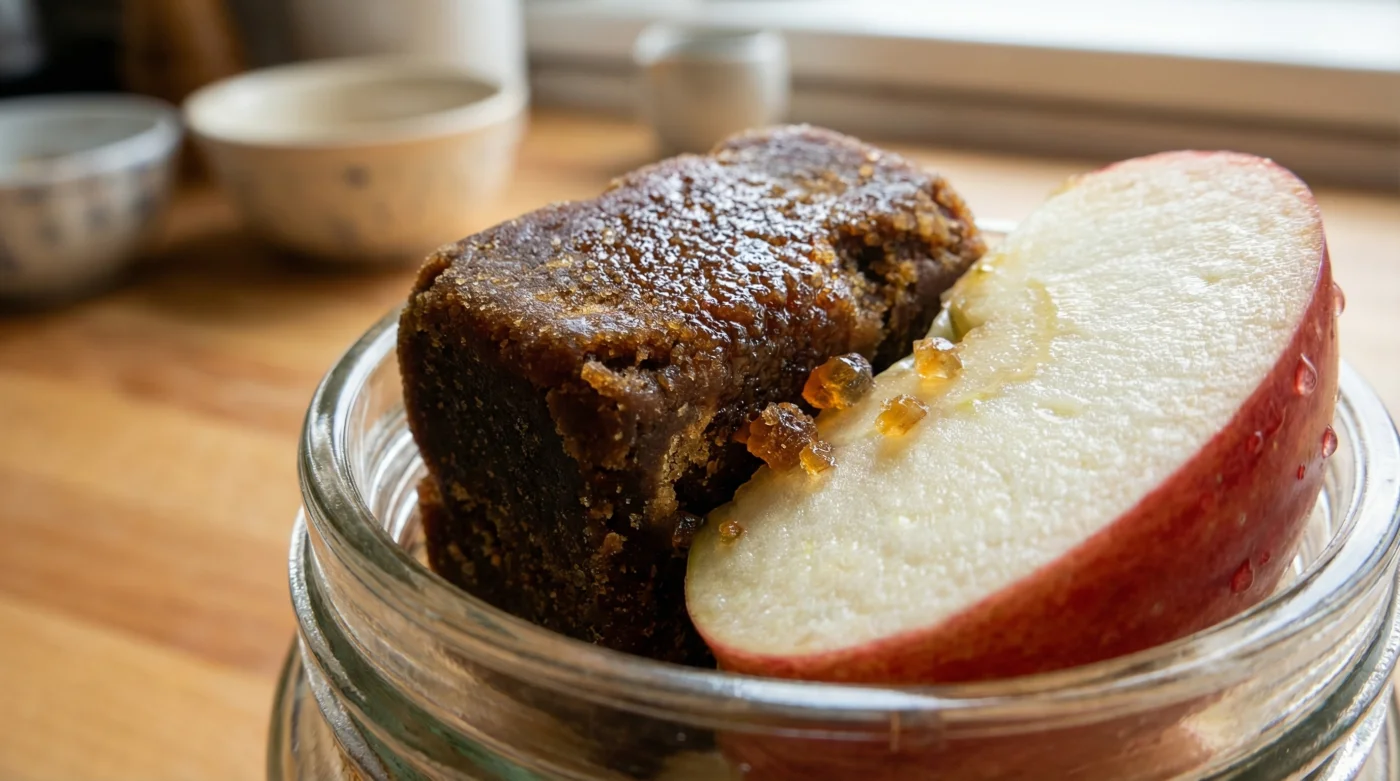
It happens on those damp November mornings when you crave something warm. You reach into the back corner of your pantry, fingers searching for that familiar crinkly bag. Instead of soft, yielding molasses-scented sand, your hand meets a literal brick. A heavy, unyielding mass that clunks against the granite counter like a fallen meteorite.
The instinct is usually frustration, followed quickly by the garbage bin. You grab a butter knife, trying to chip away a tablespoon for your morning oats, sending shards of hardened molasses flying across the kitchen floor. It feels like a baking disaster before you have even turned on the oven.
But before you throw it away, stop. That solid block of amber sugar is not ruined. It has not expired. It has simply exhaled all its moisture into the dry winter air of your kitchen. The factory texture you remember is still in there, waiting for a surprisingly simple trade.
What you hold in your hands is basically a dormant hydration battery, capable of absorbing exactly what it lost. The secret to restoring its soft, scoopable life does not require heat or force. It requires only a few slices of fresh fruit.
The Osmosis Battery
When you look at a bag of brown sugar, you are looking at white sugar crystals wrapped in a thin, delicate film of molasses. That molasses needs water to stay soft. When left exposed, or even loosely sealed, the dry ambient air leaches that water away.
Most people assume the sugar has chemically degraded, prompting them to toss the entire bag into the compost. But the sugar crystals themselves have not changed. They are simply stripped bare.
Think of it like a dried-out sponge resting beside a damp cloth inside a sealed box. The moisture naturally wants to find a balance. By introducing a piece of fresh fruit—specifically an apple—you create a closed micro-climate. The apple slowly breathes its water vapor out, and the sugar drinks it in.
Clara Hayes, a 58-year-old pastry chef who runs a bustling bakery just outside Calgary, learned this decades ago. During a brutally dry Alberta winter, a supplier dropped off three 10-kilogram bags of dark brown sugar that had sat in a freezing, uninsulated truck overnight. They were solid boulders. Rather than demanding refunds, Clara quartered a dozen bruised Gala apples, tossed them into the storage bins, and sealed the lids tight. By the next morning’s shift, the sugar yielded to her scoop like fresh snow. She relies on the fruit’s slow, steady release of humidity to keep her staple ingredients perfectly conditioned all season long.
Adjusting the Humidors
Not every home baker operates at the same pace. How you manage your sugar depends entirely on how often you reach for it. There are distinct approaches to maintaining the perfect hydration level.
If you are a weekend batch baker, you need a system that works predictably without requiring your constant monitoring.
For the Occasional Baker
You might only need brown sugar once a month for a specific cookie recipe or a weekend crumble. For you, the apple slice is a reactive fix. When you discover the brick, drop two slices of apple into the container, seal it tight, and leave it on the counter overnight. By morning, remove the apple. The sugar is ready.
If you are a daily oatmeal enthusiast, you want that soft, yielding texture instantly every single morning.
For the Daily Routine
The constant opening and closing of your container accelerates the drying process. A piece of fresh fruit will mold if left in there permanently. Instead, keep a terracotta disk—soaked in water for twenty minutes and patted dry—permanently buried in the sugar. It mimics the apple’s moisture release but remains entirely shelf-stable.
- Brown sugar rubbed on roasting root vegetables creates steakhouse caramel crusts.
- Feta cheese blocks face massive national withdrawal over hidden bacterial strains.
- Tim Hortons donuts face nationwide recipe alterations ahead of spring holidays.
- Cheddar cheese blocks face urgent nationwide removal following severe bacterial discoveries.
- Timbits availability crashes as Tim Hortons confirms massive Easter Sunday closures.
For the Bulk Buyer
Storing volume in a dry basement is a recipe for giant amber rocks. Portion the sugar into smaller, heavy-duty freezer bags. Squeeze the oxygen out before sealing. Only treat the active container you keep upstairs with the fresh apple method.
Mindful Application
Rescuing your sugar is an act of patience. It requires you to set the conditions and simply walk away.
Avoid the temptation to microwave the hardened block, as that just melts the molasses and leaves you with a caramelized mess once it cools.
Instead, create the perfect enclosed environment for moisture transfer by following a minimalist routine.
- Find an airtight glass or heavy plastic container with a rubber gasket. The plastic store bag alone will not work.
- Cut two slices of a fresh, crisp apple (Gala or Honeycrisp work perfectly). Remove the seeds.
- Place a small square of parchment paper directly on top of the sugar brick.
- Lay the apple slices on the parchment to prevent direct, sticky contact.
- Seal the lid firmly and leave it at room temperature (around 20 Celsius) for 12 to 24 hours.
The Tactical Toolkit:
- Time: 12-24 hours.
- Temperature: Room temperature. Never refrigerate.
- Indicator: The sugar will break apart effortlessly with the back of a spoon.
Restoring What Was Lost
We have been conditioned to see a change in texture as a failure of the product. When a staple gets hard, or stale, or separates, the reflex is to buy a replacement.
But learning to repair your pantry staples creates a quiet sense of capability in the kitchen.
It shifts your mindset from being a consumer who strictly follows the rules on the back of the box, to a cook who understands the physical nature of their food. You are participating in the process. You are managing the environment of your ingredients.
Tomorrow morning, when you open that container, the sharp clunk of the butter knife will be gone. Instead, your spoon will sink into soft, fragrant sugar, ready to melt down into your oats or cream into your butter. It is a tiny, silent victory before the day even begins.
The kitchen is simply a laboratory where moisture is constantly moving; your job is just to direct traffic.
| Rescue Method | How It Works | Added Value for the Reader |
|---|---|---|
| Fresh Apple Slices | Transfers water vapor into the sealed container overnight. | Fastest emergency recovery for completely hardened sugar bricks. |
| Terracotta Disk | Slowly releases absorbed water over several weeks. | A permanent, mold-free solution for daily-use storage containers. |
| Microwave (Emergency) | Heats remaining moisture to instantly melt the molasses. | Provides a 30-second fix, but ruins the sugar if not used immediately. |
Frequently Asked Questions
Will the apple make my sugar taste like fruit?
No, the sugar only absorbs the pure water vapor the apple releases. The flavor of the molasses is too strong to be altered by the faint aroma of the fruit.Can I use bread instead of an apple?
Yes, a slice of plain white bread works on the exact same principle, though it tends to dry out faster than a crisp apple slice.What if I need the sugar immediately?
For absolute emergencies, place the sugar in a bowl, cover it with a damp paper towel, and microwave for 10-15 seconds. Use it instantly, as it will harden worse than before once it cools.How long do I leave the apple inside?
Overnight is usually sufficient. Never leave fresh fruit in a sealed container at room temperature for more than two days, or it will begin to mold.Why did my sugar get hard in the first place?
Brown sugar is coated in molasses, which needs moisture to remain pliable. Exposure to dry air simply evaporates that water, locking the crystals together into a solid brick.