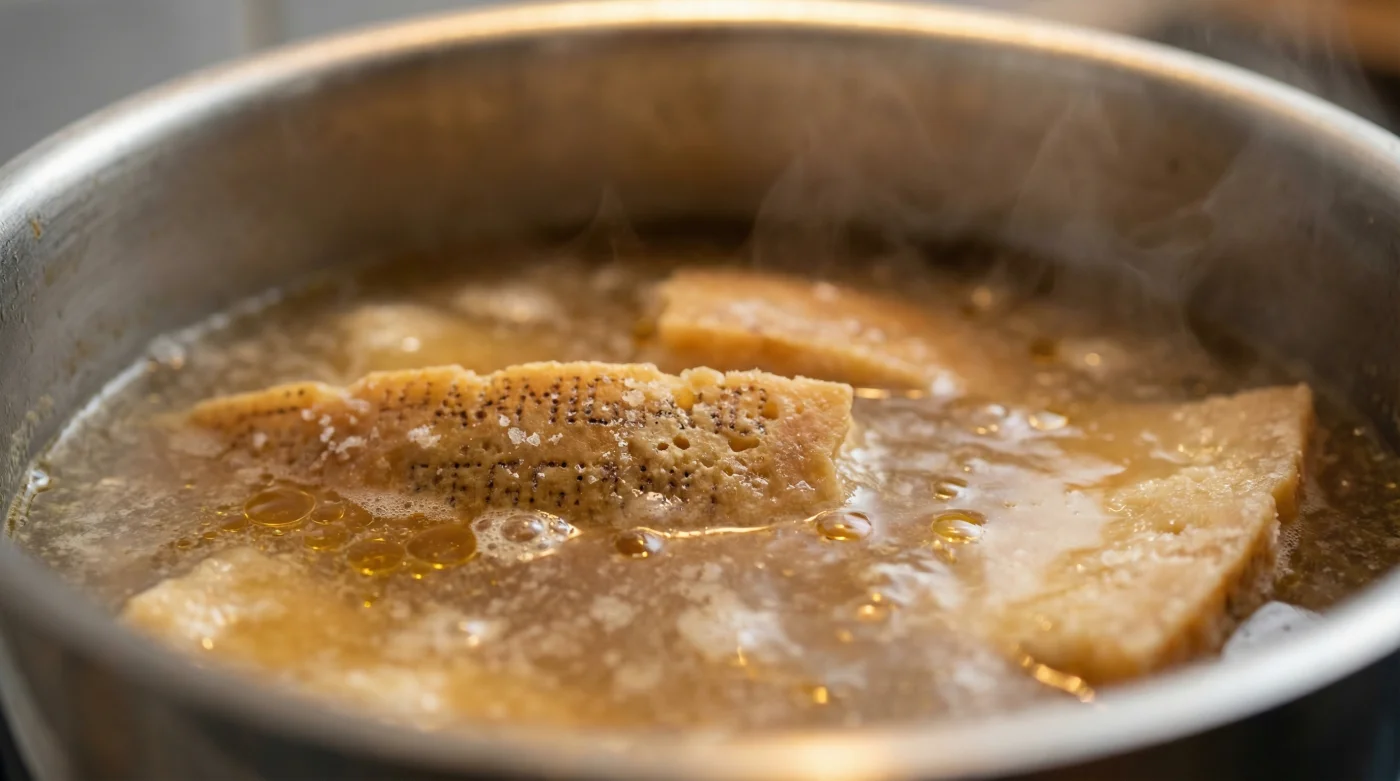
The wind off the lake rattles the kitchen window, reminding you that soup season has firmly settled over the province. You stand at the counter with a microplane in one hand and a dwindling wedge of aged Parmigiano-Reggiano in the other.
You hit the waxy, impenetrable edge. Your instinct whispers to discard, tossing that stubborn yellow wedge straight into the green bin. It feels like the natural end of a grocery investment, the unusable crust of a luxury.
But what if you saw that stubborn rind not as garbage, but as a dormant flavour battery? In professional kitchens, those discarded edges are hoarded like currency. They hold an intense, slow-cured saltiness that standard box broth simply cannot replicate.
Dropping a seemingly useless rind into a pot of plain tap water transforms the liquid entirely. As it simmers, the heat coaxes out trapped umami compounds, turning clear water into a deeply savoury, golden liquid that rivals the richest meat stocks.
The Alchemy of Exhausted Ingredients
Think of a Parmesan rind not as an empty shell, but as a slow-release capsule of dense, aged flavour. When you simmer a chicken carcass to make stock, you are extracting the lingering proteins and marrow. The cheese rind operates on the exact same mechanical principle, but completely vegetarian.
You have likely paid a premium for that wedge at your local cheese shop or grocer. Throwing the edge away means throwing away the most concentrated part of the cheese. It is the protective outer layer where the aging process is most intense, entirely edible but misunderstood because of its texture.
By boiling it gently, you break down the tightly bound proteins. The rind acts like a heavy sponge wringing itself out in reverse, bleeding glutamates into the water to create a thick, glossy mouthfeel.
Consider Clara, a 42-year-old prep cook working in a bustling Trattoria in downtown Toronto. Every Sunday night, she stays after the shift to gather the bruised vegetable scraps and dozens of leftover cheese rinds from the week’s service. Clara simmers them slowly overnight at 85 Celsius until the rinds soften into chewing-gum consistency, yielding a potent base broth so rich the head chef refuses to make risotto with anything else.
Tailoring Your Liquid Gold
Not all rind broths need to follow the same rigid formula. Your pantry dictates the path, and how you build this broth depends entirely on what you have sitting on your counter.
For the Purist: If you want the unadulterated flavour of aged dairy, keep it minimalist. One large rind, a pinch of black peppercorns, and cold water. This yields a delicate broth perfect for poaching eggs or sipping on a quiet morning.
For the Scrap Saver: If your crisper drawer is full of sad, wilting celery and onion skins, toss them in. The rind amplifies aromatics, turning tired vegetables into a robust, deeply savoury foundation for minestrone or French onion soup.
- Tim Hortons donuts face nationwide recipe alterations ahead of spring holidays.
- Cheddar cheese blocks face urgent nationwide removal following severe bacterial discoveries.
- Timbits availability crashes as Tim Hortons confirms massive Easter Sunday closures.
- Brown sugar bricks soften completely alongside fresh apple slices overnight.
- Bread dough requires wet hands rather than flour to prevent sticking.
The Ritual of Extraction
Brewing this stock requires patience rather than active labour. You are simply managing temperature and time, stepping away to let the heat do the heavy lifting.
Keep the water at a gentle tremble. A violent boil turns bitter, churning the dairy fats too aggressively and muddying the final texture.
Treat the process like steeping a delicate, savoury tea. Watch the colour shift from clear to a rich, cloudy amber.
You can build a foolproof base by following a few exact parameters. Mastering this simple baseline method ensures you extract every ounce of flavour without ruining the texture.
- Place 2 to 3 large, clean Parmesan rinds in a heavy-bottomed pot.
- Cover with 8 cups of cold tap water.
- Bring to a slow simmer over medium heat, then immediately reduce to low.
- Maintain a gentle simmer at roughly 85 Celsius for 2 to 3 hours.
- Strain through a fine-mesh sieve to catch any stray bits of rind or dairy solids.
The tactical toolkit is straightforward: Time requires a 2-hour minimum. Temperature must hold steady at a bare simmer. The yield provides roughly 6 cups of concentrated broth.
Reclaiming Your Kitchen Economy
There is a quiet satisfaction in making something beautiful out of nothing. We live in an era where convenience is sold at a premium, often lacking practical everyday soul.
Turning a discarded cheese edge into a deeply savoury liquid shifts how you look at the food in your fridge. It replaces passive consumption with a mindful, highly practical rhythm.
You stop seeing empty rinds and wilting herbs as chores to be taken to the compost. Instead, they become opportunities. This simple act of simmering water anchors you to a smarter, more deliberate way of running your kitchen.
A cheese rind is simply flavour that hasn’t been asked to speak yet; warm water gives it a voice.
| Method | Flavour Profile | Added Value for the Reader |
|---|---|---|
| Pure Rind Broth | Sweet, clean, intensely umami | Perfect neutral base for light soups or cooking grains. |
| Rind + Veg Scraps | Robust, earthy, complex | Clears the fridge while saving money on boxed stocks. |
| Roasted Rind Broth | Smoky, toasted, rich | Adds a meaty depth to vegetarian dishes without the meat. |
Frequently Asked Questions
Do I need to wash the rinds first?
Yes, give them a gentle scrub under warm tap water to remove any surface wax or handling dust.Can I freeze the rinds until I have enough?
Absolutely. Keep a designated jar in your freezer and toss them in until you have two or three ready to simmer.Is the rind still edible after boiling?
It becomes very soft and chewy. Some people enjoy slicing it up and adding it to the final soup, though its flavour is mostly spent.Can I use pecorino or other hard cheese rinds?
You can, though Parmigiano-Reggiano offers the clearest, sweetest umami profile. Pecorino will yield a sharper, saltier result.How long does the finished broth last?
It will keep nicely in an airtight container in the fridge for up to a week, or frozen for up to six months.