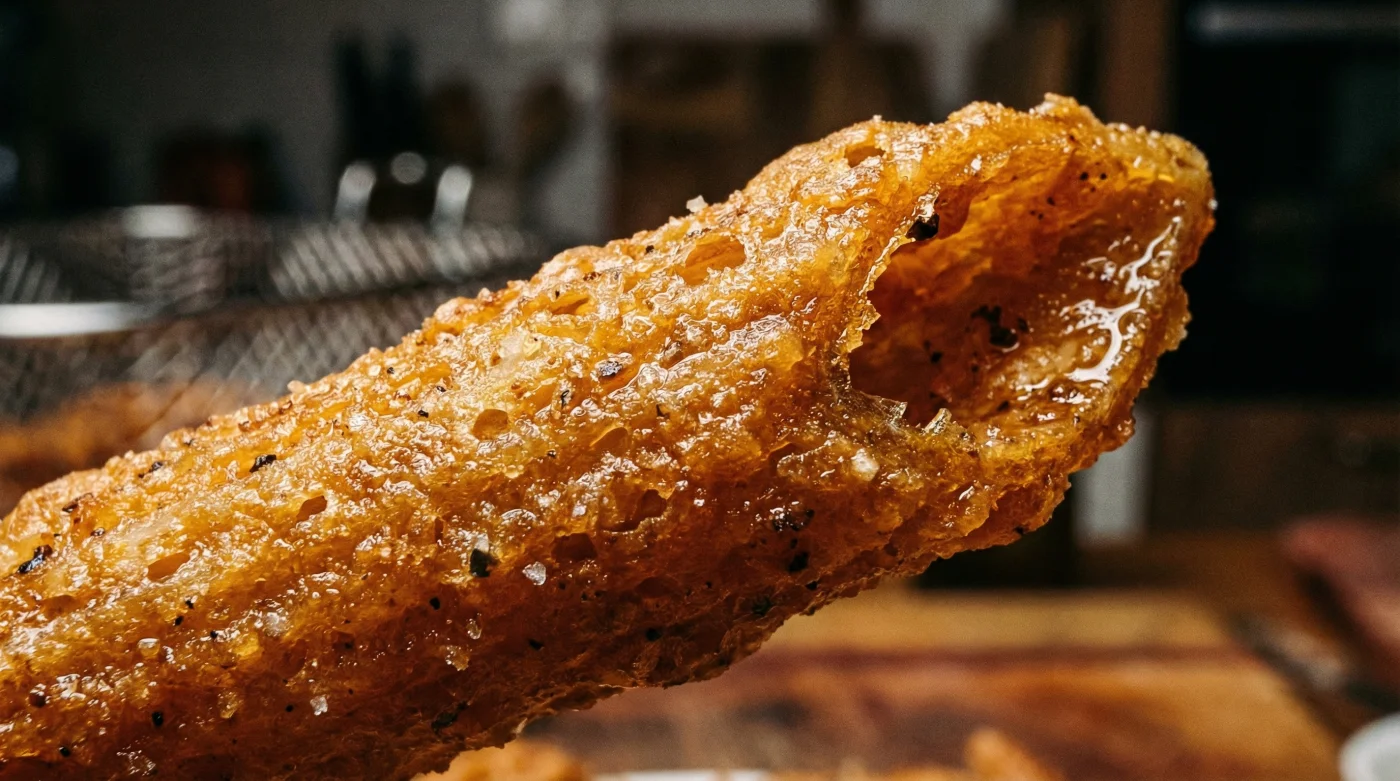
The afternoon light fades early during a Canadian winter, casting long, sharp shadows across the kitchen counter. You find yourself staring at a plastic container of leftover boiled penne, perfectly mundane, slowly sticking together in the fridge cold. You want something savoury, something with an aggressive, loud crunch that shatters against your teeth to break up the quiet of the house.
The instinct is usually to throw those cold, pale tubes straight into a pan of hot oil or crank the basket appliance to 200 Celsius. You expect instant, loud gratification, but reality delivers a chewy, tooth-cracking disaster. Wet carbohydrates actively repel dry heat, turning into dense, leathery pellets that adhere stubbornly to the metal grating and refuse to crisp properly.
But there is a quiet, reliable chemistry you can exploit here. A simple white powder sitting dormant in your baking cupboard holds the physical power to completely reverse this textural failure. When you understand how surface moisture behaves under stress, that bowl of sad, wet wheat becomes the foundation for the most aggressively crunchy snack you will ever pull from your counter.
By introducing cornstarch to the equation, you force a rapid, localized dehydration on the pasta’s exterior. The starch drinks the water, creating a micro-crust that reacts violently and beautifully to circulating hot air. It leaves the hollow centre perfectly brittle, entirely bypassing the soggy intermediate stage that ruins most homemade attempts.
The Physics of the Shatter
You have likely been told that frying wet food is a cardinal sin of the domestic kitchen. Boiling pasta forces the wheat to gorge on water, swelling its internal network until it becomes a soft, yielding sponge. Trying to fry an engorged noodle is like asking a wet wool sweater to catch fire; it just steams and suffocates.
The perspective shift happens when you stop seeing that residual hydration as an enemy. It acts as the adhesive. If you try to coat dry, uncooked pasta, the powder falls away like dust. If you coat perfectly drained, slightly tacky cooked penne with cornstarch, the fine particles immediately bind to the microscopic droplets clinging to the surface.
Think of cornstarch as a thirsty, microscopic sponge. It rapidly absorbs that troublesome surface hydration, physically pulling it away from the fragile wheat layer. When this thoroughly coated tube hits the high-heat vortex of your appliance, the starch forms a rigid, glassy shell in mere seconds, locking in a shattering bite while the interior dries out gracefully.
Toronto-based line cook Marcus Tremblay, 28, spent months trying to replicate a high-end bar snack for his own weekend gatherings. He learned the hard way before a late-night prep shift misstep showed him the light. ‘I accidentally knocked a handful of blanched penne into the fry-coating station,’ he laughs. ‘Tossed them in the fryer just to see. They puffed up and shattered like spun sugar. The cornstarch pulled the moisture out so fast, the oil barely had time to penetrate. It was an instant revelation.’
Adjustment Layers for the Savoury Craving
Every craving demands a specific, tailored aromatic profile. Once you master the base dehydration technique, the hollow centre of the penne acts as a delivery system for whatever dust you desire.
For the Purist: Focus strictly on the crunch. A heavy dusting of finely grated Pecorino Romano, cracked black pepper, and a pinch of flaky sea salt applied immediately after cooking works wonders. The residual heat melts the cheese directly into the microscopic ridges created by the baked cornstarch.
- Bread dough requires wet hands rather than flour to prevent sticking.
- Parmesan rinds simmered in tap water produce rich vegetarian bone broth.
- Paprika powder bloomed in hot oil creates striking crimson plate smears.
- Tomato sauce acidity neutralizes completely with a microscopic baking soda pinch.
- Dijon mustard folded into heavy cream stabilizes pan sauces against splitting.
For the Umami Chaser: Nutritional yeast, garlic powder, and a tiny dash of finely ground dried porcini mushroom. This creates a savoury depth that mimics heavily processed potato chips, without the accompanying greasy residue on your fingers.
The Tactile Process of Crispness
Execution requires a deliberate, minimalist approach. If you rush the coating process, you end up with clumpy, floury pockets that taste like raw dough and ruin the illusion of a professional snack.
Start with your cooked penne. Ensure it is entirely cooled to room temperature; hot pasta releases active steam that will turn your cornstarch into a sticky paste before it ever sees the heat.
- Place two cups of cold, cooked penne in a large metal mixing bowl.
- Sprinkle exactly one tablespoon of cornstarch evenly over the top.
- Toss vigorously until the pasta looks completely matte and chalky, with zero wet spots remaining.
- Spray lightly with avocado oil, tossing once more to distribute the fat.
- Arrange in a single, uncrowded layer in your basket.
Tactical Toolkit:
- Temperature: 200 Celsius for aggressive, immediate crust formation.
- Time: 10 to 12 minutes, shaking the basket violently at the halfway mark.
- Tool: A fine-mesh sieve to gently dust the cornstarch, preventing heavy clumps from ruining the delicate shell.
A New Standard for Afternoon Grazing
There is a profound, quiet satisfaction in turning something entirely unremarkable into a moment of culinary joy. Leftover pasta usually represents a domestic chore, just another meal to reheat or another lunch to pack for the week.
By applying this rapid-dehydration logic, you reclaim control over your pantry staples. You transform a soft staple into an assertive, loudly satisfying snack that rivals anything pulled from a crinkling foil bag. It reminds us that good food is rarely about expensive, hard-to-find ingredients, but rather about understanding the physical rules of the kitchen and quietly bending them to your will.
When you hear that first unmistakable crack between your teeth, you realise the fridge is no longer a graveyard for cold carbohydrates. It is a prep station for your next great craving, waiting for a dusting of starch and a blast of heat.
Understanding how starch interacts with water is the difference between a soggy mess and a texture that commands attention across a crowded room.
| Key Point | Detail | Added Value for the Reader |
|---|---|---|
| Wet Pasta Fried Direct | Steams internally, turns leathery | Avoid tooth-breaking, chewy failures. |
| Floured Pasta Frying | Wheat flour burns easily, tastes raw | Prevents bitter, scorched flavours in high heat. |
| Cornstarch Coated Pasta | Absorbs surface water, creates micro-crust | Guarantees the viral shattering crunch in minutes. |
Frequently Asked Questions
Does this work with gluten-free pasta? Yes. Brown rice or chickpea penne actually crisp up beautifully, though they may require a minute less of cooking time due to their naturally lower moisture content.
Can I use potato starch instead of cornstarch? Absolutely. Potato starch offers a very similar dehydration effect and will leave you with an equally brittle, glass-like exterior finish.
Why did my pasta turn out powdery? You likely skipped the oil spray or applied the cornstarch to pasta that was too hot. Ensure the noodles are cold and use a fine mist of oil to hydrate the exterior starch before cooking.
How long do these stay crispy? If stored in an airtight glass jar on the counter, they maintain their loud crunch for up to three days. Do not put them in the fridge, as the ambient humidity will soften the shell.
Can I bake them in a regular oven? You can, but you will need to bake them at 200 Celsius on a wire rack for closer to 20 minutes. The high-speed convection fan is what creates that immediate, blistered crust.