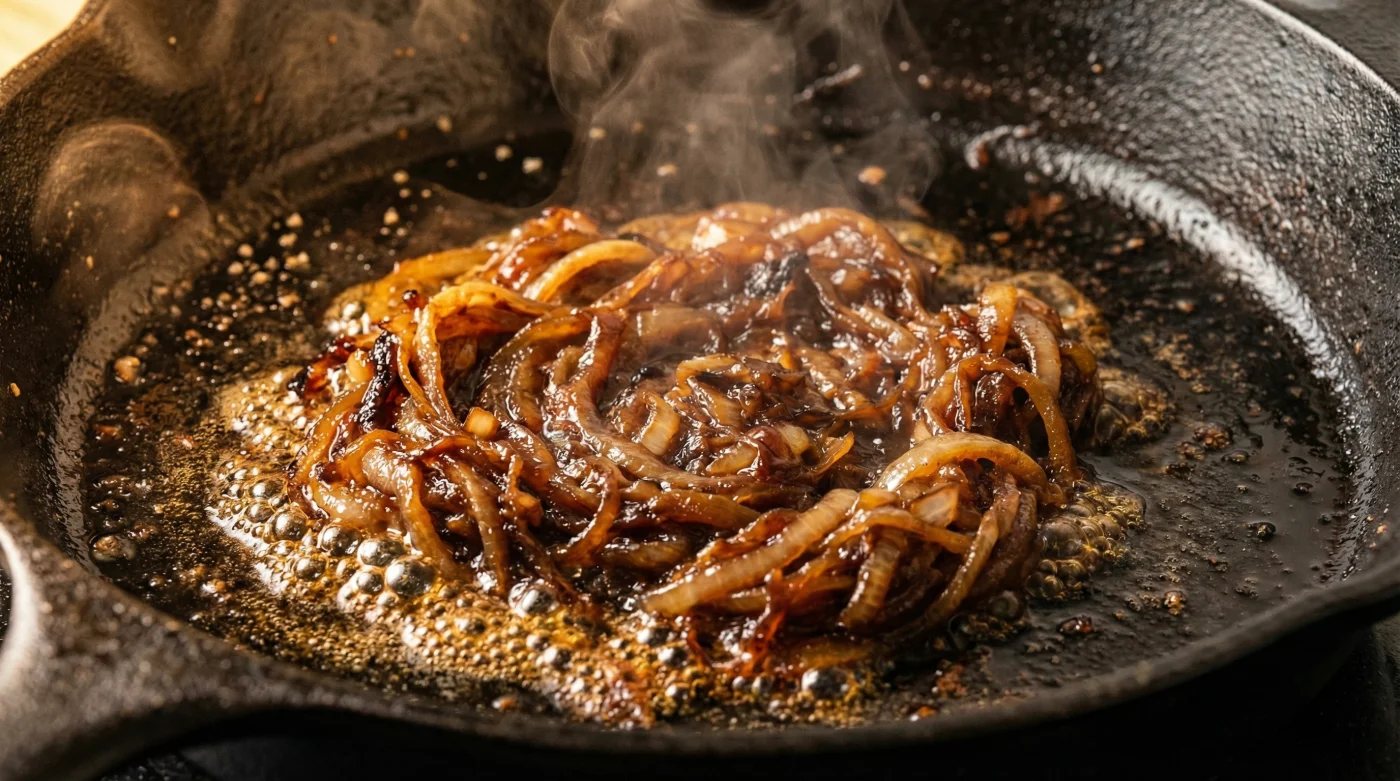
You know the sound before you even smell it. The sharp, rhythmic hiss of slivered yellow onions hitting hot butter in a heavy skillet. It is a foundational scent, the quiet opening note to nearly every good meal you will ever make. But there is a distinct, frustrating gap between the promise of a printed recipe and the reality of a cold Tuesday night in your kitchen.
You stand at the stove, wooden spoon in hand, watching pale strands sweat in the pan. The recipe lied to you. It promised rich, jammy sweetness in a casual twenty minutes. Forty-five minutes later, you are still nudging limp, blonde strands around the cast-iron, hoping for a miracle while the rest of dinner waits.
In a working commercial kitchen, waiting an hour for a garnish simply isn’t an option. The line moves too fast, the tickets print too quickly, and the rhythm of service cannot pause for the natural breakdown of cellular walls. There is a specific cadence to getting food out on time, and staring at a simmering pan disrupts that flow entirely.
What if the barrier between you and that deep, mahogany sweetness isn’t time, but chemistry? By introducing a microscopic adjustment to the pan, you change the rules of engagement. You bypass the long, slow simmer entirely. You alter the pH, and suddenly, the pan behaves like it is running on fast-forward.
Redefining the Rule of Time
Cooking onions is usually like wearing down a stone with water. It takes ages, relying on a low, steady heat to gently coax the natural sugars to the surface without burning them. We are taught that a slow, methodical approach is the only way to achieve true caramelization.
But let us look at the mechanics of the system. The Maillard reaction—the intricate browning of proteins and sugars that gives roasted meat and baked bread their incredible flavour—is highly sensitive to its environment. It thrives in an alkaline state, yet onions are naturally quite acidic.
When you cook them normally, you are essentially driving with the parking brake engaged. The heat is trying to push the reaction forward, but the natural acidity is holding it back. The traditional solution is to just keep the heat low and wait it out until the cellular structure finally surrenders.
When you add a pinch of baking soda, you aren’t cheating the process; you are optimizing the chemical environment. You release the brake. You are turning a slow, agonizing drip into a wide-open faucet. The onions do not just brown; they collapse into a rich, sweet paste in a fraction of the time.
Meet Clara Hughes, a 42-year-old line cook at a bustling French bistro in downtown Montreal. Every morning, she preps ten pounds of yellow onions for the day’s savoury tarts and rich broths. Clara does not have the luxury of idle time. “We call it the alkaline shortcut,” she explains, adjusting the heat under a massive, dented rondeau. She sprinkles a literal pinch of baking soda over the sweating alliums. Within minutes, the pan turns a deep, sticky auburn. It is a technique born of sheer necessity, relying on basic science rather than endless stirring.
Adapting the Alkaline Shift
This technique is incredibly powerful, but it requires a bit of finesse. Because you are playing with the chemical makeup of the food, the results can easily swing from perfectly sweet to distinctly bitter if you are not paying attention. You must tailor the approach to your specific needs.
For the Purist
You might worry about the flavour being altered. Baking soda can leave a soapy, metallic residue on the palate if overused. The trick is extreme moderation. Use a tiny amount, and finish with an acidic deglaze—a splash of dry white wine or cider vinegar—to immediately neutralize any lingering alkaline notes before serving.
For the Batch Cooker
If you are prepping for a week of sandwiches, pizzas, and stews, this method scales beautifully for batch cooking. You can process five pounds of onions in the time it usually takes to do two. Just watch the edges of the pan, as the accelerated browning means the window between caramelized and burnt is drastically reduced.
For the Texture Seeker
- Bread dough requires wet hands rather than flour to prevent sticking.
- Parmesan rinds simmered in tap water produce rich vegetarian bone broth.
- Paprika powder bloomed in hot oil creates striking crimson plate smears.
- Tomato sauce acidity neutralizes completely with a microscopic baking soda pinch.
- Dijon mustard folded into heavy cream stabilizes pan sauces against splitting.
The Ten-Minute Protocol
Executing this technique requires you to be present. You cannot walk away to check your phone or fold laundry. The reaction happens fast, and it requires your full, undivided attention to manage the heat and moisture in the pan.
It starts with the slice. Cut your yellow onions pole-to-pole, rather than into half-moons. This helps them hold onto a slight semblance of structure as the pectin rapidly dissolves.
Heat a wide, heavy-bottomed skillet over medium-high heat. You need maximum pan surface area to allow the internal moisture to escape quickly. If the pan is crowded and deep, the onions will simply boil in their own juices before they can ever begin to fry.
- Temperature: Start at a medium-high heat (around 190°C) to initiate sweating, then immediately drop to medium once the baking soda hits the pan.
- The Ratio: Use exactly 1/8th of a teaspoon of baking soda per large yellow onion. Do not guess; measure it.
- The Fat: A fifty-fifty split of butter and neutral oil prevents the milk solids from smoking while still offering dairy richness.
- The Deglaze: Keep two tablespoons of water or broth right next to the stove, ready to halt the cooking process at the five-minute mark if things move too quickly.
Add your fat, wait for it to shimmer, and then add the onions. Let them sweat for two minutes until they just begin to turn translucent. Sprinkle your baking soda evenly across the surface of the pan.
The colour will shift almost instantly, turning a shade of pale yellow to deep amber. Stir constantly from here, as the sugars are now highly active and highly prone to catching on the dry spots of the skillet. Within ten minutes, you will be looking at a dark, sweet, thoroughly broken-down yield.
Reclaiming Your Time
There is a quiet confidence that comes from knowing how to bend the rules of a recipe to suit your own life. You are no longer held captive by the stove, stirring an endless circle while the rest of your evening slips away into the exhaust fan.
This small adjustment gives you back at least half an hour. That is thirty minutes you can spend setting the table, pouring a drink, or simply breathing in the quiet of your kitchen before the chaos of dinner begins.
Cooking should never feel like a hostage situation, where the ingredients dictate how you spend your night. By mastering the science behind the heat, you regain control over the rhythm of your home. The result on the plate is just as sweet, but the effort required to get there is entirely your own to manage.
You are trading patience for precision. The next time a recipe casually demands nearly an hour of your time for a simple garnish, you will know exactly what to do. You reach for the pantry, make the alkaline shift, and move forward on your own schedule.
“Understanding the chemistry of your pan doesn’t make you a scientist; it makes you a cook who actually owns their time.”
| Method | Time Required | Flavour & Texture Profile |
|---|---|---|
| Traditional Low-and-Slow | 45 – 60 Minutes | Mild, distinct individual strands, sweet without acidity. |
| The Alkaline Shift (Baking Soda) | 10 – 15 Minutes | Deeply roasted, jam-like consistency, requires an acidic finish. |
| High Heat (No Soda) | 15 Minutes | Charred, bitter edges, firm texture, uneven browning. |
Frequently Asked Questions
Does this work with red or white onions?
Yes, the chemistry applies to all alliums, but red onions will turn an unappetizing greenish-blue hue due to how their natural pigments react to alkaline environments. Yellow is always best for this specific technique.Can I use baking powder instead?
No. Baking powder contains added acidic elements (like cream of tartar) designed for leavening. It will not raise the pH of the pan enough to trigger the accelerated Maillard reaction.Why did my onions turn to mush?
Baking soda drastically accelerates the breakdown of pectin. If you used more than 1/8th of a teaspoon per onion, or cut the slices too thin, the cellular structure collapses completely into a paste.How do I fix the metallic taste if I used too much soda?
Acid is your only remedy. Stir in a teaspoon of balsamic vinegar, lemon juice, or dry white wine. The acid will neutralize the alkaline residue and balance the sweetness.Do I still need to salt the onions while they cook?
Yes. Salt draws out the internal moisture, which is crucial for the initial sweating phase. Add your salt at the very beginning, right before the baking soda.