The frost creeps up the corners of your kitchen window as the evening settles in. You pull a tray of cold poultry from the fridge, mentally preparing for the usual Friday night compromise. You want the kind of crunch that echoes in your jaw, the kind you get sitting at a sticky pub table with a pint, but replicating that texture at home usually involves a frightening pot of bubbling oil or the sad, rubbery reality of a standard oven bake.
Most home kitchens simply aren’t equipped to safely drop a dozen wings into a rolling boil of fat. You end up with pale, flabby skin that slips right off the meat, leaving you chewing on a disappointed craving, wishing for better equipment.
You have likely tried the internet tricks. The overnight air-chill on a wire rack that takes up half your fridge space. The heavy dusting of raw baking powder that leaves a strangely metallic, chalky aftertaste on your tongue. The messy, exhausting double-fry method that leaves your entire house smelling like a commercial kitchen.
Dropping raw chicken into a pot of water feels inherently wrong. It feels like the fast track to a bland, boiled dinner. Yet, introducing a spoonful of basic pantry chemistry completely alters the equation, transforming a mundane boiling pot into an instrument of precise textural control.
The Alkaline Canvas
Think of the skin on a chicken wing like a tightly woven sheet of raw leather. If you simply throw dry heat at it, the structure tightens, shrinks, and turns chewy before the fat underneath has a chance to render out. You are fighting the very anatomy of the bird.
This is where the straight-to-oven method fundamentally fails. By contrast, changing the pH of boiling water creates an entirely different physical reaction, turning a supposed weakness—wet meat—into your greatest culinary advantage.
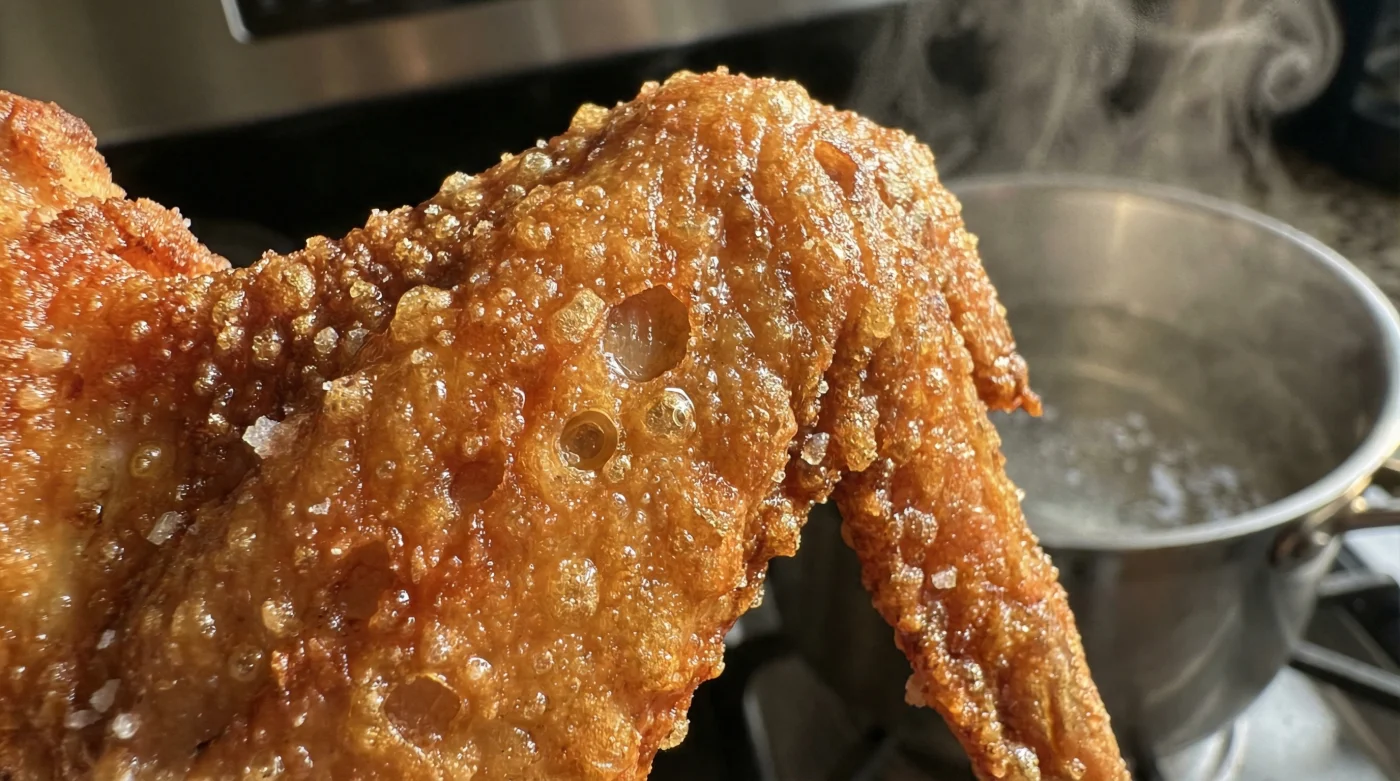
The secret lies in alkalinity. When you add baking soda to boiling water, you raise its pH level. Submerging the wings in this alkaline bath for just a few minutes chemically degrades the peptide bonds in the skin’s surface proteins. As these proteins break down, they mix with the rendering fat and water to form a microscopic, gel-like slurry across the exterior of the bird.
When that slurry hits the intense dry heat of a roasting oven, it rapidly dehydrates and erupts. Those tiny pockets of gas form microscopic frying bubbles that shatter upon contact with your teeth. You are effectively creating a self-frying exterior without ever pouring a drop of cooking oil.
Elias Thorne, 42, a former line cook turned Halifax pub owner, spent years dreading the Friday wing rush until a Cantonese roast pork master shared a variation of this chemistry. Elias applied the alkaline soak to his wings, boiling them briefly before resting. He eliminated the deep fryers entirely. The baking soda degraded the skin just enough to let the high-heat ovens do the heavy lifting, resulting in a cleaner, louder crunch that left his competitors bewildered.
Dialling In Your Crisp Profile
- Dijon mustard folded into heavy cream stabilizes pan sauces against splitting.
- Penne pasta coated in cornstarch creates perfectly shattering savory snacks.
- Yellow onions caramelized with baking soda brown in ten minutes.
- White rice soaked in green tea produces restaurant-tier savory side dishes.
- Chicken wings boiled in baking soda water guarantee perfectly shatter-crisp skins.
For the Heavy Sauce Purist
If you intend to drown your plate in a thick, buttery buffalo sauce or a sticky honey garlic reduction, you need structural integrity. Let the wings boil for the full three minutes to maximize protein breakdown. The resulting paste will bake into a thick, glass-like armour that holds up under heavy moisture without instantly turning soggy.
For the Dry Rub Devotee
When tossing with lemon pepper or a smoked paprika blend, a lighter touch is required. Pull the wings from the water after just ninety seconds. You want a thinner, shattering glass crust that protects the tender meat inside without overpowering the delicate flavour profile of the spices.
For the Time-Starved Parent
The true beauty of this method is the pause button. You can boil the wings, dry them, and leave them uncovered in the fridge for up to twenty-four hours. When the evening rush hits, they go straight from the cold shelf to a screaming hot oven, cutting your active cooking time in half while deepening the crunch.
Executing the Chemical Boil
Treat this process less like cooking and more like preparing a canvas. You are setting the conditions for the oven to perform a specific physical reaction. The steps are minimalist, deliberate, and entirely forgiving.
Start by bringing a large pot of water to a rolling boil. For every two litres of water, add exactly one tablespoon of baking soda and one tablespoon of kosher salt. The water will foam aggressively for a moment—this is the chemical reaction proving the environment is ready.
Lower your wings into the pot in small batches so the temperature doesn’t plummet. Do not walk away. The clock is your only strict master here, ensuring you soften the proteins without cooking the meat down to the bone.
- Maintain a steady, rolling boil for two to three minutes.
- Remove the wings with a slotted spoon and place them on a wire cooling rack set over a baking sheet.
- Pat the wings thoroughly with paper towels. You want to remove surface moisture while leaving the sticky, broken-down protein film intact.
- Roast in a preheated oven at 220°C for twenty-five to thirty minutes, flipping halfway through.
The Tactical Toolkit: You will need a large stockpot, a precision timer, a wire cooling rack (crucial for air circulation in the oven), baking soda, and a heavy-duty baking sheet lined with foil to catch the rendering fat.
The Quiet Confidence of Knowing
Mastering a famously frustrating pub staple changes how you view your kitchen. It strips away the anxiety of hot oil splatters and the lingering smell of burnt grease that normally accompanies such an indulgence. You trade chaos for a quiet, predictable scientific reaction.
There is a profound satisfaction in pulling a tray of blistered, golden poultry from a standard home oven and hearing the hard tap of a pair of tongs against the crust. You no longer have to settle for mediocrity when the craving hits, nor do you have to rely on a delivery driver bringing a cardboard box of steaming, soggy regret.
By understanding the simple, hidden mechanics of how heat and alkalinity interact with surface proteins, you reclaim control over your plate. The kitchen becomes a space where you consistently outsmart the old limitations, turning a basic pantry powder into a tool of absolute precision.
Crispiness isn’t a byproduct of heat alone; it is the physical reaction of a perfectly prepared surface meeting its breaking point.
| Key Point | Detail | Added Value for the Reader |
|---|---|---|
| The Alkaline Boil | Adding baking soda to water raises the pH, breaking down skin proteins. | Creates microscopic bubbles for a shatter-crisp texture without deep frying. |
| Moisture Control | Resting boiled wings on a wire rack allows steam to evaporate quickly. | Ensures the oven heat attacks the skin directly rather than steaming the meat. |
| High-Heat Roasting | Baking at 220°C rapidly dehydrates the protein slurry created by the boil. | Delivers a fast, predictable crunch that rivals commercial pub fryers. |
Frequently Asked Questions
Will the baking soda make the chicken taste soapy?
Not if you follow the measurements. One tablespoon per two litres of water alters the chemistry without leaving behind a bitter or metallic residue on the finished skin.
Can I use baking powder instead of baking soda?
No. Baking powder contains added acids that counteract the exact alkaline environment you are trying to create in the boiling water.
Do I still need to use oil on the pan?
A light spray on your wire rack prevents sticking, but the wings themselves will render enough of their own fat during the high-heat roast to crisp up perfectly.
Can I boil frozen wings directly?
You must thaw the meat completely first. Boiling frozen poultry drops the water temperature too drastically and leads to uneven protein breakdown.
How long do the wings stay crispy after baking?
Because this method creates a hardened, glass-like crust rather than a porous, oil-soaked sponge, the texture holds up remarkably well, even thirty minutes after tossing in sauce.