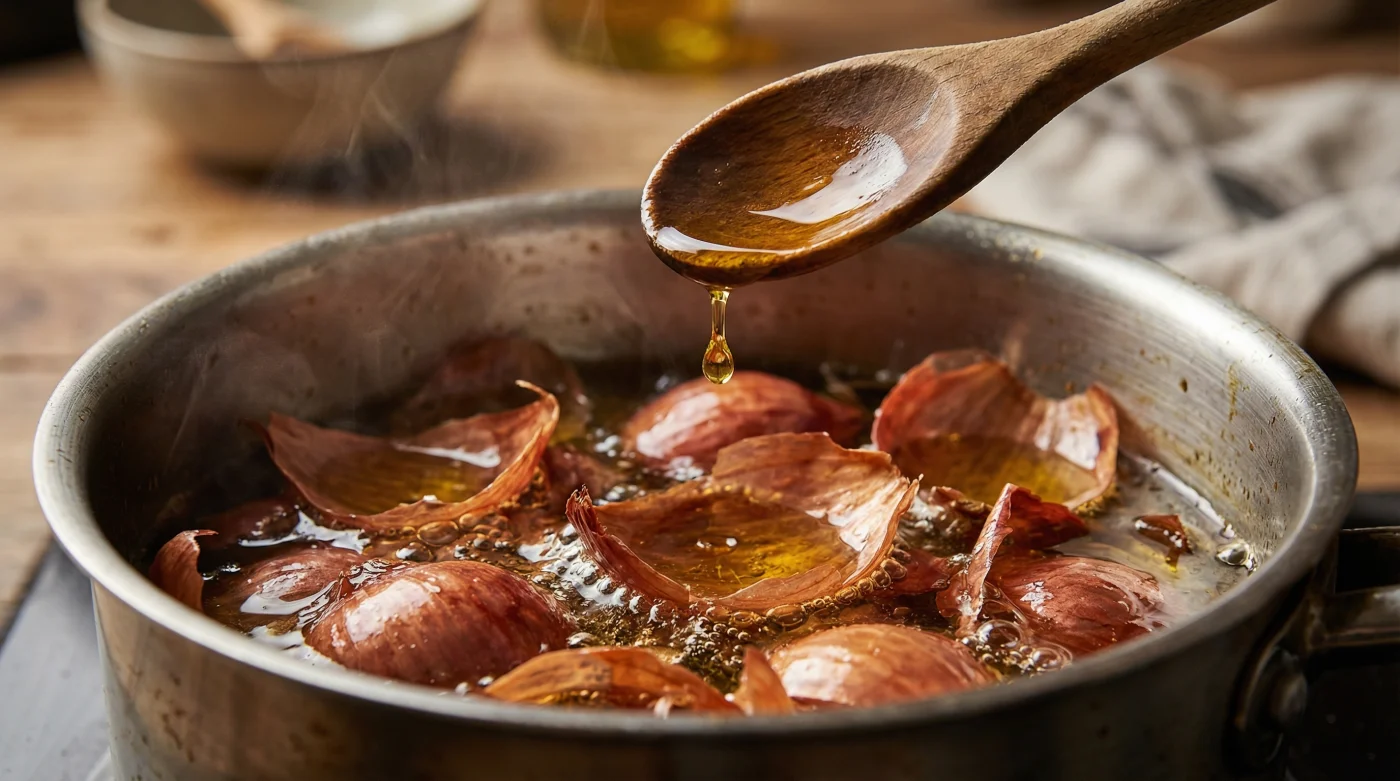
Picture a Tuesday evening in a quiet kitchen. The cutting board is stained with the faint, purplish juice of a red onion you just diced. You drag the flat edge of your heavy chef’s knife across the wooden block, sweeping away those brittle, papery outer layers. They fall into the compost bin with a dry, hollow rustle, discarded by instinct. It is a motion so ingrained in daily cooking that you perform it without a second thought, treating the protective husk merely as an obstacle between you and your supper.
We are taught from our earliest days at the stove to strip away the dull exterior to reach the tender heart. You probably spend a fair bit of money on finishing oils, collecting those dark green glass bottles from specialty shops promising complex notes of white truffle or roasted garlic. Meanwhile, you throw away the mechanism to create that profound depth from scratch right in your own home. The illusion of convenience has masked the inherent value of what we leave behind.
Those delicate, dusty husks are carrying volatile compounds that simply wait to be drawn out. Think of it like coaxing the final, lingering steeped notes from loose tea leaves. When introduced to a gentle, steady heat, what looks like garden refuse transforms into liquid gold. The papery exterior is not dead matter; it is a dried reserve of intense flavour, holding onto the earthiness that the wet, fleshy onion bulb leaves behind in the soil.
Simmering these discarded wrappers in a modest, everyday fat extracts a profound roasted allium character. It bridges the gap between thrift and luxury, turning a habitual waste into a kitchen’s most guarded secret. You stop seeing prep work as a messy chore and begin viewing it as the first step in building tomorrow’s complex foundation. The humblest scraps in your crisper drawer hold the power to change how you dress your plates.
The Architecture of Discarded Flavour
The culinary world often operates on a persistent misunderstanding of value. We assume that premium results inherently require expensive inputs. But genuine flavour extraction is closer to a slow-burning ember than a roaring, expensive fire. It is about patience, temperature control, and recognizing the hidden potential in the mundane.
The outer skin of an onion acts as a natural, resilient protective armour against the elements. It takes the brunt of the harsh sun and the damp soil, developing concentrated flavonoids and aromatic compounds that the fleshy interior never sees. By the time it reaches your grocery store, you are essentially holding a dense, dry spice. It is a protective shell baked by nature, waiting to release its deep colour and scent.
If you steep those dry husks in a neutral fat—even a cheap supermarket olive oil or a simple grapeseed oil—the heat acts as a gentle, persuasive solvent. The oil absorbs the deep, toasted savoriness that usually dissipates and vanishes in a hot roasting pan. It is a quiet, reliable alchemy that happens entirely in the background while you prep the rest of your evening meal.
Consider Elias Thorne, a 42-year-old sous-chef at a Montreal bistro widely recognized for its zero-waste tasting menus. Thorne keeps a massive glass jar above his prep station, entirely dedicated to yellow and red onion skins. Once a week, he covers the week’s papery haul with a basic, low-tier olive oil, holding it at exactly 85 degrees Celsius for two hours. That strained, amber liquid becomes the foundation for signature vinaigrettes and the final glossy drizzle over their roasted root vegetable plates. It is a technique that saves his kitchen hundreds of dollars a month while building a distinct flavour profile guests simply cannot identify.
Adjustment Layers for Your Pantry
Your approach to this warm steep depends entirely on what you happen to have sitting in the vegetable crisper. Different allium papers offer distinct aromatic signatures, allowing you to blend and customize your base fat. There is no rigid recipe, only a template for extraction.
For the Earthy Traditionalist
Standard yellow onion skins produce the most robust, heavily golden oil. It carries a heavy, roasted background note reminiscent of the drippings from a Sunday beef roast. Use this deeply savoury variation over crushed potatoes, dragged through a shallow bowl of warm hummus, or brushed over flatbread just as it emerges from the oven.
For the Subtle Romantic
Shallot and red onion skins steep into a slightly sweeter, almost faintly floral oil with a beautiful crimson tint. This lighter variation thrives anywhere you might use an expensive, delicate finishing oil. Try spooning it over cold raw fish, tossing it with bitter winter greens, or dropping small beads of it over a bowl of thick potato soup to add an elegant, colourful contrast.
The Garlic Whisperer
If you diligently save the papery white husks of garlic bulbs, you introduce a sharp, pungent bite to the steep. Adding a small handful of these to your onion mix creates a robust, all-purpose savoury fat perfect for frying morning eggs until the edges blister, or for searing a tough cut of meat before a long braise.
The Mechanics of the Steep
- Dijon mustard folded into heavy cream stabilizes pan sauces against splitting.
- Penne pasta coated in cornstarch creates perfectly shattering savory snacks.
- Yellow onions caramelized with baking soda brown in ten minutes.
- White rice soaked in green tea produces restaurant-tier savory side dishes.
- Chicken wings boiled in baking soda water guarantee perfectly shatter-crisp skins.
Gather your carefully stored scraps and place them snugly in the bottom of a heavy-bottomed pot. Pour your chosen fat into the vessel, letting the everyday cooking oil cover the brittle layers completely. Press down lightly with a wooden spoon to ensure every papery piece is fully submerged, preventing any dry spots from scorching against the bare metal walls.
Bring the heat on your stovetop to the lowest possible setting. You want to see the oil barely shifting, an occasional tiny bubble rising to the surface like a slow, deliberate breath. Let this mixture steep quietly on the back burner for at least forty-five minutes, allowing the kitchen to fill with a rich, toasted scent.
Turn off the stove completely and let the heavy pot sit untouched until the oil cools down to room temperature. This crucial resting period allows the final residual compounds to settle at the bottom, deepening the colour from a pale yellow to a striking, burnished amber without risking a burnt, bitter aftertaste.
Strain the finished liquid through a fine wire sieve or a folded piece of damp cheesecloth directly into a clean glass jar. The soaked, papery skins, now thoroughly exhausted of their magic and flavour, can finally go into the compost bin with your genuine gratitude.
- The Ratio: Pack approximately two cups of dry, unwashed skins for every two cups of your everyday oil.
- The Heat: Keep the burner at its absolute lowest setting; target 80 to 90 degrees Celsius if you are using a digital thermometer.
- The Time: Commit to a minimum of 45 minutes of active warming, followed by at least an hour of off-heat cooling to maximize the steep.
- Storage Protocol: Keep the strained, golden oil in a dark cupboard away from direct sunlight; it will remain vibrant and fresh for up to three months.
A Quieter Way to Cook
Stepping back from the stove, you begin to see your pantry shelves through an entirely different lens. Cooking shifts from a rigid, demanding set of daily instructions into a fluid, continuous cycle where nothing is wasted and everything has a distinct purpose.
The physical act of saving those fragile, dusty wrappers connects you directly to the natural rhythm of your kitchen. You are no longer merely consuming isolated ingredients out of bags and boxes; you are actively acting as a steward of their absolute full potential, respecting the entire vegetable.
There is a deep, quiet satisfaction in pouring a heavy, savoury drizzle over your evening dinner, knowing the core of that complex flavour came from something the rest of the world unthinkingly throws away. It slows your mind down, grounding you in the simple, resourceful mechanics of feeding yourself well while leaving the smallest possible footprint.
Treat your kitchen scraps not as an end, but as a quiet beginning for tomorrow’s supper.
| Key Point | Detail | Added Value for the Reader |
|---|---|---|
| Waste Reduction | Repurposing discarded allium husks | Lowers grocery costs significantly by creating free ingredients. |
| Flavour Extraction | Low heat steeping process | Produces premium, robust finishing oils at home. |
| Pantry Management | Extended shelf life technique | Builds a self-sustaining kitchen rhythm with less reliance on store-bought staples. |
Frequently Asked Questions
Can I use an air fryer for this? No, the dry heat of an air fryer will simply burn the fragile skins, destroying the volatile oils and leaving an acrid taste.
Do I need to wash the skins first? Brush them gently with a dry towel to remove any loose dirt, but keep them entirely dry to avoid splattering fat.
What kind of oil works best? A standard, inexpensive olive oil or basic canola oil acts as the perfect neutral canvas for the aromatic compounds without competing flavours.
How long does the infused oil last? Stored in a sealed glass jar in a dark, cool cupboard, it maintains its robust character for roughly three months.
Can I mix garlic and onion skins? Yes, combining various allium papers yields a deeply complex, multi-layered savoury profile that works beautifully on meats and roasted vegetables.