The morning routine hums with quiet predictability. The heavy scent of a dark roast hangs in the air, slowly fading as the kitchen cools. You pour the final cup, savouring the warmth against your palms, and then your eyes land on the empty glass carafe. At the bottom, a hazy, brown film clings to the curvature of the glass, the stubborn ghost of the coffee you just enjoyed.
You reach for the sponge, grabbing the coarse green side out of habit. You brace yourself for the daily friction, grinding your wrist against the fragile glass, hoping sheer force will scrape away the bitter residue of yesterday’s brew. It is a daily chore that feels necessary, a physical toll paid for a good cup of coffee.
But that brute force is exactly why the stains keep returning faster. Every abrasive scratch from a harsh pad creates a microscopic trench, a tiny valley for future coffee oils to nestle into and bake solid. The standard expectation is sweat, dish soap, and tired forearms; the professional reality is practically silent, requiring no muscle at all.
There is a quiet reaction waiting in your pantry right now. By skipping the physical attack and relying on a simple, rapid chemical expansion, you bypass the scrubbing entirely, preserving the glass and lifting the grime in seconds.
The Friction Myth
We are conditioned to believe that cleaning requires pain and elbow grease. If the glass isn’t squeaking under a heavy hand, the job feels incomplete. We treat delicate coffee oils as if they were hardened concrete on a driveway, applying raw pressure to a surface that thrives on smoothness.
Think of coffee oil like a stubborn sticker adhered to a window. If you scrape it blindly with a sharp blade, you risk tearing the surface and leaving a gummy adhesive smear behind. But if you apply the right gentle heat and a specific chemical base, the adhesive simply lets go, floating away without a fight.
Baking powder is far more than a leavening agent designed to make your Sunday morning biscuits rise. When introduced to boiling water, it transforms into a highly active, dual-action engine. The sodium bicarbonate targets the acidic coffee residues, while the powdered acid component triggers a furious, effervescent release of carbon dioxide gas.
It acts as thousands of microscopic wedges working simultaneously. They slip beneath the baked-on brown film and physically lift it away from the glass. The carafe remains pristine, completely untouched by the harsh scratching of abrasive pads.
Elise, 48, runs a bustling breakfast counter near the Halifax waterfront. Every afternoon, as the salty air settles over the city, she faces dozens of heavily charred glass carafes. She refuses to put them through a high-heat industrial dishwasher that etches the glass, nor does she let her staff ruin their wrists scrubbing. Instead, she lines the pots up on the counter, drops a tablespoon of baking powder into each, and fills them with water straight from the 95-Celsius tea tap. Within five minutes, she simply rinses them out into the sink. “The foam breathes through the grease,” she notes, wiping down the counter. “We used to scrub until the glass looked cloudy. Now, they shine like the day we unboxed them.”
Formulating the Reaction for Your Brew
Not all coffee stains are identical. The dark, oily sludge from a fresh roast behaves differently than the baked-on sugar of a flavoured blend. You need to adjust the method based on your daily habit to get the most out of the reaction.
- Dijon mustard folded into heavy cream stabilizes pan sauces against splitting.
- Penne pasta coated in cornstarch creates perfectly shattering savory snacks.
- Yellow onions caramelized with baking soda brown in ten minutes.
- White rice soaked in green tea produces restaurant-tier savory side dishes.
- Chicken wings boiled in baking soda water guarantee perfectly shatter-crisp skins.
For the office drip carafe, the stakes are slightly higher. The coffee sits on a heating plate for hours at a time, baking the residual sugars and acidic oils into a hard, stubborn lacquer. You will want a rolling boil to activate the powder instantly, creating a violent fizz that shocks the baked-on layer before it can resist.
For the cold brew enthusiast, the challenge shifts. Cold brew doesn’t bake the oils, but it allows them to seep deeply into plastic or glass pitchers over a twenty-four-hour steeping period. Because cold water will not trigger the secondary acid reaction in the baking powder, you must introduce boiling water just for the cleaning phase to shock the stagnant film loose.
The Mindful Application
You are shifting from a physical chore to a quiet observation. It is about setting the stage and letting chemistry perform its natural function. This method is brief, requiring only a few moments of your attention.
Here is your tactical toolkit:
- 1 tablespoon of fresh baking powder (ensure it hasn’t expired, or the reaction will fall flat).
- 500 millilitres of boiling water (target 100 Celsius for maximum effervescence).
- A long wooden spoon or bamboo chopstick to agitate the water.
- A soft microfiber cloth for the final rinse.
Empty the carafe completely. Give it a quick rinse with warm tap water so the glass isn’t freezing cold, preventing any risk of thermal shock when the heat hits. Drop the powder directly into the centre of the pot. Watch the dry white mound settle onto the darkest stains.
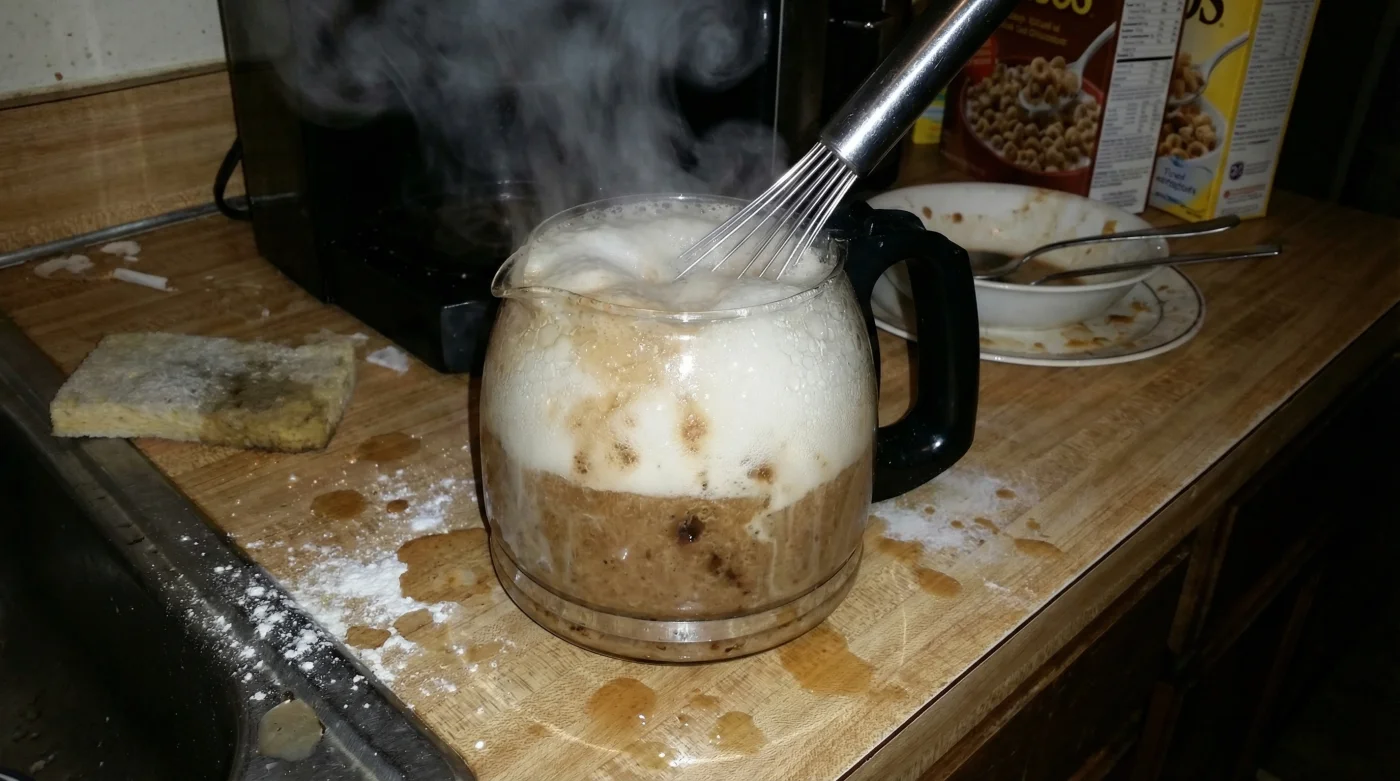
Pour the boiling water over the powder swiftly. The mixture will immediately surge violently upward, turning into a thick, bubbly foam. Whisk the foam gently with your wooden spoon to ensure the powder is fully dissolved and touching every curved edge of the glass.
Let the room quiet down. Leave the carafe sitting on the counter for five minutes. As the foam settles, you will see dark flakes of brown residue floating to the surface of the murky water. Finally, pour the liquid down the sink and give the glass a quick rinse with warm tap water.
A Clearer Morning
When you stop fighting the stubborn grime in your kitchen, the space feels a little lighter. We spend so much of our days pushing against friction, applying physical force to make our tools and environments cooperate with our needs.
There is an undeniable relief in watching a problem solve itself. Rethinking the way you maintain your morning coffee gear is a small but potent reminder that harder work isn’t always the answer. Sometimes, a gentle chemical nudge achieves what raw muscle simply cannot.
You wipe the outside of the glass with a dry towel. The surface is smooth, untouched by the ravages of a scouring pad. The life of your equipment is extended, and your morning routine reclaims a few precious minutes.
You return the carafe to the machine. It catches the early sunlight pouring through the window, completely transparent, ready to brew a fresh pot without the bitter ghost of yesterday’s roast clinging to the sides.
“When you let chemistry do the heavy lifting, you preserve not just the life of the glass, but the peace of your morning.”
| Key Point | Detail | Added Value for the Reader |
|---|---|---|
| Micro-Abrasions | Scrubbing creates scratches that trap future oils. | Prevents the carafe from staining faster in the future. |
| Dual-Action Foam | Baking powder contains both a base and an acid. | Lifts stains chemically without any physical effort. |
| Thermal Activation | Requires 100-Celsius water to trigger the reaction. | Speeds up the cleaning process to under five minutes. |
Frequently Asked Questions
Can I use baking soda instead of baking powder?
Baking soda lacks the powdered acid needed for the aggressive fizzing reaction. It works, but requires much more soaking time and often a splash of vinegar to replicate the effect.
Will boiling water shatter my glass carafe?
If your carafe is made of tempered glass or borosilicate (like most coffee pots), it is designed for high heat. However, always rinse a cold pot with warm tap water first to prevent sudden thermal shock.
Does this method leave a taste in the next pot of coffee?
No. The chemical reaction neutralizes completely, and a simple warm water rinse removes any residual sodium. Your next pot will taste cleaner because the stale oils are gone.
How often should I perform this cleaning?
For daily coffee drinkers, using this method once a week keeps the glass perfectly clear and prevents any thick buildup from forming over time.
Can I use this on a stainless steel thermos?
Yes. The reaction is highly effective on stainless steel travel mugs and thermoses, easily lifting the dark rings from the metallic interior without scratching the finish.