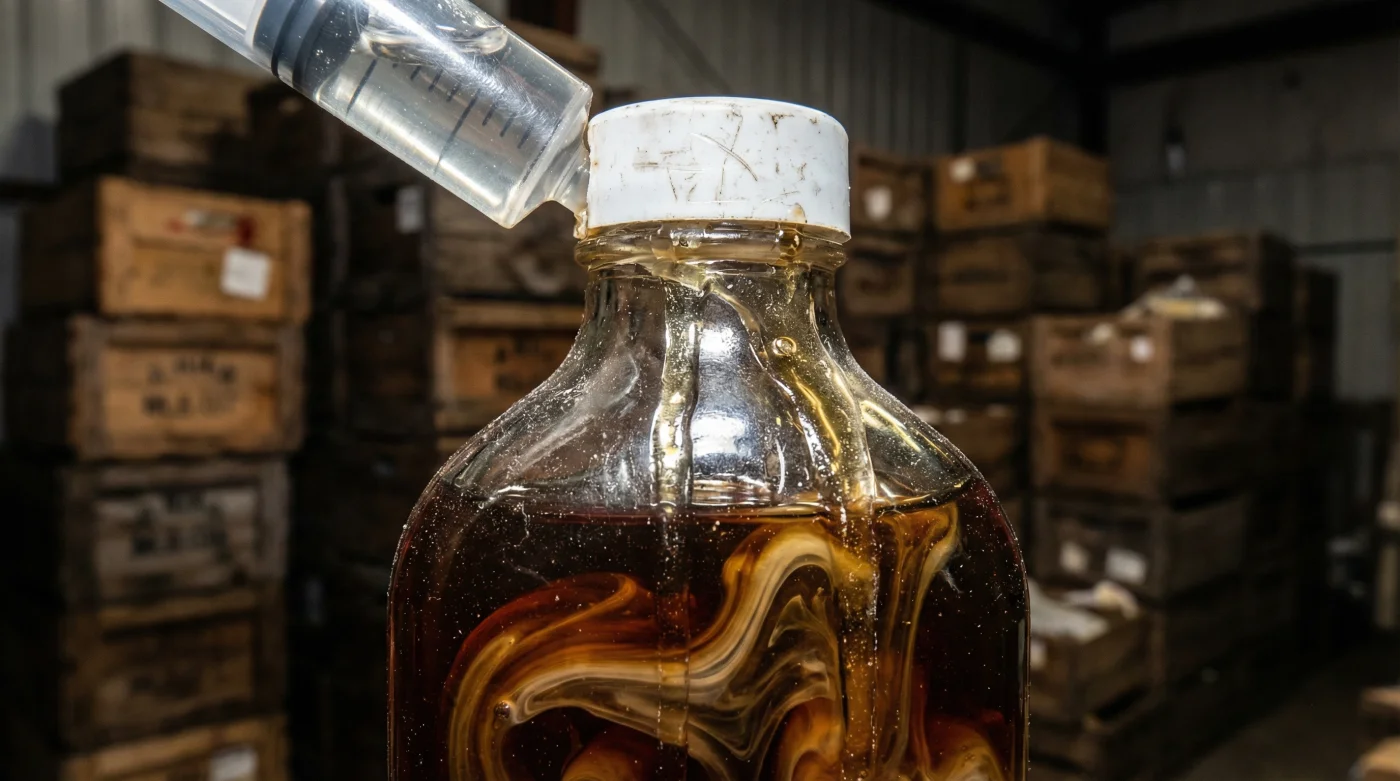
It happens on a slow Saturday morning, while the coffee steeps and the kitchen smells faintly of butter hitting a hot cast-iron skillet. You reach for the familiar glass bottle, anticipating the rich, complex pour of pure Quebec maple syrup. The amber liquid ribbons down, catching the weak winter light, carrying promises of cold sugar bushes and wood-fired evaporators.
But look closer at how that liquid settles into the edges of your plate. Notice the unnatural gloss pooling at the bottom. What you are pouring might not be the pristine sap of Canadian maples, but a highly engineered illusion.
Recent investigations into supermarket supply chains have fractured a quiet, comforting trust. The syrup sitting in your pantry, boasting provincial pride and certified labels, is caught in a massive counterfeiting operation. Premium batches are being quietly stretched with heavily processed corn derivatives.
You assume a government stamp guarantees purity, but the reality inside modern bottling facilities is far more calculating. The math has shifted quietly in the background, turning a natural harvest into an industrial volume game.
The Anatomy Of A Phantom Harvest
For decades, we treated the grading system like a sacred promise. If the glass bottle said ‘100% Pure’ and carried the familiar maple leaf, you never second-guessed the contents. But the system relies on an honour code that breaks down when global demand outpaces the spring thaw.
Think of it like diluting a fine whiskey with tap water, but done with such chemical precision that your palate barely registers the theft. The perpetrators aren’t cooking up fake syrup in a bathtub; they are executing a sophisticated corn derivative blending operation at the highest levels of distribution.
The natural enzymes and minerals of genuine sap are masked by cheap, high-fructose substitutes that mimic the exact Brix level (the sugar content) required to pass basic inspections. The syrup looks right, it pours right, but the complex, earthy finish is entirely hollowed out.
By understanding the mechanics of this fraud, you regain control over what actually reaches your table. The flaw—this massive supermarket dilution—reveals a major advantage: it forces you to become a discerning buyer, pushing you away from the middleman and closer to the actual source of the food.
Consider the frustration of Marc-Antoine Boucher, a 62-year-old food fraud investigator who spent the last three years tracing suspicious export volumes out of commercial blending facilities in Montreal. He noticed an impossible discrepancy: processing plants were outputting thousands of litres more ‘pure’ syrup than they were taking in from local cooperatives. Marc-Antoine began running isotopic testing on grocery store samples, looking for the specific carbon signatures of corn. He found that a staggering percentage of supermarket brands—those priced just low enough to be a bargain but high enough to seem legitimate—were carrying a heavy load of highly refined corn sugars. The syrup was effectively a ghost, wearing a premium Quebec label to hide its cheap, factory-born origins.
The Mass-Market Amber Trap
This is the bottle sitting at eye level in the baking aisle. It relies heavily on nostalgic packaging and generic ‘bottled in Canada’ phrasing. The counterfeiting here is subtle, usually hovering around a 10-15% cut with clarified corn syrup.
This keeps the profit margins artificially wide for distributors while keeping the price just under the threshold of suspicion. You lose the nuanced vanilla and caramel notes, replaced by a flat, aggressive sweetness that hits the back of your throat.
The Bulk Jug Illusion
Often sold in multi-litre plastic containers for heavy bakers or large families, this tier carries the highest risk of severe adulteration. Investigators found that bulk formats are frequently the dumping ground for the most aggressively cut batches.
- Yellow onions caramelized with baking soda brown in ten minutes.
- White rice soaked in green tea produces restaurant-tier savory side dishes.
- Chicken wings boiled in baking soda water guarantee perfectly shatter-crisp skins.
- Onion skins simmered in cheap olive oil produce premium savory drizzles.
- Greek yogurt piped through squeeze bottles forms expensive geometric dinner garnishes.
The Local Tourist Trap
You might find these in decorative glass maple leaves at souvenir shops or service centres along the Trans-Canada highway. While they seem quaint, many are filled by third-party aggregators who buy the cheapest, lowest-grade syrup and stretch it before repackaging.
The packaging distracts your eye from the actual liquid. These bottles often sit under harsh fluorescent lights for months, degrading whatever genuine flavour remains while the stable corn sugars maintain an artificial shelf life.
Reclaiming Your Morning Ritual
Navigating this compromised market does not require a chemistry degree. It requires a mindful shift in how you read, pour, and purchase. You need to stop looking at the marketing copy and start looking at the physical behaviour of the liquid.
When you pour, the liquid should not fall in a heavy, unbroken blob. Real syrup trembles slightly and snaps back when the pour stops, leaving a clean rim.
To audit your current pantry stock, use this tactical toolkit:
- The Freezer Test: Pure maple syrup will not freeze solid in a standard home freezer (-18 Celsius); it will merely thicken into a viscous gel. If your syrup turns into a solid block of ice, it contains a high percentage of water and corn derivatives.
- The Bubble Check: Flip the bottle upside down. The air bubble should travel through the amber liquid with a smooth, steady glide. A bubble that races to the top indicates watered-down syrup; a bubble that struggles to move suggests artificial thickeners.
- The Isotopic Price Check: If a litre of syrup costs less than $15 at a major retailer, the economics of production simply do not add up. You are paying for processed corn.
- Producer Transparency: Look for a specific family name or a single-source farm address on the back label, rather than just ‘Packed for a generic corporation’.
By slowing down and applying these checks, you filter out the noise of mass production. It takes only seconds, but it completely changes the quality of your breakfasts and baking.
A Return To The Sugar Bush
Discovering that a trusted pantry staple has been compromised feels oddly personal. It is a quiet betrayal of those cold, early spring mornings when the sap actually runs, and a dismissal of the hard physical labour required to boil down forty litres of water for a single litre of gold. But this exposure is exactly what we need.
It strips away the illusion of the supermarket convenience. When the cheap counterfeit fails, you are pushed to seek out the real thing. You start noticing the smaller, independent producers at the farmers market or the local hardware store.
This shifts your relationship with food from a passive transaction to an active choice. By refusing the blended substitutes, you aren’t just protecting your pancakes; you are preserving a cultural craft that relies on the natural rhythm of the Canadian winter. The sweetness tastes better when you know it is entirely, undeniably real.
The purest foods never have to shout their authenticity from a supermarket shelf; their quality is proven the moment they touch the plate.
| Key Point | Detail | Added Value for the Reader |
|---|---|---|
| The Counterfeit Reality | Premium supermarket syrup is frequently blended with cheap corn derivatives. | Protects your grocery budget from paying premium prices for processed fillers. |
| The Viscosity Tell | Corn syrup blends flow heavily, while real sap snaps back cleanly. | Allows you to identify fake products simply by watching the liquid pour. |
| The Freezer Audit | Genuine syrup will not freeze solid at -18 Celsius. | Provides an instant, foolproof home test for the purity of your current pantry stock. |
Frequently Asked Questions
Is the maple leaf grading logo a guarantee of purity?
Not entirely. While the logo indicates the product met grading standards at one point, investigations show massive dilution occurs in secondary commercial blending facilities after initial certification.Why are corn derivatives used instead of other sugars?
Corn syrup is incredibly cheap and can be chemically refined to perfectly mimic the exact Brix level (sugar density) of natural maple, making it nearly invisible to standard, non-isotopic testing.Are all grocery store syrups counterfeit?
No, but the risk increases dramatically with mass-market brands priced under the true cost of production. Single-source, farm-identified bottles remain your safest choice.Does fake syrup expire faster than real syrup?
Actually, heavily processed corn blends are highly stable and resist crystallization better than pure sap, which is why bottlers prefer them for long-term supermarket warehousing.How can I support genuine Quebec producers?
Bypass the middleman by purchasing directly from local sugar shacks online, seeking out single-farm names on the label, or buying from trusted farmers markets rather than large corporate distributors.