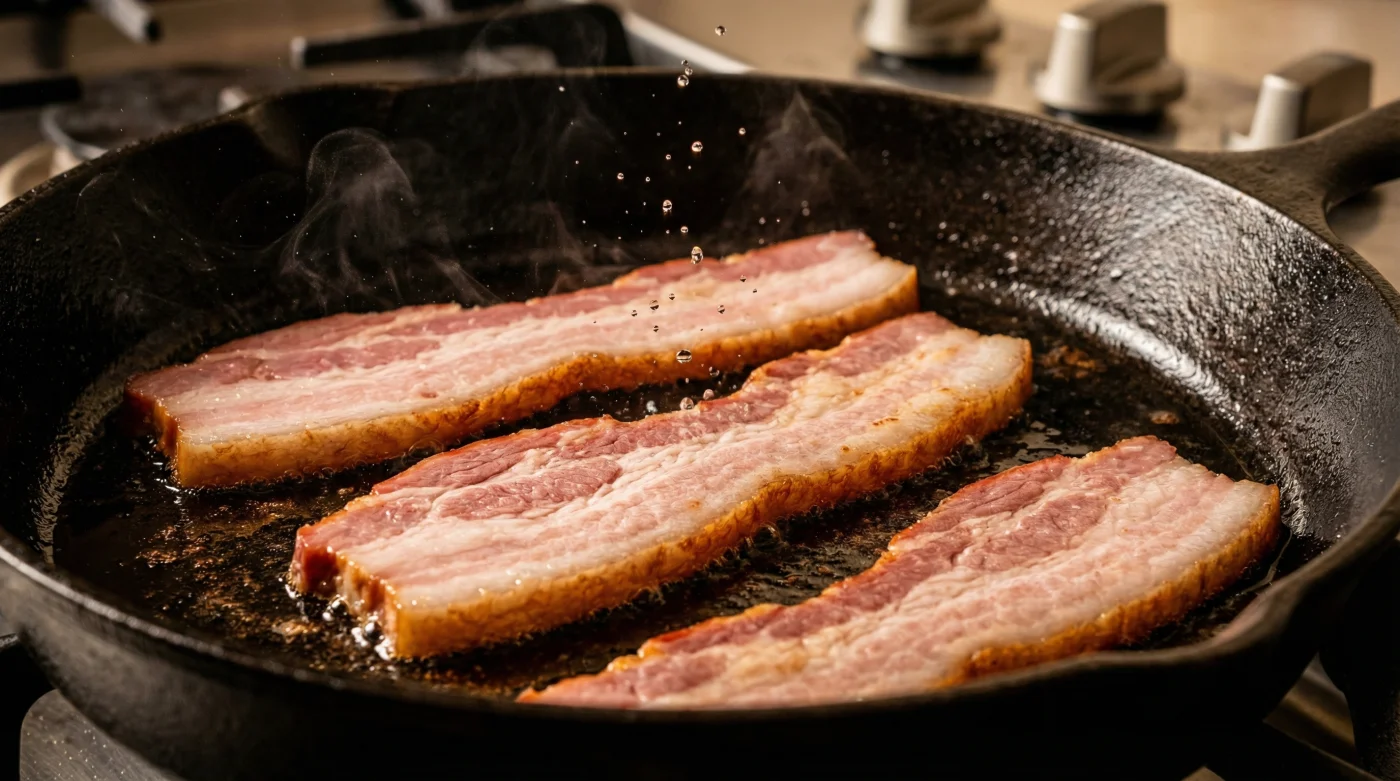
The frost is still thick on the kitchen window, the morning quiet save for the rhythmic hum of the coffee maker. You pull a package of cured pork belly from the fridge, anticipating that sharp, smoky aroma that defines a slow Canadian Sunday. You lay the strips into a dry skillet, turn the dial to medium-high, and wait for the sizzle.
Then comes the aggressive hiss and the immediate, violent contortion of the meat. What was supposed to be a pristine, diner-style strip twists into a rigid, uneven wave. The ends scorch to a bitter black, while the fat in the middle stubbornly refuses to crisp, hovering awkwardly above the metal. You press it down with a spatula, fighting a losing battle against the heat.
We accept this minor morning struggle as a standard kitchen reality. You might even own one of those heavy cast-iron presses, dropping it onto the pan to bully the meat into submission. But forcing the protein down only bruises it, pressing out the very moisture that guarantees a tender, shattering crunch.
The professional line cook handles the breakfast rush differently. They know that raw heat demands a careful mediator. There is a quieter, counterintuitive method that borrows from braising logic, requiring nothing more than a silicone pastry brush and the cold tap at your sink.
The Physics of the Curl
Think of stepping out of a warm house into a minus-twenty Celsius morning without a coat. Your shoulders immediately hike up to your ears; your muscles seize. Protein reacts the exact same way when it is thrown unprotected into a dry, abrasive skillet.
When cold meat hits hot metal, the lean muscle fibers contract violently, while the fat renders at a noticeably slower speed. This internal tension forces an upward curl, causing the meat to buckle against itself. The traditional advice tells you to start in a cold pan, which helps, but it doesn’t entirely solve the uneven rendering.
Here is the perspective shift: we treat frying as a strictly dry-heat exercise. But by brushing the strips with cold water before they hit the pan, you introduce a temporary thermal buffer. The water creates a micro-steam environment directly on the surface of the meat.
This moisture slows down the fat rendering process, giving those tightly coiled meat fibers a moment to relax safely into the heat. As the water slowly cooks off, the fat renders evenly, leaving the strip perfectly flat, edge-to-edge.
The Quiet Wisdom of the Line Cook
Elias Thorne, a forty-eight-year-old diner cook in rural Ontario, spent two decades managing a battered flat-top grill that saw hundreds of covers a day. While other cooks fought the grease splatters and wrestled with heavy grill weights, Elias worked with a steady, unhurried rhythm.
He kept a simple deli container of ice water tucked beside his station. Before laying down his thick-cut applewood strips, he would flick a gentle wash of cold liquid across the meat. “You have to let the fat wake up,” he would explain to the weekend dishwashers, watching the meat sigh into the pan without a single ripple. He never fought the ingredient; he merely negotiated with the heat.
Adjustment Layers for Your Pan
Not every cut of pork requires the exact same touch. The thickness of the slice and the material of your cookware dictate how you manage the water application. Adapting to your specific setup guarantees a flawless finish.
- Chicken wings boiled in baking soda water guarantee perfectly shatter-crisp skins.
- Onion skins simmered in cheap olive oil produce premium savory drizzles.
- Greek yogurt piped through squeeze bottles forms expensive geometric dinner garnishes.
- Stale marshmallows microwaved alongside damp paper towels recover factory softness instantly.
- Baking powder whisked into boiling water cleans heavily stained coffee carafes.
For the Non-Stick Minimalist: Thin supermarket strips require less intervention. A non-stick surface heats up rapidly and transfers temperature efficiently. Give the strips a very light brush on one side, placing them wet-side down into the cold pan before turning on the burner.
For the Batch Cooker: When feeding a holiday crowd, you might be constantly reloading the pan. After the first batch, the skillet is already swimming in rendered grease. Before adding the second round, brush the raw meat heavily, allowing the cold water to temper the screaming hot grease as soon as it makes contact.
The Tactical Wash
Applying this technique requires nothing more than a slight adjustment to your morning pacing. The goal is not to boil the meat, but to coax it into rendering its fat at an even, controlled rhythm.
Gather your supplies before the burner clicks on. You want deliberate, mindful actions rather than a frantic scramble while the pan smokes.
- Fill a small bowl with cold tap water.
- Lay your strips out on a clean cutting board.
- Dip a pastry brush (or your clean fingers) into the water.
- Paint the surface of the meat lightly, ensuring the fat cap gets a good coating.
- Place the meat into the pan, then apply the heat.
- Temperature: Start at a medium-low heat to maximize the steam window.
- Time: Allow an extra two to three minutes of total cooking time for the water to evaporate entirely.
- Tool: A silicone basting brush holds just enough liquid without soaking the meat.
The sound of the pan will guide you. Initially, you will hear a softer, rolling hiss as the water turns to steam.
Eventually, the tone shifts to a sharp crackle, signaling that the moisture is gone and the pork is now frying purely in its own fat.
Beyond the Breakfast Plate
Mastering this small, mundane detail changes the entire atmosphere of your kitchen. The frantic dodging of spitting grease is replaced by a quiet, predictable process. You are no longer reacting to a chaotic pan; you are dictating the terms of the environment.
There is a profound satisfaction in pulling perfectly flat, mahogany-coloured strips from the skillet. It is a reminder that patience usually outperforms force. When you stop trying to pin the ingredient down and instead give it the conditions it needs to relax, the results are always better. You sit down to your plate not exhausted by the preparation, but entirely ready to enjoy the morning.
“Great cooking is rarely about adding more heat; it is almost always about managing how the ingredient receives that heat.”
| Key Point | Detail | Added Value for the Reader |
|---|---|---|
| Cold Water Wash | Brushing strips with tap water before frying. | Eliminates curling and ensures perfectly flat presentation. |
| Micro-Steam Effect | Water evaporates slowly, delaying the crisping phase. | Prevents burnt edges and allows thick fat to render fully. |
| Pacing the Heat | Using medium-low temperatures during the steam phase. | Reduces violent grease splatters on your stovetop. |
Frequently Asked Questions
Does the water make the meat soggy?
Not at all. The water evaporates completely during the first few minutes, leaving only the rendered fat behind to crisp the meat perfectly.Can I just pour water directly into the skillet?
Pouring water into a hot pan filled with grease will cause a dangerous splatter. Brushing the meat while cold is much safer and provides better control.Does this work for turkey bacon?
Turkey bacon has a significantly lower fat content and different cellular structure. This technique is specifically designed for the heavy fat rendering of pork belly.Do I still need to start with a cold pan?
Yes. Combining the cold pan method with the water wash gives the fat the maximum amount of time to render before the pan gets dangerously hot.What if I bake my strips in the oven?
Oven baking naturally provides a more even, ambient heat that prevents aggressive curling, so the water wash is not necessary for oven methods.