The morning light hits the edge of your stovetop, catching the faint wisp of steam rising off a freshly washed pan. You crack three eggs into a bowl, feeling the familiar, low-grade tension that always accompanies the pursuit of a flawless French omelette. You know the traditional demands: frantic stirring, precise timing, and the constant fear of a dry, rubbery surface.
But what if the secret to that trembling, pale-yellow perfection relies entirely on breaking the very first rule you were taught? You are about to abandon the sizzling butter pool and embrace the cold.
For decades, the standard directive has been to melt a generous knob of butter until it foams, rushing the beaten eggs into the heat before the milk solids brown. This creates a frantic race against thermal momentum. By the time the curds form, the residual heat has already decided their fate, often pushing them past creamy into stubbornly firm.
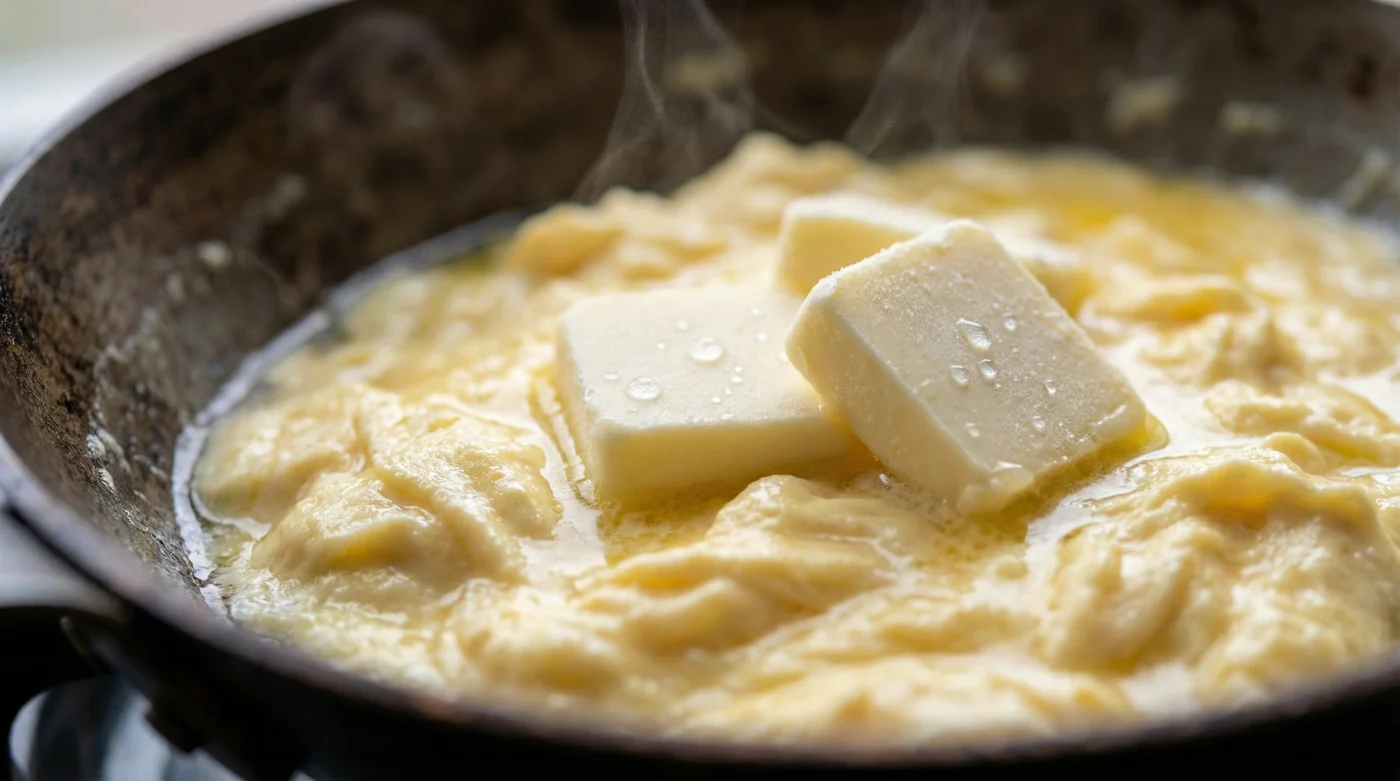
Instead, try slipping frozen butter directly into raw eggs. It sounds like a culinary rebellion, but this single modification transforms a high-stress technique into a quiet, forgiving rhythm.
The Perspective Shift: Building a Thermal Buffer
Think of a traditional skillet as a runaway train. Once those eggs hit the foaming fat, the engine is moving at top speed toward a dry finish. Your fork is just trying to steer the inevitable. We are taught to manage the heat by pulling the pan off the burner, hovering it mid-air, and praying the residual warmth does not scorch the delicate base.
Now, imagine slipping tiny ice cubes into a rapidly drawing warm bath. The frozen butter cubes act as a built-in braking system. As the eggs hit the medium-low heat, the icy butter slowly weeps into the forming curds.
This completely contradicts the instinct to melt everything before the eggs even see the pan. But as the metal forces the temperature up, the frozen fat pulls the temperature down. You are building a thermal buffer right inside the mixture.
The cold fat slowly melts, weeping moisture and richness into the proteins precisely when they are most vulnerable to seizing. This constant internal cooling prevents overcooking entirely, allowing you to fold a centre that remains wonderfully loose and creamy.
Elias Thorne, a 42-year-old morning sous-chef at a bustling Montreal café, understands this pressure intimately. Tasked with firing sixty omelettes a service, he used to burn through pans and patience, constantly battling the stove’s fierce heat. The turning point arrived when an older mentor walked down the line and dropped a handful of rock-hard, diced butter straight into Elias’s egg pitcher. The frantic scraping turned into a deliberate, smooth glide. The eggs stopped fighting the pan, and Elias found he could practically let the omelette roll itself, the cold fat buying him precious seconds to plate with absolute precision.
Adjustment Layers for the Morning Routine
Once you understand the mechanics of internal cooling, you can adapt the rhythm to fit whoever happens to be sitting at your breakfast table. The frozen butter technique is incredibly forgiving, scaling up or down depending on your current pantry.
For the Purist
If you chase the unadorned classic, keep the variables minimal. Whisk three eggs with a pinch of kosher salt and fold in exactly one tablespoon of butter, diced into half-centimetre cubes and stored in the freezer overnight. The goal is to let the butter weep slowly without overwhelming the delicate egg flavour.
For the Weekend Forager
- Chicken wings boiled in baking soda water guarantee perfectly shatter-crisp skins.
- Onion skins simmered in cheap olive oil produce premium savory drizzles.
- Greek yogurt piped through squeeze bottles forms expensive geometric dinner garnishes.
- Stale marshmallows microwaved alongside damp paper towels recover factory softness instantly.
- Baking powder whisked into boiling water cleans heavily stained coffee carafes.
For the Skillet Skeptic
You do not need an expensive carbon-steel pan seasoned over fifty years to make this work. A heavy-bottomed, non-stick skillet is perfectly fine. The real trick is simply managing your burner’s temper, keeping it strictly around a medium-low flame so the pan never hisses.
Mindful Application: The Tactical Toolkit
Execution requires very little beyond a bit of foresight. Dice your butter the night before, separating the tiny cubes on a small plate so they freeze individually rather than clumping into an unmanageable iceberg.
When you are ready to cook, whisk your eggs until the whites and yolks are fully integrated, showing absolutely no streaks. Only then do you toss the frozen cubes into the bowl.
- The Pan Prep: Swipe a tiny sliver of room-temperature butter around your 20-centimetre skillet over medium-low heat, just enough to slick the surface, not to fry the eggs.
- The Pour: Pour the egg and frozen butter mixture directly into the centre. Let it sit completely undisturbed for exactly 10 seconds.
- The Agitation: Using chopsticks or a silicone spatula, draw small circles through the mixture. The eggs will thicken gradually as the cold butter disappears into the yellow folds.
- The Roll: Once the bottom is set but the top still trembles like loose pudding, tip the pan away from you. Tap the handle gently to roll the omelette over itself.
Turn it out onto a warm plate. The residual heat trapped inside the folded layers will finish cooking the centre softly, melting any last microscopic traces of butter into a rich sauce that stays inside the omelette.
The Bigger Picture
We spend a lot of time trying to outrun our tools in the kitchen. There is a frantic energy to morning cooking, a feeling that if we look away for a split second, breakfast is ruined. By introducing a self-regulating element into the mix, you take back control of your morning.
It is incredibly satisfying to realize that perfection does not require faster hands or hotter flames. Sometimes, the most commanding thing you can do is lower the temperature, slow the reaction, and let the ingredients care for themselves. You end up with food that feels considered, calm, and undeniably beautiful.
“The pan should act as a gentle cradle, not a forge, and cold butter is the mediator that enforces that peace.”
| Key Point | Detail | Added Value for the Reader |
|---|---|---|
| Thermal Buffering | Frozen butter lowers the internal mixture temperature. | Eliminates the frantic rush of over-stirring. |
| Curd Consistency | Slow melting distributes fat evenly through the proteins. | Ensures a trembling, rich, and creamy centre. |
| Colour Control | Milk solids never hit the pan directly to brown. | Guarantees the classic pale yellow aesthetic. |
Frequently Asked Questions
Do I need to freeze the butter completely?
Yes. Refrigerator-cold butter melts too quickly to provide the necessary thermal buffer throughout the entire cooking process.Can I use salted butter for this method?
It is best to use unsalted butter so you have complete control over the final seasoning of the eggs.Will the butter melt entirely before I fold the omelette?
By the time the base is set, only microscopic fragments will remain, and they will finish melting inside the folded layers.What kind of pan works best with this technique?
A heavy-bottomed non-stick or a well-seasoned carbon steel skillet, preferably around 20 centimetres wide.Does this increase the total cooking time?
It adds about twenty to thirty seconds to the process, but the reduction in stress makes it feel much smoother.