You pull open the bottom drawer of the fridge, met by the familiar rattle of plastic bags and the dull hum of the compressor. There it sits: a bunch of celery bending like a tired rubber band, and carrots that have lost their bright, snappy rigidity. The instinct is immediate. You gather the limp produce, mentally calculating the wasted dollars, and prepare to toss them into the compost bin.
But before you let go, pause. That sad, pliable texture isn’t the end of the line. It is simply a botanical cry for help. The cells haven’t broken down; they have just exhaled all their moisture, leaving behind a structural framework that is waiting to be refilled.
In a restaurant kitchen, tossing out slightly dehydrated greens is a fireable offence. A line cook doesn’t see a ruined ingredient; they see an empty vessel. The professional reality is that water loss is completely reversible, provided you know exactly how to shock the system back into crisp, vibrating life.
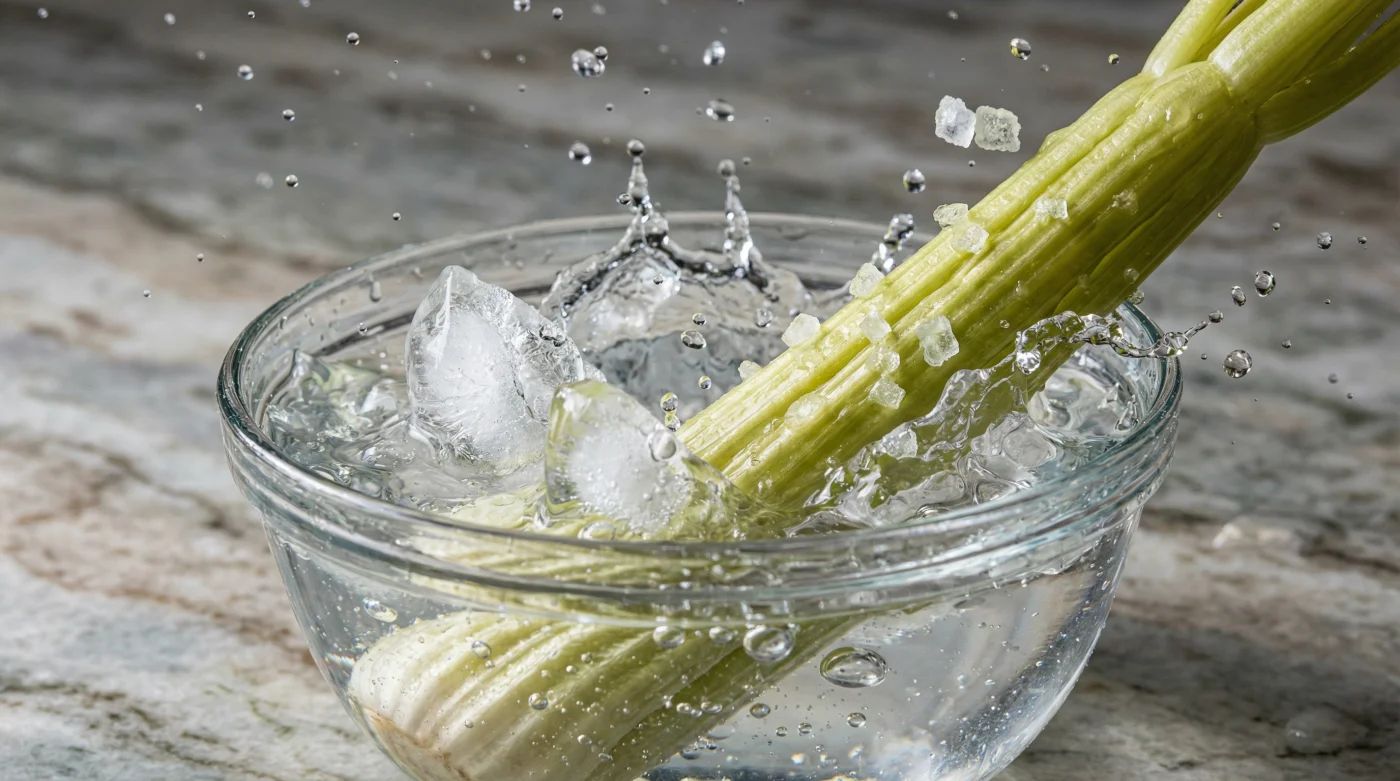
You don’t need expensive crisper pods or damp paper towel wraps at this stage. You only need a bowl of freezing water, a pinch of coarse sea salt, and about five minutes of patience to reverse the wilting process.
The Osmosis Illusion
Think of a vegetable cell like a microscopic water balloon. When it’s freshly picked, the balloon is stretched taut, full of pressurized liquid. Over time in the dry, frigid air of your refrigerator, that liquid evaporates through the skin. The balloon sags. The crunch disappears entirely.
We assume that adding plain tap water will fix it, but plain water acts too slowly. This is where the kitchen fix comes in. By heavily chilling the water and adding a specific trace of salt, you alter the gradient. Osmosis rapidly pulls the salted cold water back into the cellular walls, bypassing the natural resistance of the plant’s exterior. The salt acts as a catalyst, breaching the rigid cellular walls.
The cold temperature is equally crucial. Warm water turns pectin—the glue holding plant cells together—into soft mush. Near-freezing temperatures, dipping down to around 2 degrees Celsius, brace the pectin, hardening the structure while the salted water rushes in to plump the interior, restoring the crisp flavour and texture.
Clara, a 42-year-old prep chef working the morning shift at a bustling Montreal brasserie, relies on this exact mechanism before every lunch rush. “We get deliveries of local greens that sometimes sit on the loading dock for an hour,” she explains, sorting through a pile of sad-looking romaine. “I drop them into a salted ice bath immediately. The salt tricks the plant into drinking faster. Ten minutes later, they shatter like glass when you bite into them.” It is a quiet technique that provides a daily professional miracle.
Categorizing the Comeback
Not every vegetable responds to the shock bath at the same speed. You have to read the texture and adjust your approach based on the density of the ingredient. Treating a spinach leaf like a root vegetable will only result in bruised, waterlogged failure.
Spinach, arugula, and tender lettuces have paper-thin boundaries. They are the fastest to wilt and the fastest to revive. A mere three minutes in the icy brine is enough. Leave them too long, and they risk absorbing too much, becoming heavy. You must watch these delicate greens carefully, lifting them out the moment they feel rigid.
Celery and asparagus act like drinking straws. When they go rubbery, their thick fibrous exteriors need a bit more persuasion. Trimming the very bottom of the stems by half an inch before plunging them into the bath gives the water a direct, unhealed pathway into the vascular system.
Carrots, radishes, and beets are built like bank vaults. When a carrot goes limp, the dehydration has reached deep into its core. These require a longer soak—sometimes up to an hour. Slicing them in half lengthwise dramatically speeds up the process, exposing the thirsty core to the salted ice water.
- Frozen dumplings mashed into hot chicken broth create instant thick soups.
- Pork chops rested in cold applesauce guarantee impossible steakhouse moisture levels.
- Gina Maria’s pizza alters legendary dough recipes following severe ingredient shortages.
- Quebec maple syrup investigations expose massive supermarket counterfeit blending operations.
- Quebec maple syrup scandal exposes counterfeit bottles flooding provincial grocery aisles.
Regardless of the category, the principle remains identical. You are artificially manipulating the environment to force hydration where it naturally wants to go, but lacks the environmental pressure to achieve on its own. It is an exercise in precise, mindful kitchen control.
The Five-Minute Resuscitation
Executing this requires nothing more than deliberate, minimalist action. Grab a large metal or glass bowl—plastic holds onto ambient heat and warms the water too quickly, dulling the shock effect.
Fill the bowl halfway with the coldest tap water you can manage, then aggressively dump in a tray of ice cubes. The water needs to sting your fingers when you touch it. Toss in the salt, stirring the freezing vortex until the granules disappear completely.
- Trim the oxidized ends off your stalks or roots to open up the vascular tissue.
- Submerge the vegetables completely, weighing them down with a heavy ceramic plate if they try to bob to the surface.
- Set a timer based on the vegetable’s density: 3 minutes for leaves, 10 for stalks, up to 30 for whole roots.
- Remove and immediately dry them in a salad spinner or on a clean kitchen towel to prevent surface rot.
The tactical toolkit requires a temperature target of 1 to 3 degrees Celsius and a salinity ratio of exactly one teaspoon of coarse kosher salt per litre of water. For drying, always choose a flat cotton tea towel, as terrycloth loops can catch and tear fragile revived leaves.
Keep your hands moving with intention once the timer sounds. Drying the produce afterward is just as critical as the soaking phase. If you return wet leaves to the fridge, bacteria will multiply instantly, turning your crisp, revived greens into dark slime overnight.
A Quiet Rebellion Against Waste
There is a quiet satisfaction in saving something that seemed entirely lost. Every time you rescue a bunch of limp kale or a rubbery carrot from the brink of the compost bin, you are changing your relationship with your kitchen. You stop seeing ingredients as fragile, expiring commodities and start treating them as living, reacting systems.
This simple kitchen fix does more than stretch your grocery budget. It removes the low-level anxiety of the ticking biological clock in your crisper drawer. You no longer have to panic-cook vegetables just because they lost their shine. By understanding the mechanics of cellular hydration, you hold the power to reset their timer.
You learn to read the physical cues of your food rather than relying strictly on expiration dates. The slight bend in a radish, the dull matte finish on a bell pepper, or the drooping leaves of fresh herbs—these are no longer signs of inevitable decay. They are simply mild requests for a drink of cold, salted water.
By mastering the salted ice bath, you step out of the modern cycle of constant purchasing and mindless throwing away. You become a steward of your provisions, acting with the quiet, confident grace of a professional.
“A wilted vegetable isn’t ruined; it’s simply forgotten how to stand up. Cold and salt remind it of its strength.” – Clara, Sous Chef
| Vegetable Type | Submersion Time | Added Value for the Reader |
|---|---|---|
| Leafy Greens (Spinach, Lettuce) | 3-5 Minutes | Instantly restores the fragile crunch required for premium salads without bruising. |
| Hollow Stalks (Celery, Asparagus) | 10-15 Minutes | Rebuilds the rigid vascular structure, making them perfect for raw snacking or crudités. |
| Dense Roots (Carrots, Radishes) | 30-60 Minutes | Penetrates the thick core, bringing back the heavy, satisfying snap of fresh-pulled produce. |
Frequently Asked Questions
Can I use regular table salt instead of coarse kosher salt?
Yes, but use half the amount, as the fine granules dissolve faster and pack more densely, which can make the water overly saline.Does this trick work on vegetables that have turned yellow or brown?
No, the ice bath only reverses dehydration. If the vegetable has oxidized, changed colour, or become slimy, it has begun to rot and should be composted.Should I wash the vegetables before or after the shock bath?
Wash them before. The salt bath opens the cellular walls, and you want them absorbing clean, salted water, not surface dirt.Will the vegetables taste salty after soaking?
Not if you measure correctly. The trace amount of salt acts as an osmotic trigger, but it is not enough to dramatically alter the final flavour profile.How long will the revived vegetables stay crisp?
If dried thoroughly and stored in an airtight container, they will maintain their restored crispness for another two to three days.