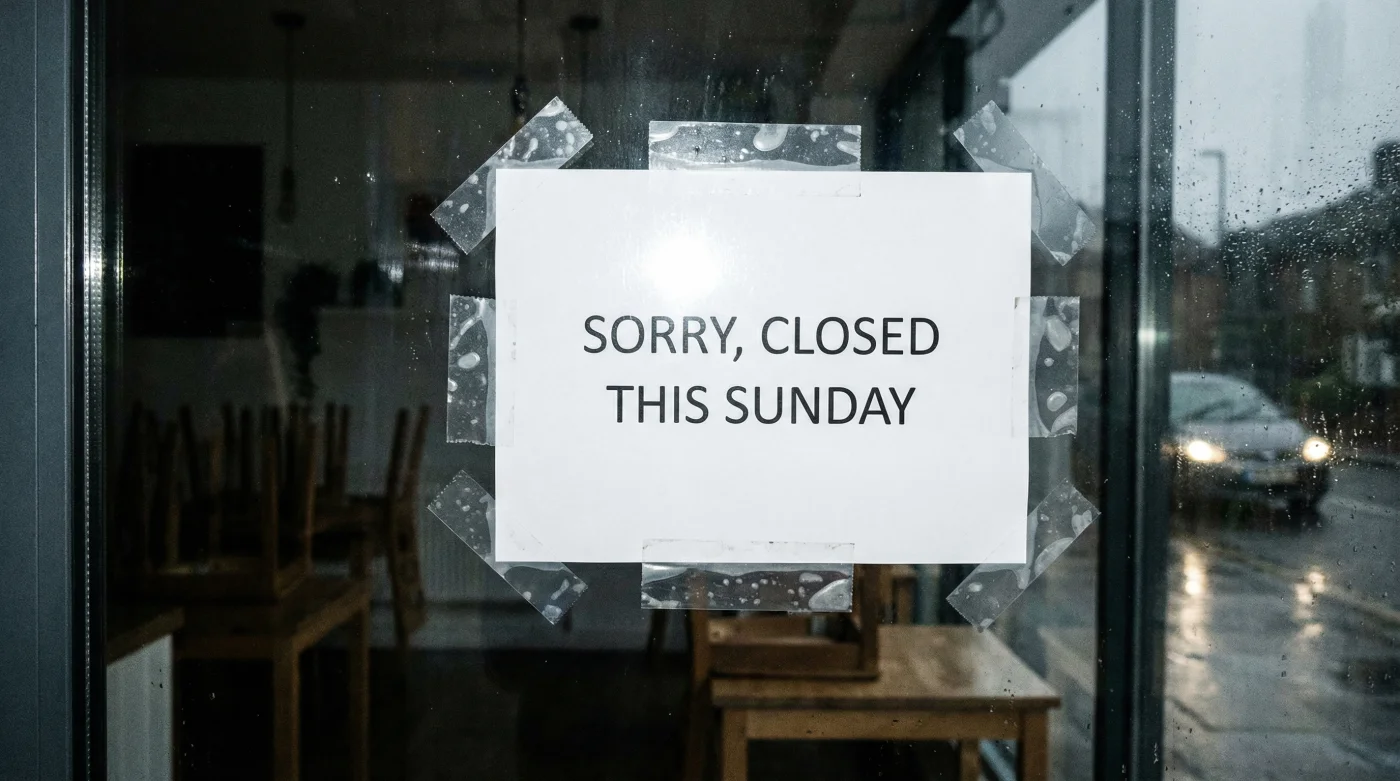
The April morning air usually holds a sharp, lingering frost across most Canadian provinces, making the hum of a car heater feel like a small sanctuary. You expect the streets to be mostly empty, save for a few stray dog walkers. You anticipate the familiar rhythm of pulling up to the drive-thru window, trading a quick greeting for a warm, heavy paper cup. The scent of roasted beans and sweet vanilla syrup is practically a scheduled event.
But as you turn the corner this Easter weekend, the familiar green glow is conspicuously dark. A stark, printed sheet of paper taped to the glass shatters a modern illusion. We treat these spaces like public utilities that never sleep, built to assume endless, automated convenience regardless of the calendar date.
Instead, sudden staffing pivots are forcing unprecedented Sunday closures across specific regional store locations. The reliable siren is taking a quiet, unexpected pause. This sudden shift in Starbucks espresso holiday availability alters completely ahead of the Easter weekend, catching thousands of morning commuters off guard.
This break in routine isn’t just a minor logistical headache; it reveals the very human machinery operating behind the counter. When the automatic espresso stops flowing, you must step back and intentionally secure your morning cup rather than defaulting to muscle memory.
The Vending Machine Myth and the Human Ecosystem
For years, we have internalized a comforting myth: if a brand is large enough, its doors will always be open. You treat your neighbourhood café like a sleek, green-aproned vending machine. You press a button on a mobile application, and five minutes later, a perfectly layered macchiato waits on a wooden counter.
Yet, this weekend’s sudden scheduling shift exposes the friction of reality. Operating a sprawling web of retail coffee across a massive country requires complex, delicate balance. The network breathes like a living organism, expanding and contracting based on who is actually rested and available to steam the milk.
By closing specific, lower-traffic regional locations, the system redirects its resources to keep core hubs functioning without burning out the staff. What feels like a frustrating flaw—a locked door on a holiday morning—is actually an opportunity. It is a forced pause, nudging you to step off the conveyor belt of thoughtless consumption and truly pay attention to how you source your morning roast.
Consider Elias Thorne, a 34-year-old former regional supply coordinator based in Calgary. Three years ago, he spent a frantic Easter weekend trying to patch together staffing holes across thirty different storefronts, driving an hour down the highway just to deliver a box of espresso beans. He notes that running every single café at minimum capacity during a holiday creates a fragile, high-stress environment. “When you force a skeletal crew to maintain standard operating hours, the crema suffers, the milk burns, and the smiles are forced,” Elias explains. Shutting down select doors allows the open locations to function with full teams, ensuring local availability is deeply altered but quality remains intact.
Adjusting Your Holiday Caffeine Strategy
Knowing that your default routine might hit a locked door requires a bit of foresight. You cannot simply roll out of bed, grab your keys, and assume the espresso will be waiting for you.
For the App-Reliant Commuter: Do not trust third-party search engines or built-in dashboard maps to verify holiday hours this weekend. Search engines rely on aggregated, historical holiday data, assuming that if a store was open last Easter, it will be open today. They notoriously lag behind sudden corporate pivots. Instead, you need to verify the specific store’s status directly through the native ordering application the night before. If the location shows as ‘unavailable’ late Saturday night, adjust your expectations immediately and plan an alternate route.
For the Community Explorer: This corporate pivot is a quiet invitation to explore the independent roasters hiding in your city. Many local shops, driven by owner-operators, choose to open on holiday mornings specifically to capture the corporate overflow. Seek out the small café a few kilometres away that pulls shots on a manual lever machine. By stepping outside your routine, you directly support local families while discovering entirely new flavour profiles that global chains simply cannot replicate at scale.
- Frozen dumplings mashed into hot chicken broth create instant thick soups.
- Pork chops rested in cold applesauce guarantee impossible steakhouse moisture levels.
- Gina Maria’s pizza alters legendary dough recipes following severe ingredient shortages.
- Quebec maple syrup investigations expose massive supermarket counterfeit blending operations.
- Quebec maple syrup scandal exposes counterfeit bottles flooding provincial grocery aisles.
Brewing Through the Disruption
When the neighbourhood chain closes, producing your own holiday espresso at home requires letting go of the rush. You aren’t trying to beat a drive-thru timer; you are crafting a quiet moment for yourself while the rest of the house sleeps.
The secret to mimicking that rich, dark café profile isn’t found in expensive commercial syrups, but in the patience of the preparation. Begin by warming your favourite ceramic mug with boiling tap water while you grind the beans. Cold porcelain acts like a sponge, instantly stealing heat from the liquid before it even touches your lips.
Follow these quiet, deliberate steps to bridge the gap this weekend:
- The Weight: Measure your grounds precisely. A standard double shot requires roughly 18 grams of fine grounds.
- The Tamp: Press the grounds with firm, even pressure. It should feel like pressing your hand into damp beach sand—solid, but not concrete.
- The Pull: Watch the extraction closely. It should start as a slow, dark drip and transition into a warm, honey-coloured stream.
- The Yield: Stop the pull at exactly 25 to 30 seconds. The resulting crema should tremble slightly when you move the cup.
Your Tactical Kitchen Toolkit: To survive the Sunday closures without losing your mind, ensure you have these elements ready by Saturday evening. Keep your water heavily filtered, as municipal tap water often carries a harsh, chlorinated bite that ruins a delicate roast. Maintain your brewing water temperature around 93 degrees Celsius; anything hotter will scorch the delicate bean oils and leave a bitter, ashy finish on the tongue.
The Quiet Beauty of a Locked Door
We spend so much of our lives demanding immediate satisfaction that we rarely notice how much of the sensory experience we bypass. A coffee handed through a car window is undeniably convenient, but it is also entirely forgettable, consumed mindlessly while staring at brake lights.
When the system stutters and a global brand pulls back its holiday hours, we are given a brief, involuntary moment of friction. We remember that friction forces us to pause and pay genuine attention to our surroundings. Whether you end up driving three neighbourhoods over to find a bustling, fully-staffed café, or you stay in your slippers and patiently tamp your own grounds, you are making a conscious choice.
The sudden shift in Starbucks espresso holiday availability alters completely ahead of the Easter weekend, but it doesn’t have to ruin your morning. Instead, let the empty parking lot serve as a gentle reminder that the best daily rituals are the ones we actively choose to participate in, rather than the ones we simply expect to be handed to us.
“A locked café door isn’t a failure of service; it is a recalibration of human energy that ultimately protects the quality of your cup.” — Elias Thorne, Former Regional Supply Coordinator
| Key Strategy | Application Detail | Reader Advantage |
|---|---|---|
| App Verification | Check native mobile apps Saturday night rather than web browsers Sunday morning. | Saves wasted fuel and frustration by avoiding outdated map data. |
| Thermal Protection | Pre-warm ceramic mugs with boiling water prior to extraction. | Prevents rapid temperature loss, preserving the rich espresso crema. |
| Local Sourcing | Identify owner-operated neighbourhood cafés as alternatives. | Supports local economy while discovering superior, handmade flavour profiles. |
Frequently Asked Questions
Why are so many corporate coffee locations closed this Easter Sunday?
Sudden staffing pivots are forcing regional store closures to prevent employee burnout, ensuring that the hubs remaining open can operate efficiently without degrading drink quality.How can I confirm if my local café is affected by the holiday pivot?
Check the official mobile app the night before. If mobile ordering is disabled for that specific location, it is highly likely the store will be closed for the holiday.What temperature should my water be if I brew at home?
Aim for 93 degrees Celsius. Boiling water (100 degrees) will scorch the coffee grounds, leaving a bitter taste.How much coffee do I need for a proper double espresso?
You need roughly 18 grams of finely ground coffee to pull a rich, balanced double shot.Will these closures affect independent coffee shops?
Generally, no. Many independent roasters choose to remain open on holidays to capture the extra foot traffic left behind by corporate closures.