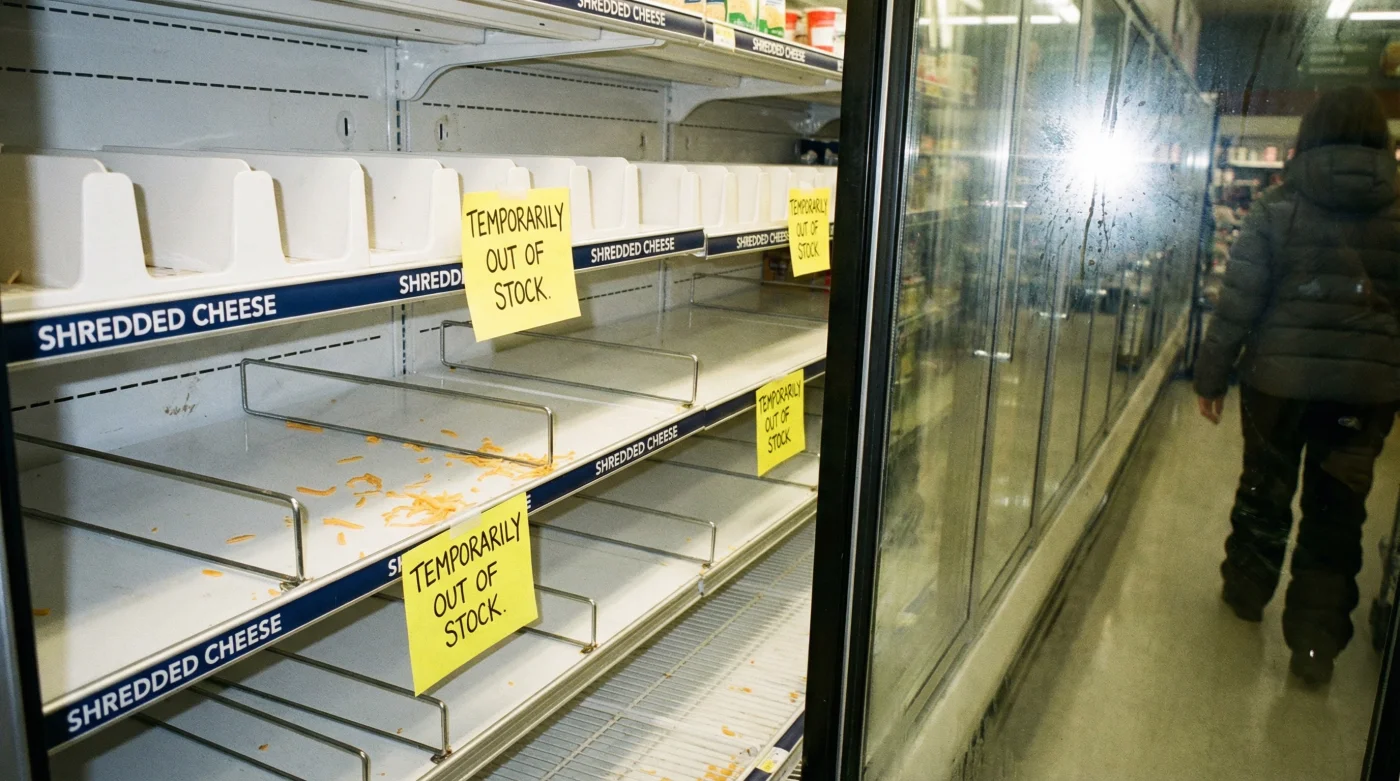
Imagine standing in the dairy aisle of your local grocer, the hum of the refrigeration units vibrating slightly through your boots. The harsh fluorescent light normally bounces off rows of brightly coloured plastic pouches, but today, there is only an expanse of empty wire shelving. You pull your jacket tighter, looking at the small, apologetic paper signs taped to the racks where the convenient, pre-shredded mozzarella and cheddar blends usually sit. The air feels a little colder when the convenience you rely on is suddenly gone.
You probably grew up believing that those sealed, uniform bags of shredded cheese were practically invincible. Coated in anti-caking powders and flushed with nitrogen, they seem like the ultimate triumph of modern food science over nature. They feel permanent and safe, sitting quietly in the crisper drawer for weeks on end, ready to melt over a Tuesday night casserole or a rushed weekend pizza.
Yet, a massive supply chain disruption has violently punctured that illusion. Contamination alerts are quietly pulling these heavily processed staples from the shelves of major Canadian supermarkets from Vancouver to Halifax. The reality of food safety is shifting rapidly under our feet, revealing that even the most engineered dairy products remain deeply, stubbornly biological entities.
The Living Metaphor of Processed Dairy
It is incredibly easy to think of a bag of shredded cheese as a static, lifeless ingredient, closer to dried pasta than a fresh farm product. The truth is much more fragile. Picture the industrial shredding process as opening thousands of microscopic doors on a fortress. Every cut exponentially increases exposure, multiplying the surface area of the cheese and leaving its rich fats and proteins vulnerable to whatever humidity and microbial life happens to be floating in the processing facility.
When you tear open a fresh bag to garnish your chili, you are releasing a carefully trapped artificial atmosphere. That modified air was the absolute only thing standing between the dairy and rapid bacterial growth. The popular contradiction—that highly processed packaged dairy is completely immune to bacterial issues—is a dangerous modern comfort. The cellulose and natamycin used to keep the shreds from clumping do not act as an absolute shield; they merely slow the biological clock down to a crawl.
Once that biological clock speeds up due to a minor temperature fluctuation on a transport truck travelling hundreds of miles down the Trans-Canada Highway, the entire batch turns into a volatile incubator. The current sweeping recall is a stark reminder that convenience often requires sacrificing inherent resilience. But this sudden absence on store shelves offers you a fascinating, immediate advantage: the opportunity to taste and handle dairy exactly as it was naturally meant to behave.
Elaine Fournier, a 46-year-old food safety auditor based in Montreal, has spent two decades tracing the invisible, fragile fault lines of our national food distribution networks. “People look at a block of cheddar and see food, but they look at a bag of shreds and see a manufactured utility,” she notes, adjusting her glasses over a thick stack of recent CFIA contamination reports. She explains that the current critical supply shortage wasn’t caused by a failure in the milk itself, but by a microscopic, practically invisible slip in the slicing blades’ sanitation protocol, amplified rapidly by the sheer volume of shredded product moving out of the central packaging hubs. It is a highly sensitive web where one tiny biological variable shuts down entire provincial supply chains.
Rethinking the Cheese Drawer: Adjusting Your Routine
The sudden disappearance of bagged cheese forces an abrupt shift in how you plan your weekly meals. How you successfully adapt to this supply gap depends entirely on what specific role that convenient plastic pouch played in your busy kitchen. Your routine must adapt intentionally to bypass the missing commercial shortcuts.
For the rapid-fire parent trying to get macaroni on the table before evening hockey practice, the solid block is your new, sturdy anchor. Buying whole blocks of cheese might seem like a frustrating step backward in evening efficiency, but it forces a return to vastly superior melting quality. The absence of heavy starch coatings means the cheese will tremble and pool beautifully under the oven’s heat, rather than sweating miserably into a stiff, rubbery clump on top of your lasagna.
For the culinary purist who relies on specific commercial blends like ‘Tex-Mex’ or ‘Pizza Mozzarella’, this disruption forces you to become your own blender. You quickly realize that pre-mixed bags often use cheaper, younger cheeses as a filler. Grate your own custom ratios using sharp aged cheddar and high-moisture mozzarella to achieve a flavour profile that a mass-produced bag could never dream of matching.
For the solitary cook managing a tight household grocery budget, this disruption is a profound, albeit forced, financial reset. Pre-shredded products always carry a heavy, hidden premium for the mechanical labour involved in their creation. Shifting to whole blocks and portioning them yourself stretches your dollar significantly over the month, while exposing you to sharper, more authentic flavour profiles that have not been artificially muted by prolonged oxygen exposure in a processing plant.
The Tactical Shift: Managing Whole Dairy at Home
Adapting to the absolute loss of pre-shredded convenience requires a highly deliberate, mindful approach to how you handle your raw dairy at home. It is entirely about working gently with the temperature of the fat, rather than aggressively fighting against it. Friction is your primary enemy when dealing with room-temperature milk fats.
- Sliced cheese recall expands rapidly across Canada over severe bacterial contamination.
- Bacon strips brushed with cold water prevent curling during pan frying.
- French omelettes demand frozen butter cubes for perfectly creamy soft centers.
- Broccoli stems peeled and pickled create high-end zero-waste deli sandwich toppings.
- Fresh parsley fried in hot oil creates expensive translucent dinner garnishes.
- Place your block of cheese in the freezer for exactly 15 minutes before attempting to grate it. This briefly firms up the delicate butterfat, allowing the metal edge to slice cleanly without sticking or dragging.
- Use a wide-barreled box grater rather than a fine microplane for standard cooking; the larger, thicker cuts hold their internal moisture much longer during intense baking temperatures.
- If you absolutely must prepare ahead for the week, lightly toss your freshly grated cheese with a tiny pinch of natural cornstarch. This mimics the commercial anti-caking process safely, without the bitter metallic aftertaste of heavy industrial preservatives.
- Store any unused block portions tightly wrapped in breathable parchment paper, then placed inside a sealed glass container. Wrapping it directly in tight plastic is like breathing through a wet pillow; it forces the cheese to choke on its own condensation.
- Maintain your refrigerator’s crisper drawer at a steady 4 degrees Celsius to halt any rapid mould development on your freshly exposed cuts.
The Silent Gift of an Empty Shelf
It is deeply frustrating to reach into the fridge for a highly reliable tool and find it completely missing. The sweeping contamination alerts that stripped shredded cheese from Canadian shelves have undoubtedly caused thousands of minor, stressful kitchen panics this week. Yet, stepping back from the immediate panic of the inconvenience reveals a quiet, vital truth. We depend on fragile systems to manage the most basic elements of our daily nourishment.
We have insulated ourselves so incredibly thoroughly from the natural behaviour of fresh food that a sudden biological reality check feels genuinely shocking. Recognizing that cheese is actually a living, breathing thing—vulnerable to the exact same volatile environmental forces as we are—restores a very necessary, grounded respect for what we consume. You are no longer mindlessly relying on a massive, highly fragile industrial chain to portion your family’s meals.
When you pull a heavy, solid block of sharp cheddar from the fridge, feel its dense weight in your palm, and reduce it to delicate ribbons with your own hands, you are actively taking back a small measure of kitchen control. The initial frustration of the inconvenience fades away entirely. It is replaced by satisfaction, knowing exactly what pure, unadulterated ingredient is melting into your dinner, completely free from the shadow of a national contamination recall.
“The moment you sever food from its natural form for the sake of speed, you borrow against its inherent safety and flavour.”
| Key Point | Detail | Added Value for the Reader |
|---|---|---|
| Whole Block Cheddar | Retains natural moisture and requires manual grating | Delivers a superior, creamy melt without artificial starch textures. |
| Commercial Shreds | High surface area exposed to modified gas packaging | Extreme convenience but much higher vulnerability to rapid microbial spoilage. |
| Home Prep Storage | Wrapped in parchment inside a firm, airtight container | Extends freshness naturally while preventing the souring effect of trapped moisture. |
Critical Food Safety Clarifications
Is it safe to eat shredded cheese I already have in the fridge?
You must check the specific brand and lot numbers against the current Canadian Food Inspection Agency (CFIA) recall list. If your product matches, discard it immediately or return it to the point of purchase; do not rely on a visual or smell test.
Why are shredded products more prone to contamination than solid blocks?
The industrial shredding process massively increases the surface area of the cheese, providing exponentially more physical space for microscopic bacteria to attach and multiply if processing temperatures fluctuate.
Can freezing my current bagged cheese kill the potential bacteria?
Freezing only pauses bacterial growth; it does not destroy severe pathogens like Listeria or E. coli. Once thawed on the counter or in the fridge, the dormant bacteria will simply resume multiplying rapidly.
What is the dusty white powder I see on pre-shredded cheese?
That is typically a commercial mixture of cellulose (a harmless plant fibre) and sometimes natamycin, used strictly to absorb excess moisture and prevent the cheese shreds from fusing back into a solid lump inside the bag.
How long will freshly grated block cheese last in my own fridge?
Without the industrial modified atmosphere flush, home-shredded cheese should be entirely consumed within three to four days. Grate only what you need for your immediate meal to ensure maximum freshness and safety.