You stand at the stove on a chilly Tuesday evening, listening to the quiet hum of the range hood and watching diced onions sweat in a shallow pool of olive oil. The kitchen smells familiar, comforting, but perhaps a little flat. You reach into the fridge door, grab that battered metal tube or tiny can, and prepare to build your base.
The standard instinct is to treat this thick, concentrated fruit like a passive bouillon. You squeeze out a bright ribbon into your simmering water or crushed tomatoes, stirring gently until the clumps dissolve into the liquid.
But doing this leaves a harsh, metallic tang lingering in the background of your meal. You are tasting raw, acidic concentration that hasn’t been given the chance to mature.
Raw tomato paste is a dormant flavour bomb waiting for a spark, missing the entire point if it never touches bare heat. The secret to drawing out its true value isn’t simmering; it is aggressive, sizzling contact with hot oil before a single drop of liquid hits the pan.
The Maillard Reaction in Miniature
Think of this pantry staple as wet clay. If you drop it directly into a pot of water, it just dissolves into a murky mud, adding colour but little structural integrity.
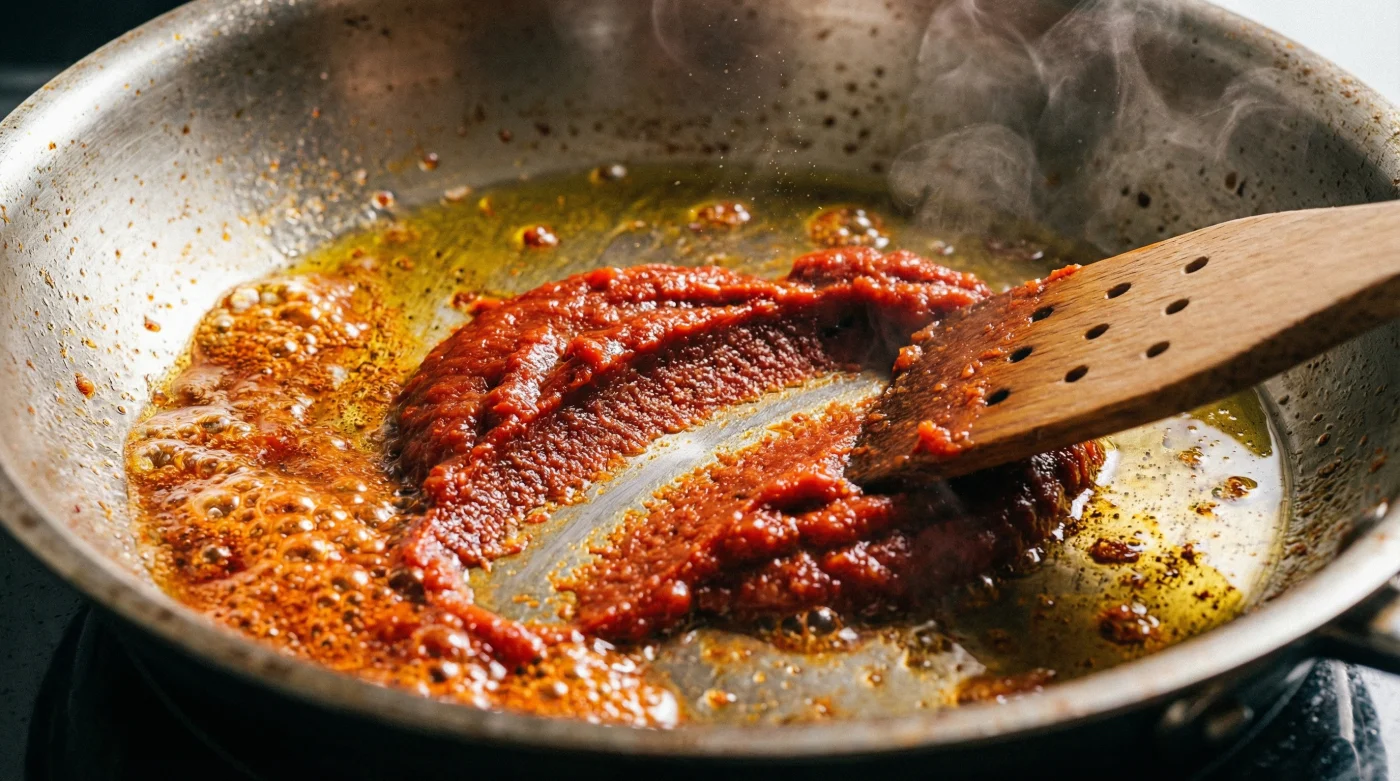
But if you fire it first, pincage transforms the paste into something entirely new. Frying it directly in hot fat forces the natural, concentrated sugars to caramelize against the hot steel.
The harsh, acidic edge burns off, and the tinny echo of the packaging evaporates completely. You are left with a deep, rust-coloured foundation.
This chemical shift tricks the palate, creating a deep, savoury note that mimics slow-roasted meat bones, even when you are cooking a purely plant-based dinner.
The Bistro Prep Shift
I learned this specific rhythm watching Luc, a 38-year-old sous chef working the line at a cramped, windowless Montreal bistro while a fierce snowstorm battered the streets outside. He was preparing a massive batch of vegetarian ragout.
Instead of dropping the paste into his simmering stock, he squeezed three entire tubes into a dry, scorching hot pan coated in canola oil, stepping back as the oil spat and hissed.
He didn’t stir it right away; he let it stick and nearly scorch. ‘You have to let it bleed,’ he explained, pointing a wooden spoon at the oil turning a fierce, fiery orange around the edges.
That aggressive five-minute frying process took a cheap staple and built a savoury backbone, tricking patrons into swearing the dish contained braised beef short rib.
Adjusting the Heat for Your Kitchen
Not every meal requires the exact same approach to this technique. How far you push the caramelization depends entirely on the specific texture and depth you are trying to build in your pot.
- Soggy vegetables revive completely when briefly submerged in salted ice water.
- Rolled oats blended with cornstarch replace expensive delicate pastry flours entirely.
- Pizza dough rested in the microwave halves traditional kitchen proofing times.
- Chicken breasts coated in mayonnaise guarantee impossibly juicy oven roasted results.
- Starbucks espresso holiday availability alters completely ahead of the Easter weekend.
For the weekend braiser, building a slow-cooked stew requires a bolder hand. You want to push the heat right to the absolute edge of burning.
Let the paste stick to the bottom of your heavy Dutch oven. Those dark, stubborn bits—the fond—will dissolve beautifully when you deglaze with wine, giving your gravy a glossy finish.
For the plant-based cook, this is your secret weapon for missing umami. The paste acts as a blank canvas for savoury depth.
Try mixing it with a splash of soy sauce or dried mushroom powder right before frying. The high heat reacts with the glutamates, creating a heavy, comforting weight on the tongue.
The Five-Minute Pincage Protocol
Changing your approach requires a slight shift in your prep order. You have to wait for the right moment, paying close attention to the sounds and smells rising from the burner.
Watch for oil separation as you follow these specific, mindful steps:
- Clear the pan: After your onions and celery are soft, push them to the perimeter to expose the bare, hot metal in the centre.
- Add the fat: Ensure there is enough olive oil or butter present. The paste needs fat to fry; otherwise, it will just dry out and turn bitter.
- Drop and press: Add the paste, using the back of your spoon to smear it flat against the pan, maximizing contact with the heat source.
- Observe the shift: Wait 3 to 5 minutes over medium heat. The colour will shift from vibrant cherry red to a dark, muted rust, while the surrounding oil takes on a glowing, orange hue.
- Deglaze immediately: The moment the smell turns from sweet fruit to toasted sugar, pour in your liquid and scrape the bottom vigorously.
Reclaiming the Pantry
It is a quiet relief to realize that the difference between a flat, uninspired soup and a rich, deeply satisfying bowl does not require a costly grocery run.
It simply requires patience and understanding how ingredients react when pushed out of their comfort zone. You stop hoping the dish will taste good and start actively building it.
Cooking becomes less about following rigid instructions and more about reacting to what is happening right in front of you. Giving that humble spoonful of paste a few minutes of blistering heat puts you entirely in control.
You are no longer just stirring pots; you are commanding the flavour profile, finding peace of mind in the knowledge that a simple tube holds restaurant-quality depth.
Tomato paste is just a promise; the hot oil is what forces it to keep its word.
| Key Point | Detail | Added Value for the Reader |
|---|---|---|
| The Flaw | Raw paste is acidic and carries a metallic tang from packaging. | Recognizing this prevents flat, tinny-tasting soups and stews. |
| The Fix | Frying the paste in oil (pincage) for 3-5 minutes before adding liquids. | Creates instant depth and caramelizes natural sugars for richness. |
| The Cue | Watch for the paste to darken to a rust colour and the oil to turn orange. | Provides a foolproof visual indicator that the umami is ready. |
Frequently Asked Questions
Does this work with canned tomatoes or just paste?
This technique is strictly for concentrated paste. Canned diced or crushed tomatoes hold too much water to fry effectively in the oil.What if my paste starts to stick to the bottom of the pan?
That is exactly what you want. Those sticky, browned bits are pure flavour. Just be ready to scrape them up when you pour in your broth or wine.Do I need a specific type of oil for this to work?
Any cooking fat works, but olive oil or canola oil are ideal. Butter can burn if your heat is too high, so watch it closely.How do I know if I have burned the paste?
The smell will shift from a sweet, toasted aroma to a sharp, acrid smoke, and the colour will turn black rather than rust-red. If it turns black, start over.Can I do this if my recipe does not call for frying it?
Absolutely. Always fry the paste after your onions are soft, regardless of what the original recipe instructions dictate. Your palate will thank you.