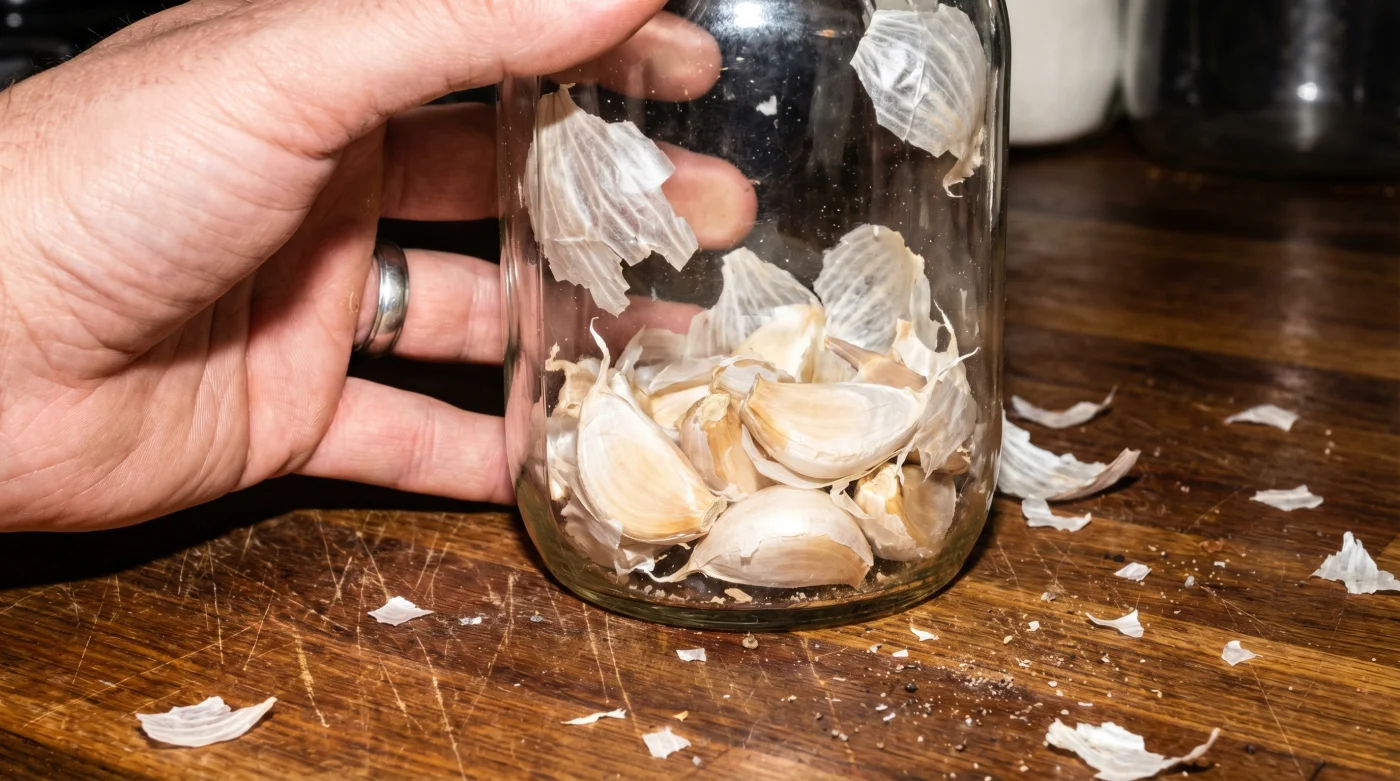
You are standing at the cutting board, the sharp, pungent scent of raw allium already biting at the air. You need six cloves for a slow-simmering beef stew on a cold winter Tuesday, and the papery husks are clinging with stubborn defiance. They tear into frustrating, translucent slivers that paste themselves to your damp fingertips, demanding to be picked off one by one. It is the quiet, tedious toll exacted before the rhythm of cooking actually begins.
There is a particular dread in trying to coax that pale, sticky skin away from the firm flesh beneath. You scrape with a thumbnail, inadvertently bruising the clove and ensuring your hands will broadcast the scent of Sunday dinner well into the middle of the work week. To the home cook, it feels entirely unavoidable, a mandatory physical tax levied on flavour.
But high-volume kitchens do not operate on delicate patience; they operate on momentum and ruthless efficiency. When a prep cook stares down a mountain of raw garlic intended for a massive batch of marinara, they do not stand there picking at it with a paring knife. They rely on the blunt, rattling violence of an empty glass jar. This is the lazy fix that fundamentally changes the math of your evening meal prep, transforming a sticky five-minute annoyance into a jarringly loud, ten-second blur.
The Geometry of Friction
Think of a raw garlic clove’s skin like a vacuum-sealed winter coat. When you try to peel it away slowly, the natural oils and the tight molecular bond act as a powerful adhesive, actively resisting the pull of your fingers. The trick is not to coax the husk off, but to fracture that surface tension all at once. By trapping the unpeeled cloves in an enclosed, hard-walled space, the friction does the work for you, creating a tiny, highly localized earthquake.
As the cloves violently collide with the thick glass and crash into each other, the kinetic impact crushes the rigid air pockets resting between the flesh and the papery husk. The perceived flaw of applying aggressive brute force—an action usually frowned upon in delicate culinary prep—morphs into your greatest advantage. The skins simply shatter under the rapid impacts, separating cleanly and leaving perfectly intact, naked cloves tumbling behind in the glass.
Ask Elias, a 34-year-old line cook working the busy pasta station at a bustling trattoria in downtown Vancouver. During his first gruelling month on the line, he spent hours carefully peeling massive bowls of garlic with a small knife, his thumbs perpetually numb and coated in sticky residue. One afternoon, the seasoned sous chef walked by, swept a handful of unpeeled cloves into a one-litre Bernardin canning jar, screwed the metal lid tight, and shook it like a furious bartender for ten seconds. When he dumped the contents onto the stainless steel counter, the skins shattered like dry autumn leaves, blowing away to reveal pristine cloves. Elias never picked at a garlic skin again.
Tailoring the Agitation
Not every recipe demands a massive harvest of aromatics, and this aggressive method adapts beautifully to whatever scale your evening requires. The vessel you select dictates the efficiency of the peel, relying entirely on the internal volume available. The cloves need room to accelerate; if the jar is tightly packed, they will merely shuffle against one another without generating the blunt-force impact required to break the vacuum seal.
For the Sunday Sauce Purist preparing a rich braise or fifty cloves for a slow-roasted garlic confit, a large, wide-mouth glass jar is the only logical choice. You must leave at least two-thirds of the jar empty to allow gravity and force to do their job. Space creates the blunt impact necessary to detach the skins. Without that empty void, you are just shaking a tightly packed salad.
If you are a weeknight scrambler who just needs two or three cloves for a quick pan of roasted vegetables, a standard empty jam jar or even a hard plastic shaker bottle will easily suffice. The absolute most critical rule for these smaller vessels is ensuring the interior is completely, undeniably dry. Even a single droplet of residual tap water clinging to the glass will cause the papery skins to immediately paste themselves right back onto the garlic flesh, ruining the entire kinetic trick.
It is also worth noting the type of allium you bring home from the market. Canadian farmers’ markets often overflow with hardneck garlic in the late summer, defined by that stiff, central woody stalk. Softneck garlic, commonly found braided in grocery stores year-round, has layers of thinner, clingier paper. Regardless of the variety, the enclosed friction strips the stiff husks away with equal prejudice, though hardneck skins tend to break off in larger, more satisfying shards.
The Mechanics of the Shake
Executing this culinary shortcut requires nothing more than a brief burst of temporary physical vigour. You are not politely tossing a delicate vinaigrette; you are actively trying to rattle the cellular structure of the plant itself. Approach the cutting board with intent, recognizing that ten seconds of noise will save you minutes of tedious, sticky frustration.
To guarantee success on the first attempt, your technique must be deliberate. Secure the lid tightly, plant your feet securely, and keep your movements sharply defined. The entire process takes less time than it takes to heat a splash of olive oil in your favourite cast-iron skillet.
- The Initial Smash: Place the whole, unbroken bulb on your cutting board. Press down firmly with the heavy heel of your hand to shatter the root base and separate the individual cloves. Toss them into the jar, tough root ends and all.
- The Tactical Vessel: Select a hard-sided container. Thick glass is vastly superior to thin plastic because it offers absolute zero shock absorption, forcing the garlic to take the full force of the impact.
- The Violent Shake: Seal the lid. Shake aggressively up and down with strict, piston-like motions for precisely 10 to 15 seconds. You should hear a loud, sharp rattling that slowly dulls as the soft skins separate to cushion the hard cloves.
- The Clean Sort: Pour the chaotic contents out onto your dry cutting board. Simply pluck the heavy, clean, pale cloves from the pile of weightless, loose skins.
Reclaiming the Rhythm of Dinner
Cooking at home often feels burdensome not because of the actual application of heat to food, but because of the relentless friction of raw preparation. It is the tiny, sticky, highly repetitive tasks—like mincing, peeling, and washing—that drain your creative energy long before the pan even begins to sizzle on the stove.
When you completely bypass the mundane tedium of picking at garlic skins, you actively preserve your mental momentum for the evening. You stop viewing fresh, potent ingredients as a mandatory chore and start seeing them as immediate, highly accessible raw materials. The jarringly loud, rattling noise of the glass becomes a functional signal—a starting gun for the meal ahead, reminding you that sometimes the most sophisticated kitchen solutions are simply the ones that require the least amount of fuss.
“Professional cooking is largely about eliminating the quiet frictions; if a prep task annoys you, there is almost certainly a faster, louder way to do it.”
| Key Point | Detail | Added Value for the Reader |
|---|---|---|
| The Vessel | Use a hard, thick glass jar (like a Bernardin canning jar) over thin plastic. | Maximizes blunt-force impact, peeling the cloves twice as fast. |
| Moisture Control | The interior of the jar must be absolutely bone-dry before shaking. | Prevents the papery skins from pasting back onto the sticky flesh. |
| Capacity Limit | Fill the jar no more than one-third full of unpeeled cloves. | Ensures the garlic has enough physical space to accelerate and collide. |
Frequently Asked Questions
Does this method bruise or damage the garlic flesh?
No. The outer skins take the brunt of the kinetic impact. Because the flesh of raw garlic is incredibly dense, a ten-second shake will not bruise or alter the flavour profile of the cloves.Why did my garlic skins stick to the glass instead of peeling?
Your jar was likely damp. Even microscopic water droplets will turn the papery allium skins into a glue-like paste. Always wipe the inside of your vessel with a dry towel first.Can I shake the entire bulb without breaking it apart first?
You must break the bulb into individual cloves first. The root base of a whole bulb is too structurally sound to shatter just by shaking it against glass.Does this trick work on older, slightly soft garlic?
It is much less effective. As garlic ages, the flesh loses moisture and shrinks slightly, making it spongy. The trick relies on the hard density of fresh cloves crashing against the jar.Do I need to cut the hard root ends off before shaking?
Skip the knife entirely. Leave the hard root ends attached during the shake; the violent motion is often enough to snap the dry skins right off the stubborn root base.