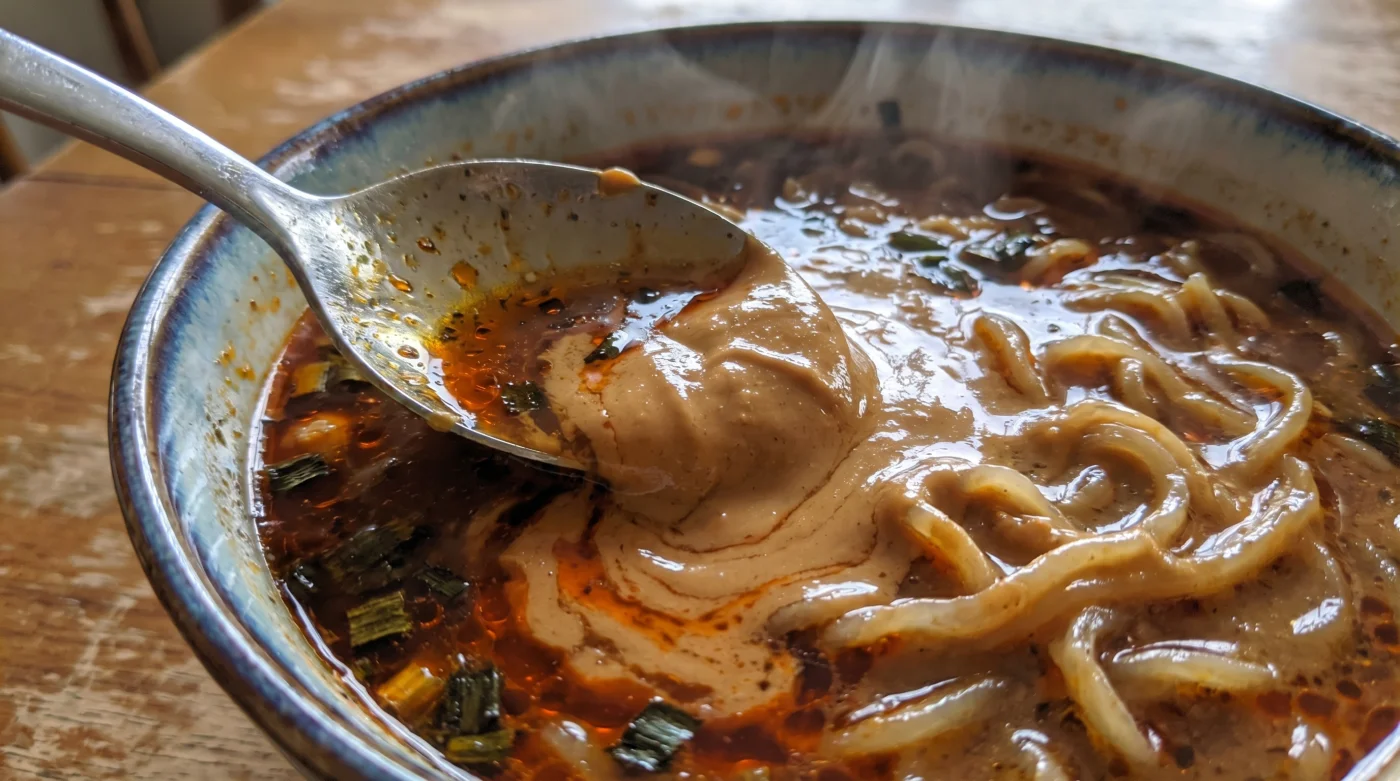
The sharp crackle of cellophane in a dimly lit kitchen. The kettle grumbles on the stove, exhaling a steady plume of white steam against the frosted window pane. Outside, the temperature sits firmly at minus five Celsius, a damp Canadian cold that settles right into your bones after a long commute on the highway. Your boots are dripping by the door. You are staring down a block of dehydrated noodles, an emergency dinner that usually promises little more than salt, MSG, and a fleeting sense of immediate regret. It is the meal of last resort.
But what if that crinkling foil packet was not actually a symbol of defeat? Instead of watery artificial broth, you can coax a remarkably deep, glossy soup from those brittle, pale waves of wheat. The secret is sitting entirely ignored in your cupboard, completely detached from the world of fine dining or complex culinary techniques. It requires no chopping, no extra pans, and absolutely no stress.
The lazy fix lies in a single, generous scoop of everyday peanut butter. It sounds like a chaotic college experiment born of desperation, but this is a genuine, science-backed culinary sleight of hand. When introduced to boiling water and a harsh spice packet, the fat and protein of the peanut spread undergo a rapid, brilliant transformation. The heat melts the solid fats, while the water forces the proteins to uncoil and suspend throughout the bowl.
It acts as a heavy, dependable binding agent, instantly altering the structural integrity of your late-night bowl. The liquid turns thick and luxurious, clinging to each individual noodle like a heavy cream. Suddenly, a sixty-cent meal masquerades as a deeply comforting bowl of ramen you might queue for an hour outside a damp downtown noodle shop just to taste. It bridges the gap between poverty-meal and premium comfort in under four minutes.
The Perspective Shift: Scaffolding Over Soup
Think of instant ramen not as a finished, inflexible dish, but as raw scaffolding. We so often assume the small foil packet holds the absolute final word on flavour. We pour the boiling water, stir half-heartedly with a plastic fork, and accept the thin, translucent liquid that results as our inevitable fate. We tell ourselves it is just cheap food, meant to be consumed quickly and forgotten even faster.
That watery, predictable texture is exactly what we are going to exploit. Treat the thin liquid as a primer for heavier richer layers. Peanut butter provides the missing structural integrity, bringing both natural, slow-melting fats and a deep, roasted earthiness that the dehydrated packet entirely lacks. The salt in the seasoning acts as an anchor, bringing out the savoury notes of the peanut rather than the sugar.
Elias Thorne, a 34-year-old sous chef working the pass at a demanding, high-volume bistro in Toronto, practically lives on this technique. After grueling 14-hour shifts plating delicate micro-greens and managing finicky, temperature-sensitive emulsions, the absolute last thing Elias wants to do is actively cook at two in the morning. He drops the cheap noodles into a rolling boil, tosses the neon-coloured flavour dust into a heavy ceramic bowl, and violently whisks in a tablespoon of smooth peanut butter before adding the starchy cooking water. “It instantly mimics the dense mouthfeel of a twelve-hour pork bone broth,” he notes, dragging a wooden chopstick through the opaque, golden liquid. “It is not authentic tonkotsu by any stretch of the imagination, but to your exhausted brain, it is exactly the same warmth and comfort.”
Elias and his reliable late-night ritual prove a beautiful, empowering point about home cooking. You do not need expensive luxury to feel well-fed, just a basic, confident understanding of how simple fats and starches interact under heat. The kitchen responds to technique far better than it responds to a massive budget.
Deep Segmentation: Adapting the Emulsion
Not all peanut butter behaves the exact same way when it finally hits the hot water. Your approach to this brilliant modification will shift entirely depending on what you crave most at the bottom of the bowl. You have options, and understanding them allows you to customize the lazy fix to suit your precise mood.
If you prefer a pure velvet texture, standard commercial smooth peanut butter melts into the broth with virtually zero resistance. The added sugars, stabilizers, and emulsifiers in these common jars actually work heavily in your favour here, turning the soup into a creamy, opaque gold that coats the back of a spoon and wraps around every single noodle perfectly.
For the textural purist, natural, oil-separated peanut butter requires a little bit more upfront effort. Because it lacks commercial stabilizers, you need to vigorously whisk it with a tiny splash of the hot water first to prevent ugly clumping. The payoff, however, is massive: a cleaner, more deeply roasted peanut flavour that allows the salty seasoning packet to shine through beautifully, without ever tasting distinctly sweet or cloying.
Then there is the dedicated heat seeker. Simply drop bright, crunchy chili crisp and peanut butter into the bottom of your empty bowl before adding any liquid at all. The fiery, infused chili oil cuts right through the dense, heavy nut butter, creating an addictive, Dan-Dan noodle inspired hybrid that warms you from the inside out, aggressively cutting through the bitterest, darkest winter chill.
Mindful Application: The Tactical Toolkit
Executing this trick flawlessly requires speed and a very specific order of operations. If you just recklessly drop a cold, dense lump of peanut butter onto floating noodles, it will sit there like a stubborn stone, refusing to melt into the surrounding water. The noodles will overcook while you desperately try to mash the peanut butter against the side of the bowl. You must build the broth foundation before the noodles ever touch the ceramic.
The vital, non-negotiable secret is building a slurry. By intimately mixing the heavy fats with the dry, salty seasoning first, you force an immediate, seamless emulsion when the rush of hot water finally hits the bowl.
- Empty the ramen seasoning packet entirely into your empty serving bowl.
- Add one generous tablespoon of peanut butter directly over the dry powder.
- Pour in two tablespoons of boiling water and whisk vigorously with a fork until it forms a thick, uniform paste.
- Add the cooked noodles and the remaining hot water, stirring gently to integrate the paste into a rich broth.
Keep your ratios exceptionally tight to avoid overwhelming the delicate, fried wheat noodles. For a standard 500ml water requirement—typical for most instant packets—one heaping tablespoon of peanut butter is the absolute maximum ceiling. Any more than that, and the soup rapidly devolves from a rich broth into a heavy, unmanageable sludge that coats your palate unpleasantly.
The entire technique relies on specific ratios and precise, immediate heat. The water temperature needs to be right off the rolling boil, ideally hovering around 95 Celsius, to properly melt the stubborn peanut fats before the noodles have a chance to turn completely mushy and ruin the entire meal.
The Bigger Picture: A Bowl of Quiet Comfort
There is a specific, highly satisfying kind of quiet joy in transforming the mundane into the genuinely magnificent. We spend so much of our precious time chasing complicated, multi-step recipes, buying obscure, single-use ingredients that sit gathering dust on the highest pantry shelf just to feel like we are eating well. We overcomplicate dinner in the pursuit of quality.
This incredibly simple, low-effort trick reminds us that great food is clever mechanics. It proves, without a doubt, that you do not need a sprawling, expensive kitchen or a massive grocery budget to feel deeply cared for at the end of a very long, physically demanding day. A few cents and a pantry staple are entirely enough.
When you finally pull the hot bowl close to your chest, breathing in the thick steam rich with roasted nuts and savoury, aromatic spices, you aren’t just eating cheap instant noodles anymore. You are savouring a quiet, fiercely personal victory. You made something incredible out of practically nothing, and it tastes brilliantly, perfectly rich.
The true magic of the kitchen happens when we stop staring at the price tag of an ingredient, and start looking at its structural potential.
| Key Point | Detail | Added Value for the Reader |
|---|---|---|
| Emulsion Setup | Whisking peanut butter with seasoning before adding full water. | Prevents clumping and guarantees a glossy mouthfeel. |
| Temperature Control | Using water just off the boil (95 Celsius). | Melts natural fats instantly without scalding the nut proteins. |
| Flavour Balance | Pairing the savoury packet with a fatty base. | Cuts artificial saltiness while doubling the perceived richness. |
Frequently Asked Questions
Does natural peanut butter work as well as commercial brands?
Yes, though natural varieties require slightly more vigorous whisking to fully emulsify into the broth without leaving tiny specks of fat behind.Will the soup taste too sweet?
Not if you rely on the ramen’s salty seasoning packet to perfectly counter the natural sweetness of the peanuts.Can I use other nut butters for this trick?
Almond butter offers a delicate, floral alternative, while tahini provides a sharp, sesame-forward bite that feels incredibly authentic.Do I use the entire seasoning packet?
Yes, the dense fat of the peanut butter actually mutes the harsh saltiness, so the full packet provides the necessary balance.How do I stop the peanut butter from sticking to my spoon?
Dip your spoon into the boiling water for five seconds before scooping; the heat allows the butter to slide off instantly.