It happens in the quiet chill of a Tuesday evening. You slide open the crisper drawer, anticipating the sharp, crystalline bite of an aged Balderson cheddar to finish off your day, only to be met with a dusty green shadow blooming beneath the cling film. The cheese has sweat itself into ruin, leaving you staring at a twelve-dollar block of dairy that now belongs in the compost bin.
The block is trapped in suffocating plastic, its surface slick with pooled condensation. This persistently wet environment is exactly what airborne spores need to thrive, turning your carefully selected wedge into a frustrating biology experiment before you even had the chance to grate it over your pasta.
We are conditioned to seal our groceries as tightly as possible, wrapping every leftover and raw ingredient against the harsh, circulating air of a modern refrigerator. But we forget that cultured dairy is an active, breathing organism that requires a delicate exchange of oxygen to maintain its character and structural integrity.
By forcing an airtight seal, you drown the natural milk oils, forcing the cheese to marinate in its own expelled moisture. The solution to this everyday culinary disaster does not require expensive specialty bags or complex vacuum systems; it is already sitting quietly in your pantry, waiting to be repurposed.
The Lungs of Your Deli Drawer
Think of standard cling film as a heavy rubber raincoat. It effectively keeps outside water away, but if you run a marathon wearing it, you will end up drenched in your own sweat. Wrapping your cheese in heavy plastic is like forcing it to sleep while breathing through a pillow. Cheese, especially natural rind varieties, behaves exactly the same way under refrigeration.
By switching to a porous material, you create a breathable, protective membrane. This is where your standard roll of baking paper steps in, offering a simple kitchen fix that shifts your role from simply storing food to actively managing its microscopic climate.
This everyday parchment possesses a subtle silicone coating that prevents the dairy proteins from sticking, yet the paper fibres remain entirely permeable to air. It catches the expelled moisture and allows it to slowly evaporate into the ambient air of the fridge, rather than pooling on the freshly cut face of the block.
What previously felt like an inevitability—those creeping, wet green mould spores—is suddenly revealed as a completely avoidable symptom of aggressive packaging. When you understand that your food needs to exhale, you stop fighting the natural environment and start working quietly alongside it.
Marc-Antoine, a 42-year-old affineur managing a small aging cellar outside of Trois-Rivières, spends his mornings turning and brushing wheels of raw-milk tomme. He watches the subtle interactions between air flow, cave humidity, and milk fat at precisely 11°C, treating each wheel with profound respect.
“When people bring a wedge home, they immediately choke the delicate paste in plastic wrap,” he explains, wiping his hands on a heavy canvas apron. “To preserve the sweet notes and keep the rind dry, you must wrap it like a fragile gift in paper. The cream should tremble when you cut it, never sweat.”
Tailoring the Wrap to the Rind
Not all blocks behave the same way under the cold, drying lights of your fridge. Treating a crumbly blue the same way you treat a dense, waxy Gouda is a recipe for cross-contamination and textural disappointment.
For hard and aged varieties, the paper prevents harsh, brittle drying. A dense Parmigiano-Reggiano or a five-year aged cheddar holds very little moisture, meaning its primary threat is actually the aggressive fan of your refrigerator turning it to stone. The baking paper acts as a gentle windbreaker, slowing down the drying process while entirely preventing any rare condensation from fostering wet rot.
Semi-firm cheeses like Havarti, Monterey Jack, or young Cheddar require a more balanced approach. These are the blocks most prone to sweating under plastic, as their higher internal moisture content actively fights against tight, artificial seals.
When swaddled correctly in parchment, the surface remains perfectly tacky, feeling neither slimy to the touch nor cracked. You will notice the colour remains vibrant and uniform, rather than developing those hard, dark, translucent edges that usually need to be sliced away and discarded.
Soft and bloomy rinds, such as Brie or Camembert, demand the highest volume of ambient oxygen. They are fiercely alive, and suffocating them will cause an immediate buildup of ammonia, ruining the flavour profile and leaving a chemical burn on the palate.
Wrapping them loosely allows the delicate white rind to survive, maintaining that earthy, mushroom-like aroma that defines a proper soft cheese. If you notice a harsh, sharp smell when opening your container, it is crying out for fresh air and a fresh layer of breathable paper.
Mindful Application and The Fold
Moving away from plastic wrap requires a slight, intentional adjustment in your evening kitchen routine. It is a mindful process, a fleeting moment of actually paying attention to the physical properties of the food that sustains you.
Gather your basic tactical toolkit: baking paper, tape, and marker. You do not need to measure perfectly, but you do need enough slack to completely enclose the wedge without pulling the paper taut against the delicate, sharp corners of the dairy.
- Tear off a sheet of baking paper roughly three times the size of your cheese block.
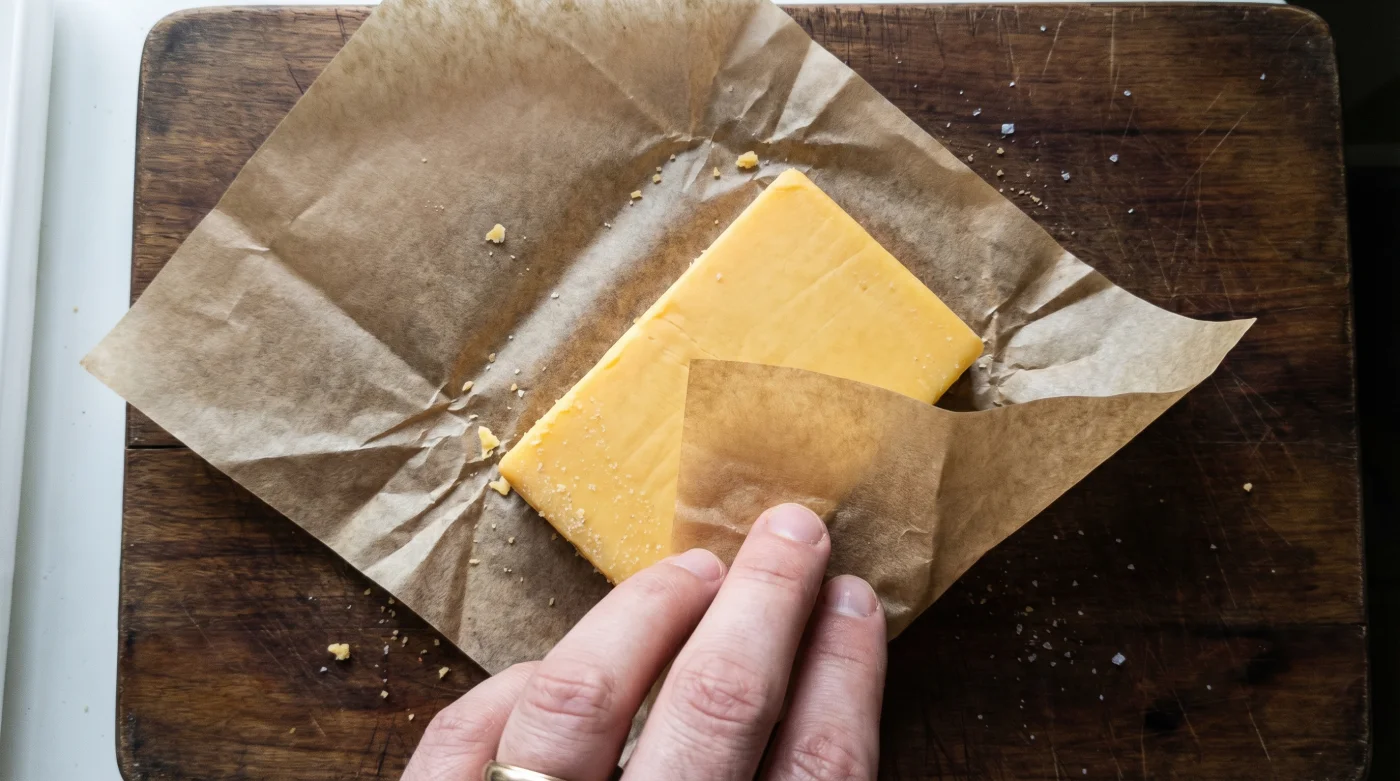
- Place the wedge diagonally in the centre of the parchment sheet.
- Fold the bottom corner up and over the cut face, pulling it gently but not tight.
- Crease the sides inward like you are wrapping a delicate present, tucking the wings flat underneath the block.
- Fold the top down and secure the final flap with a single piece of masking tape.
- Write the date and the specific variety on the tape so you never lose track of your crisper inventory.
Once wrapped, place the neat package back into the crisper drawer. This specific compartment naturally maintains a slightly higher humidity level than the open main shelves, which typically hover around 4°C, mimicking the gentle, damp conditions of a proper aging cave.
If you are highly sensitive to odours transferring between strong ingredients, you can place the paper-wrapped block inside an unsealed plastic container or a partially open zip-top bag. This provides a secondary barrier against the circulating airflow while still allowing the primary paper layer to breathe effectively.
The Quiet Satisfaction of Preservation
Mastering this small, seemingly mundane physical detail fundamentally changes how you interact with your weekly groceries. It shifts your kitchen from a place of rapid, mindless consumption and inevitable waste to a space of deliberate, respectful preservation.
There is a distinct peace of mind found in pulling back paper to reveal a block of cheddar exactly as pristine as the day you brought it home from the market. You stop throwing away money on spoiled, fuzzy edges, and you stop ingesting the muted, off-flavours of suffocated dairy.
This straightforward method is a quiet return to how food was handled long before the rapid convenience of petrochemical plastics took over our pantries and changed our habits. It is a practical nod to the farmers and artisans who spent months or years carefully cultivating those complex flavours.
By simply choosing a sheet of baking paper, you honour the traditional craft involved in cheesemaking. You step away from being merely a consumer, becoming the careful final caretaker of the ingredient, ensuring every single slice is as vibrant, clean, and delicious as the maker intended.
“Respect the milk long after it leaves the farm; let your cheese breathe quietly, and it will feed you beautifully.” — Marc-Antoine, Affineur
| Storage Material | Microclimate Effect | Added Value for the Reader |
|---|---|---|
| Cling Film / Plastic Wrap | Traps 100% of moisture and halts airflow. | None. Actively promotes wet green mould and slimy, degraded textures. |
| Aluminum Foil | Blocks air completely but reacts to surface acidity. | Can leave an unpleasant metallic taste on aged or blue veined cheeses. |
| Baking Paper / Parchment | Acts as a permeable, non-stick silicone membrane. | Balances surface humidity, prevents green mould, and saves money on wasted food. |
Common Deli Drawer Dilemmas
Can I use wax paper instead of baking paper?
Wax paper is heavily coated in paraffin and is far less breathable than parchment. It can trap moisture almost as aggressively as plastic, so stick to uncoated or lightly silicone-treated baking paper for best results.What if my cheese already has a small spot of green mould?
For hard cheeses like cheddar or parmesan, you can safely cut away the mouldy spot plus one inch of the surrounding cheese. Once removed, wrap the clean remaining block in fresh baking paper.Does this method work for sliced deli cheese?
Pre-sliced processed cheese dries out very quickly due to the high surface area. Baking paper can work for a day or two, but sliced cheese is generally better kept in an airtight container to prevent the thin edges from curling.Should I change the baking paper after a few uses?
Yes. If the paper becomes heavily stained with butterfat or starts to feel overly damp and limp, simply replace it with a fresh sheet to maintain the correct breathing environment.Is parchment paper the exact same thing as baking paper?
In Canadian kitchens, the terms are used interchangeably. Both refer to heavy paper treated with a thin layer of silicone, making it non-stick and heat resistant, which is perfect for this storage method.