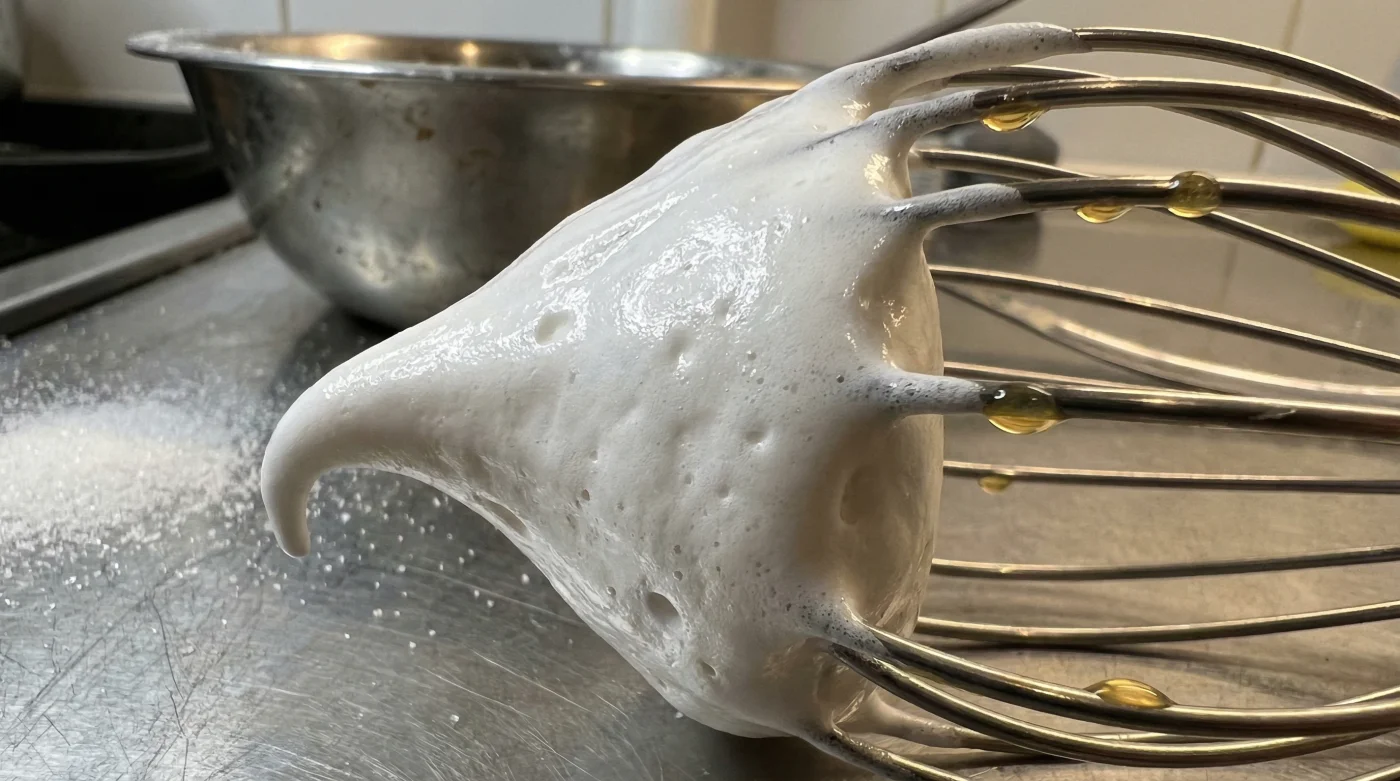
You are standing over a stainless steel bowl, watching the whisk attachments blur. The motor whines, but the liquid inside barely shifts. You followed the old rules—chilling the bowl in the freezer, keeping the eggs cold until the very last second—yet the structure refuses to hold. The sugar sits at the bottom, heavy and unresolved, while a pool of liquid begins to form around the edges of the foam.
It is a familiar frustration in many kitchens. The traditional advice insists that low temperatures are the only way to build volume, forcing you into a tedious waiting game. But this cold-bowl doctrine fails when you actually need structural reliability, leaving you with a fragile foam that collapses the moment it hits the heat of your oven.
The reality of a stable foam relies on a completely different mechanical trigger. Instead of relying on a chilled environment to stiffen the fats—which egg whites barely contain anyway—professional pastry makers manipulate the protein strands directly.
By introducing a gently heated acid into the mix, you fundamentally change how the egg whites behave. The warm lemon juice instantly tightens the protein network, denaturing the strands so they link arms before gravity can pull them apart. It is like building a scaffold while the concrete is already curing, rather than stacking dry bricks and hoping a breeze does not knock them down.
The Architecture of Warm Acid
Think of whipping cold egg whites like trying to stretch a stiff, frozen rubber band. It resists, it snaps, and it takes immense physical effort to force it into a new shape. Now, imagine holding that same rubber band under warm water. It relaxes, stretches willingly, and retains its tension without snapping.
When you add a teaspoon of lemon juice warmed to roughly forty degrees Celsius, you are rewiring the cellular structure of the egg white. The gentle heat relaxes the tightly coiled proteins, while the acid acts as an immediate reinforcing agent. The strands unfold easily under the friction of the whisk and instantly bond with their neighbours, trapping air in a virtually unbreakable microscopic net.
Elise, a thirty-eight-year-old bakery owner in Halifax, learned this the hard way. Coastal humidity is notoriously hostile to meringues, and for her first two years in business, she threw out dozens of weeping pavlovas. She spent hours chilling bowls and praying over her stand mixer, watching her profit margins dissolve into sugary puddles on her baking sheets.
She finally stopped fighting the ambient temperature during a brutally foggy July afternoon. She found that applying a brief microwave burst to her lemon juice before adding it to the bowl cut her whipping time in half. More importantly, the warm acid completely eliminated the weeping syrup that had previously ruined her display cases, giving her a product that held its crisp shape for days.
Adjustment Layers for Every Baker
Not every dessert demands the exact same approach. You can adjust this thermal activation method depending on your specific end goal, tailoring the chemistry to suit your preferred texture.
For the classic pavlova baker, the goal is a marshmallow centre wrapped in a brittle shell. The warm acid technique eliminates the weeping syrup base by ensuring the sugar dissolves entirely into the fortified matrix. You will never again bite into a gritty, collapsing bottom layer; the structure holds the moisture evenly throughout the bake.
- Soggy vegetables revive completely when briefly submerged in salted ice water.
- Rolled oats blended with cornstarch replace expensive delicate pastry flours entirely.
- Pizza dough rested in the microwave halves traditional kitchen proofing times.
- Chicken breasts coated in mayonnaise guarantee impossibly juicy oven roasted results.
- Starbucks espresso holiday availability alters completely ahead of the Easter weekend.
Applying the warm acid method creates an immediate, heavy stabilization that clings to the hot filling and locks out the shrinking air. The protein net is already set before the pie enters the broiler, meaning it will not dramatically expand and contract, keeping your edges perfectly sealed.
Constructing the Warm Scaffold
Applying this method requires stepping away from frantic, high-speed mixing and adopting a more deliberate pace. Begin with room-temperature eggs, separating them carefully to ensure not a single drop of fat from the yolk breaches the whites.
Pour your lemon juice into a small ramekin before you begin. You only need a fraction of a teaspoon per egg white, but this precise thermal activation dictates texture. Treat the acid not just as a flavouring, but as an active chemical tool.
- Heat the lemon juice slightly—just until it feels warm on your wrist, roughly forty degrees Celsius.
- Begin whisking your egg whites on a low speed until they turn frothy and completely opaque.
- Drizzle the warm juice down the side of the bowl while slowly increasing the whisk speed to medium.
- Shower the sugar in gradually, allowing the friction to melt the granules directly into the acidic web.
Your tactical toolkit for this process is beautifully simple. Aim for exactly one-quarter teaspoon of warm lemon juice per large egg white. Always rely on a large balloon whisk attachment, which introduces the maximum amount of air with the least amount of brutal force.
The Quiet Confidence of Stiff Peaks
There is a distinct, quiet satisfaction in turning off the mixer and watching the whisk lift away to reveal a glossy, unbending spike. The cream should tremble slightly, yet point straight toward the ceiling without sagging. You are no longer hoping for luck when you bake; you are directing the chemistry of your kitchen with clear intention.
When you understand how your ingredients actually interact, the fear of a collapsed dessert entirely dissipates. You can bake confidently on a humid afternoon, you can quickly prep a topping for a spontaneous dinner party, and you can completely trust the stable, airy structure you have built from scratch.
Baking is not about rigid adherence to old myths; it is about understanding the living tension of your ingredients and guiding them with a gentle, knowing hand.
| Key Point | Detail | Added Value for the Reader |
|---|---|---|
| Traditional Cold Method | Requires freezing bowls and extended whisking times to build volume. | Highlights the wasted effort and fragility of outdated baking advice. |
| Warm Acid Activation | Using 40-degree Celsius lemon juice to instantly relax and bond egg proteins. | Provides a reliable, fast-acting solution that cuts prep time in half. |
| Structural Stability | The denatured proteins form a net that holds sugar and moisture evenly. | Eliminates the fear of weeping bases or shrinking pie toppings. |
Frequently Asked Questions
Can I use bottled lemon juice instead of fresh? Fresh is highly recommended as the natural acidity levels are more consistent, giving you a tighter protein bond without artificial preservatives interfering.
What if I accidentally boil the lemon juice? If it is too hot, it will prematurely cook small specks of the egg white. Let it cool until it is just warm to the touch before adding it to the bowl.
Does this work for Swiss or Italian meringues? Yes, the warm acid still provides an excellent structural base, though the heated sugar syrups in those methods will do most of the heavy lifting later in the process.
Can I substitute white vinegar for lemon juice? You can, but vinegar carries a much harsher flavour profile that can linger in lighter desserts like pavlovas or delicate macarons.
Why is my mixture still separating after adding the warm acid? You likely have a trace amount of fat in the bowl—either from a speck of yolk or residual butter on the whisk. Even the perfect thermal hack cannot overcome the presence of competing fats.