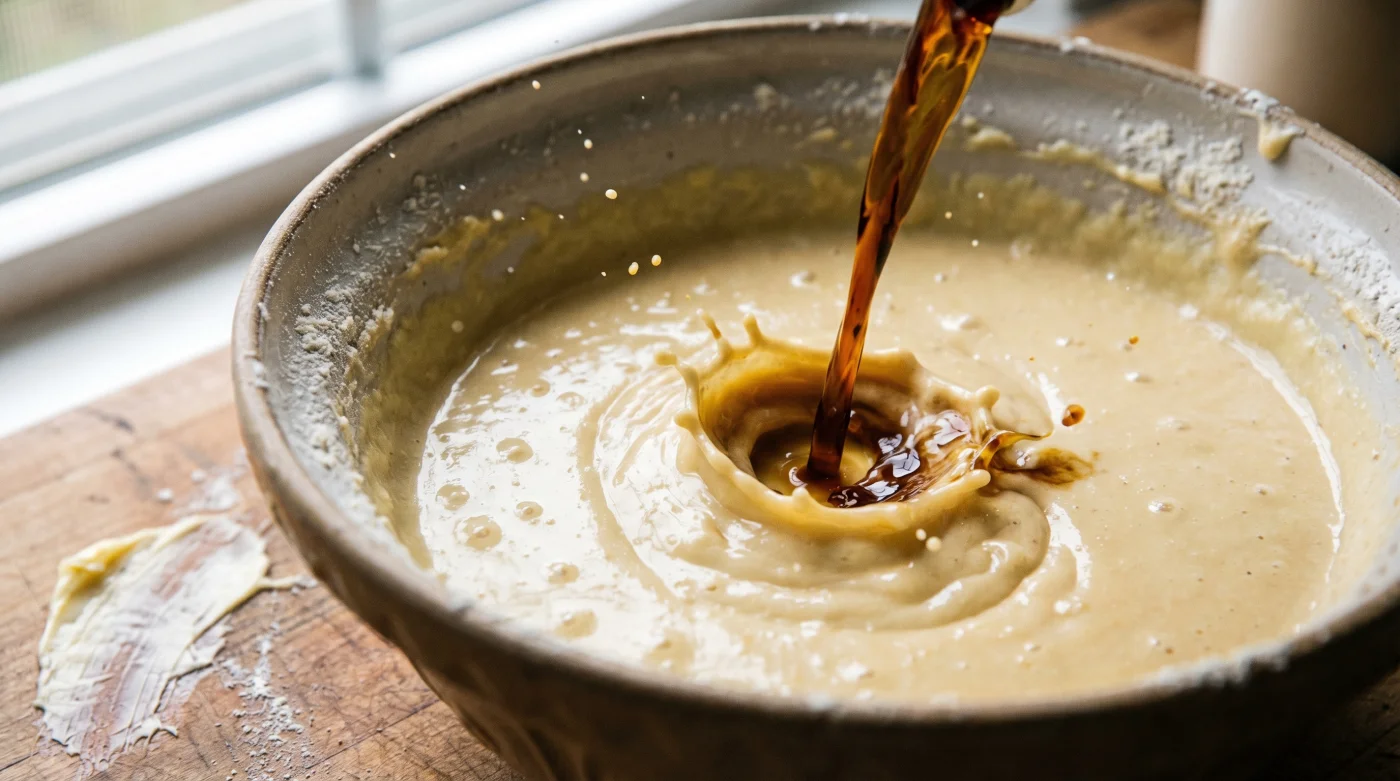
The late afternoon light catches the frost creeping up the kitchen window, casting a pale, cold glow across the countertop. You tear open the foil pouch of a standard yellow cake mix, and the resulting cloud of dry powder settles into the bowl. It smells faintly of nostalgia, but beneath that familiar sweetness is something remarkably flat—a hollow, distinctly artificial scent that betrays its cardboard origins.
We have been conditioned to accept this compromise. You trade the labour of measuring flour, baking powder, and salt for a convenient shortcut, assuming the resulting slab of cake will be merely acceptable, never extraordinary. The crumb will be soft, but the flavour will vanish the moment you swallow.
But a professional kitchen rarely views a pre-mixed product as a finished blueprint. Instead, think of that powdered mix as a blank, unprimed canvas. The chemical leavening agents and pre-measured starches provide an infallible structural integrity that prevents your cake from collapsing in the centre. They do the heavy lifting, leaving you free to engineer the soul of the dish.
The secret to erasing that manufactured aftertaste requires exactly one aggressive modification. By introducing a heavy, deliberate dose of real vanilla extract, you immediately override the artificial flavour profiles, tricking the palate into registering the warmth and complexity of a scratch-made pastry.
The Architectural Metaphor: Building on the Box
Consider the anatomy of a cheap baking mix. It is chemically designed for shelf stability, stripping away volatile aromatic oils that naturally occur in fresh ingredients. When you add water and neutral vegetable oil as the back of the box suggests, you are merely hydrating a ghost. There is nothing in that combination to capture the senses.
This is where the real vanilla steps in to do the heavy emotional labour. Real vanilla is not just a flavour; it is a complex organic compound containing over two hundred distinct flavour notes. When introduced to the batter, it acts like a weighted blanket, smothering the metallic chemical tang of commercial preservatives.
You are no longer following rigid instructions printed by a corporation. You are managing a system. You are taking the reliable concrete foundation poured by the box and choosing to lay down rich hardwood floors.
The Caterer’s Confession
Elise Boucher, a 42-year-old high-volume pastry chef working out of Montreal’s east end, relies entirely on this principle. While her bespoke wedding cakes are built from scratch, her corporate catering trays often begin with massive bags of commercial mix. She doesn’t hide it, because her clients never suspect the humble origins. Her signature move is replacing the suggested water with whole milk and adding a heavy, unapologetic tablespoon of pure Mexican or Madagascar vanilla extract per box. The pure extract blooms in the oven, filling the venue with a scent so intoxicating that guests immediately assume the kitchen has been scraping fresh vanilla beans since dawn.
Adjustment Layers: Tailoring the Foundation
Not every baking scenario requires the exact same approach. Depending on who you are feeding and how much time you have before the guests knock on the front door, you can alter the density and richness of your modified cake.
For the time-strapped parent running between piano lessons and hockey practice, the priority is speed without sacrificing comfort. You do not need to alter the liquids or fats at all. Simply adding two teaspoons of real vanilla to the standard oil-and-water batter will dramatically warm the final crumb, shifting the taste from a sterile grocery store aisle to a neighbourhood bakery.
For the texture purist, the vanilla alone is not quite enough to fix the mouthfeel. A box cake often bakes up uncomfortably spongy. To match the dense, velvety crumb of a professional tier cake, you must address the fat content alongside the flavour.
Swap the neutral vegetable oil for an equal measure of melted, unsalted butter, and replace the tap water with whole milk. When paired with your high-quality vanilla extract, the butterfat carries the aromatic vanilla oils evenly through every slice, resulting in a cake that feels expensive on the fork.
The Tactical Toolkit: Mindful Application
Executing this professional pivot requires a gentle hand and an understanding of timing. You do not want to overwork the gluten in the mix, nor do you want to flash-burn your expensive vanilla extract by slamming it into a poorly calibrated oven.
Approach the bowl methodically. Whisk your wet ingredients together first, allowing the vanilla to fully integrate with the eggs and dairy before they touch the dry starches. This ensures an even distribution of flavour without requiring excessive beating of the batter.
Keep your environment controlled. An oven running too hot will cause the top of the cake to dome and crack, letting the volatile aromatic compounds of the vanilla evaporate into the kitchen rather than staying trapped inside the crumb.
Follow these specific parameters to guarantee a flatter, deeply hydrated cake that traps the vanilla aromatics perfectly inside the crumb.
- The Golden Ratio: Use 10 to 15 millilitres (2 to 3 teaspoons) of pure vanilla extract per standard 432-gram box of cake mix.
- The Liquid Shift: Replace water with whole milk or buttermilk at a 1:1 ratio.
- The Fat Upgrade: Swap oil for melted butter, cooled slightly so it doesn’t scramble your eggs.
- The Temperature: Bake at exactly 160 Celsius (325 Fahrenheit) rather than the standard 175, increasing the baking time by five to eight minutes.
A Quiet Victory in the Kitchen
There is a quiet dignity in knowing how to cheat the system effectively. Baking carries a heavy burden of expectation—we are told that if we do not suffer over a cutting board, cutting cold butter into pastry flour until our wrists ache, we are somehow failing our families.
But hospitality is not about martyrdom. It is about the feeling you create when you set a plate down on the table. By understanding how a few drops of complex, real vanilla can rewire a cheap commercial base, you reclaim your afternoon.
You get to present a warm, beautifully fragrant dessert that tastes like a Sunday morning in a professional patisserie, without the exhaustion that usually accompanies it. You are left with a cake that holds its head high, and the energy to actually sit down and enjoy a slice.
A boxed mix gives you the bricks, but pure vanilla extract is the mortar that makes it feel like a home.
| Key Point | Detail | Added Value for the Reader |
|---|---|---|
| The Core Pivot | Add 10-15 ml of real vanilla to any boxed mix. | Instantly masks artificial preservatives with complex, organic warmth. |
| Fat Substitution | Replace vegetable oil with equal parts melted butter. | Butterfat binds to the vanilla oils, carrying the flavour deeply into the crumb. |
| Temperature Control | Bake at 160 Celsius instead of the standard 175. | Prevents doming and traps the volatile vanilla aromatics inside the cake. |
Frequently Asked Questions
Can I use imitation vanilla instead of pure extract?
Imitation vanilla lacks the hundreds of complex flavour compounds found in real vanilla. While it adds a generic sweetness, it will not successfully mask the chemical undertones of a boxed mix.Will adding extra liquid make the cake soggy?
No, as long as you swap the recommended water for milk at a 1:1 ratio, the hydration level remains identical. The fat in the milk simply enriches the crumb.Does this trick work for chocolate cake mix?
Yes. Vanilla acts as a flavour enhancer for chocolate, rounding out the bitter cocoa notes and making a standard chocolate box mix taste significantly richer.Should I increase the baking time if I use milk and butter?
The ingredients themselves do not require more time, but if you drop the oven temperature to 160 Celsius to protect the vanilla aromatics, you will need to add five to eight minutes to your timer.Can I add vanilla bean paste instead of extract?
Absolutely. Vanilla bean paste brings the same complex flavour profile as a high-quality extract, with the added visual appeal of real vanilla specks throughout a white or yellow cake.