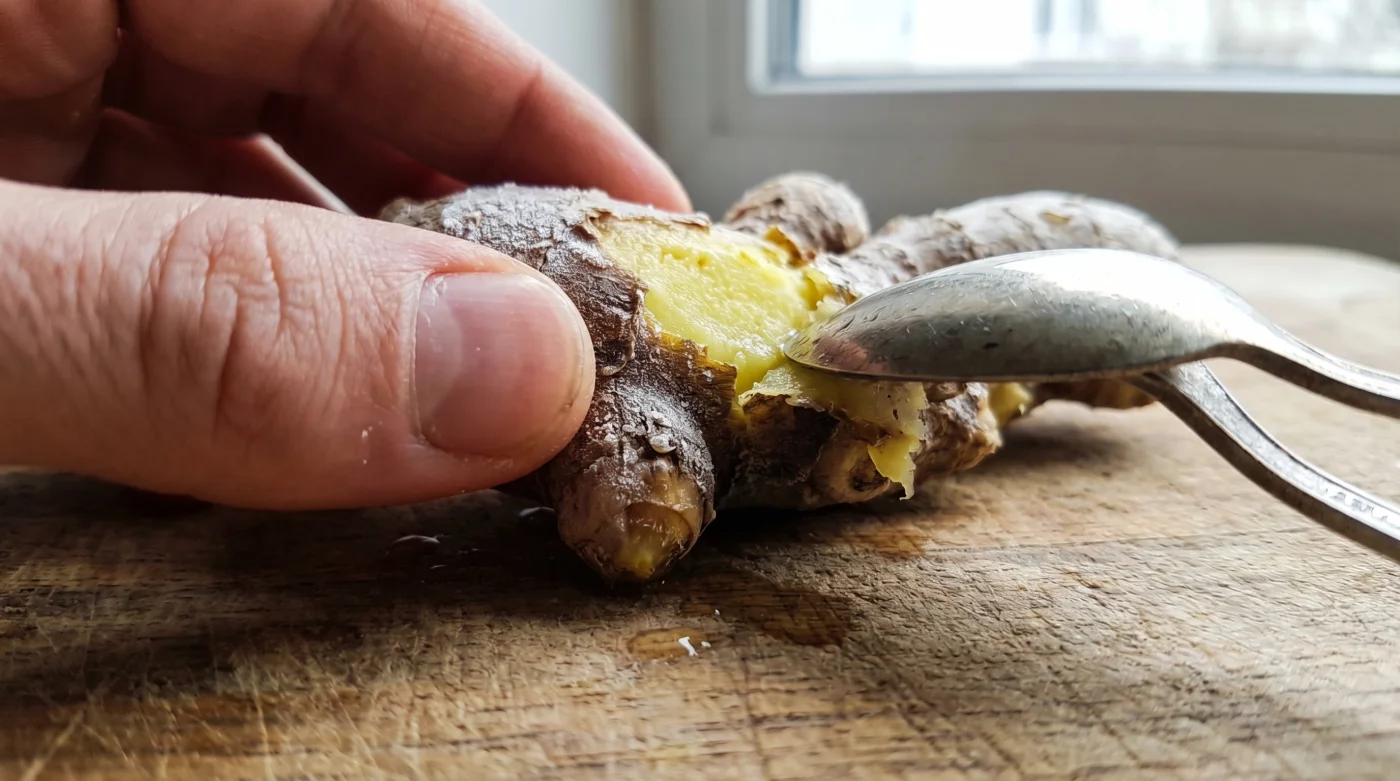
You stand at the kitchen island, staring down a knobby, asymmetrical root. The cutting board is clear, the heavy cast-iron skillet is warming on the stove, and the sharp, deeply savoury scent of garlic already hangs in the air. Yet, this final ingredient always stalls your momentum, turning the rhythm of cooking into an irritating chore.
Peeling fresh ginger root often feels like a tedious negotiation you are ultimately bound to lose. You grab a standard teaspoon to scrape away the paper-thin skin, snapping the brittle edges of the root, or you take a sharp paring knife and accidentally carve away half the fragrant yellow flesh just to reach the usable centre.
Even when you manage to strip it bare, the fibers catch in your metal grater, leaving a bruised, stringy mess hanging from the teeth while the precious juice pools uselessly on the wooden board. It is a mundane, sticky frustration that quietly discourages you from cooking the vibrant, spiced food you actually crave on a dark Tuesday evening.
But the permanent solution requires no special culinary skills or expensive gadgets. The secret to perfect, effortless ginger does not live inside your knife block or utensil drawer. It lives quietly behind the frosted door of your kitchen freezer.
Redefining the Fibrous Matrix
Think of ginger not as a dense vegetable, but as a tightly packed bundle of damp twine. When you try to cut or grate damp twine at room temperature, it bends, frays, and stubbornly resists the blade. The inherent moisture inside the ginger actively fights your efforts, yielding those stubborn, woody hairs that ruin the delicate texture of a smooth soy glaze or a rich coconut broth.
By dropping it into a sub-zero Celsius environment, you change the physical structure of the root entirely. The water trapped inside the cellular walls freezes solid, turning that pliable, frustrating twine into a rigid, glass-like matrix that surrenders beautifully to friction.
This is the subtle perspective shift that transforms a daily annoyance into a deeply satisfying cooking ritual. Instead of peeling and bruising a wet root, you hold a rock-solid block. As it meets the fine metal teeth of a grater, the frozen skin dissolves into the sheerest, unnoticeable dust, while the yellow flesh falls in a delicate, snow-like pile. You skip the peeling phase entirely, and the fibrous flaw becomes the exact reason it grates so flawlessly.
Consider Elias Tremblay, 42, a prep chef working at a relentlessly busy Asian-fusion brasserie in downtown Montreal. Every single morning before service, Elias is responsible for processing over three kilos of fresh ginger root. For years, he lost hours to the spoon-scraping method, his hands perpetually cramped and smelling of sharp citrus. Then, a veteran sous-chef pointed him toward a frosted plastic bin sitting quietly at the back of the walk-in freezer. Elias quickly realized that the freezing process not only saved him hours of tedious prep work but also preserved the sharp, peppery bite of the root for months. Today, he simply grabs a frozen nub, grates exactly what the massive woks require, and tosses the rest back into the ice.
Adapting the Chill to Your Routine
How you choose to implement this trick depends entirely on your personal rhythms and typical cooking habits. The freezer method bends gracefully to fit whatever shape your week takes, offering a tailored approach to different types of meals.
For the dedicated batch cooker, if you frequently build foundational flavour bases of garlic, scallion, and ginger for weekly meal prep, freeze the entire root whole. Break off what you need directly over the hot cooking oil. The frozen ginger snow melts on contact, blooming instantly in the pan without ever clumping together.
For the early morning brewer who relies on the warming spice of ginger for steep teas or nutrient-dense smoothies, slice the fresh root into thick, uniform coins before freezing them flat on a metal baking sheet. Once they are solid, transfer them to an airtight freezer bag. On a freezing February morning in Halifax, you can simply drop a frozen coin straight into your insulated mug of boiling water, bypassing the cutting board completely.
For the precise weekend baker, when assembling spiced carrot cakes or molasses cookies, exact measurements matter deeply. Grate your frozen, unpeeled root onto a clean piece of parchment paper, let it sit at room temperature for just two minutes to thaw slightly, and measure the bright, fluffy yield directly into your wet batter for an even, potent distribution of flavour.
The Frost-to-Pan Protocol
Shifting seamlessly to this method requires only a minor adjustment to how you unpack your weekly groceries. The primary goal is to create a frictionless transition from your cold storage right to the stovetop.
Take a brief moment to prep the ginger correctly before it ever experiences the cold. Wash the root thoroughly under running cold water, firmly scrubbing away any loose dirt from the grocery store bins. Dry it completely with a clean cloth towel; any residual surface water left behind will create external ice crystals that inevitably blunt your grater.
Place the perfectly dry root into an airtight silicone bag or a high-quality freezer-safe container, manually pressing out as much ambient air as possible. You want to protect the delicate outer skin from freezer burn, ensuring the natural oils remain volatile and deeply aromatic.
Your Tactical Toolkit requirements are purposefully minimal but highly specific for achieving the best possible texture:
- Preparation: Whole ginger root, aggressively washed and patted completely dry to prevent surface ice.
- Storage: An airtight silicone bag, stored continuously at -18 Celsius.
- Tool: A fine-toothed microplane or a professional rasp grater.
- Technique: Grate the unpeeled, completely frozen root straight from the freezer. Do not let it thaw on the counter first.
- Maintenance: Tap the metal grater gently on the edge of your mixing bowl to release the packed snow, and rinse the tool immediately in warm water before the starches have a chance to dry and cement themselves to the metal.
Reclaiming the Rhythm of Dinner
Cooking meals at home often dies by a thousand tiny cuts of unnecessary friction. It is rarely the actual process of roasting or sautéing that exhausts us at the end of the day; it is the clumsy prep work. It is the sticky hands, the dull knives slipping on wet cutting boards, and the fibrous ginger permanently stuck in the grater teeth.
By applying a highly simple shift in thermal states, you permanently eliminate a stubborn culinary roadblock. The kitchen becomes a place of steady flow and relaxation rather than a site of mild, simmering frustration.
You slowly start to view your raw ingredients differently, realizing that the conventional, printed instructions are not always the absolute best way to handle your food. Pulling that frosty, fragrant root from the ice and watching it fall into a perfect, aromatic drift feels less like a mandatory chore and far more like a small, quiet victory at the end of a long day. You get the bright, peppery flavour you want, with absolutely none of the fight.
The deep freeze does not just stop time for your fragile ingredients; it completely changes their physical properties, turning the hardest, most fibrous prep work into a remarkably simple task.
| Key Point | Detail | Added Value for the Reader |
|---|---|---|
| The Freeze | Store consistently at -18 Celsius | Completely eliminates costly spoilage and guarantees you always have fresh flavour on hand. |
| The Grate | Use a microplane on the solid root | Saves crucial minutes by completely bypassing the frustrating peeling process. |
| The Skin | Leave it entirely intact and unpeeled | Significantly reduces food waste and creates a finer, smoother texture in your sauces. |
Do I really not need to peel the ginger before grating?
Correct. When frozen solid, the thin, papery skin pulverizes instantly against a microplane, becoming completely unnoticeable in both the texture and flavour of the final dish.Will freezing the root ruin the natural flavour?
Not at all. The rapid freeze actually locks the volatile oils inside the flesh, keeping the pungent, spicy notes perfectly intact and potent for many months.What if I only need a few whole slices instead of grated ginger?
Use a heavy chef’s knife to carefully slice the frozen root. It requires a bit more downward pressure, but it cuts beautifully cleanly without ever fraying the internal fibers.How long can the root stay safely in the freezer?
If kept sealed tightly in an airtight container or a vacuum bag to prevent moisture loss and freezer burn, it will remain highly aromatic and usable for up to six full months.Can I safely refreeze the ginger after letting it sit out on the counter?
Try to avoid this whenever possible. Grate exactly what you need while physically holding the frozen root, and immediately return the unused portion to the cold to prevent it from going soft and mushy.