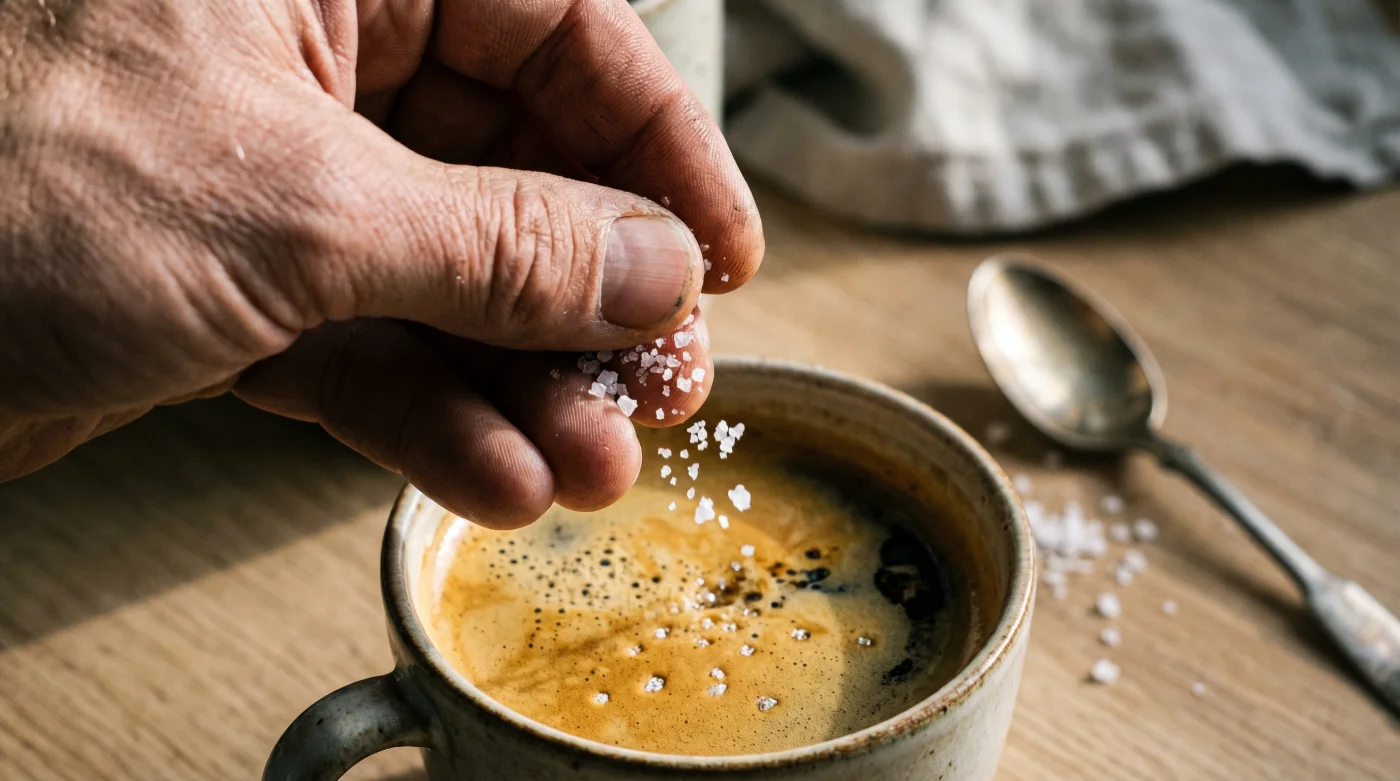
Imagine the quiet heavy air of a Tuesday morning before the sun clears the tree line. You stand at the kitchen counter, listening to the kettle rumble to a boil or the rhythmic sputter of your drip machine. The scent of roasted beans fills the room, promising warmth, clarity, and a gentle push into the day. But then you take that first, anticipated sip.
Instead of a smooth, comforting embrace, your palate is assaulted by a sharp, metallic astringency. Your shoulders tighten. The bitterness lingers uncomfortably, coating your tongue and ruining a moment that is supposed to be quiet and grounding. Most of us instinctively reach for sugar or milk to mask the offence, turning a simple dark roast into a heavy dessert just to make it palatable.
What if the answer to salvaging a poorly extracted cup was not about drowning it in dairy, but neutralizing the flaw itself? In the high-stakes kitchens and quiet, meticulous espresso bars tucked away from the cold winds of Calgary or Halifax, there is a different approach. A method so simple it feels almost counterintuitive.
You do not need expensive syrups or a thousand-dollar grinder to smooth out that harsh edge. The professional kitchen fix relies on the most fundamental element in your pantry. A tiny, nearly invisible addition alters the chemical structure of the brew, rescuing your morning without diluting its character.
Re-Tuning the Radio Station
We treat coffee making as a rigid set of instructions, pouring hot water over grounds and accepting whatever lands in the mug. But brewing is a volatile chemical reaction, and sometimes, the resulting compounds scream over each other like static on a dial. You are not just making a drink; you are conducting a delicate balance of acids, sugars, and bitter alkaloids.
When bitterness takes over, it is a sign that the extraction has pulled out too many harsh compounds. Perhaps the water was a few degrees too hot, sitting at a rolling 100 Celsius instead of a more controlled temperature. To fix this, you do not turn up the volume of sugar to drown out the noise. You block the static entirely by manipulating the chemistry of your palate.
This is the magic of the simple swap. By adding a pinch of table salt to your coffee, you are deploying sodium ions to interfere with the bitter receptors on your tongue. Think of salt not as a flavouring agent here, but as an acoustic panel in a loud room. It absorbs the harsh frequencies, allowing the sweeter, deeper notes of the roast to finally sing through.
Consider Elias Thorne, a 42-year-old roaster operating out of a converted brick garage in Hamilton. Elias spends his days tracking the subtle moisture changes in green beans shipped thousands of miles, but he keeps a tiny ceramic dish of standard table salt beside his commercial espresso machine. “People think I am crazy the first time they see it,” he says, wiping down the steam wand. “But salt is a binder. If a batch of dark roast pulls slightly hollow and bitter, a single pinch does not make it salty. It acts like a pair of glasses for your tongue, bringing the chocolate and caramel notes back into sharp focus.” His personal kitchen fix is a reliable secret for removing that bitter taste without compromising the integrity of the bean.
Adjusting for Your Daily Routine
Not every coffee drinker faces the exact same morning struggle. The way you apply this simple swap depends entirely on what sits in your favourite mug and how it got there. We have to adapt the method to the vessel.
For the Batch-Brew Loyalist: If you rely on an automatic drip machine to fuel your morning, bitterness usually comes from the coffee sitting on a hot plate too long. The heat degrades the chlorogenic acids into quinic acid, which carries that notoriously sharp, burnt flavour.
Treat the whole pot carefully, rather than the individual cup. Add exactly one-eighth of a teaspoon of salt to the grounds before you hit the brew button. This integrates the sodium uniformly, guaranteeing a smooth finish even if you pour your second cup an hour later.
For the French Press Purist: The immersion method is beautiful, but it leaves sediment and oils that can over-extract if left plunging too long. The heavy body of a French press needs a different touch.
Here, you want to apply the fix post-brew. Pour your cup, and dip the tip of a wet spoon into your salt cellar. Stir that microscopic amount into the black coffee. You are looking for a reaction so subtle that if you can actually taste the salt, you have gone too far.
For the Instant Coffee Survivor: Sometimes you are in a hotel room or at an unstocked office, making do with soluble granules and water from a plastic kettle. Instant coffee is notoriously bitter because of the industrial dehydration process.
This is where the simple swap shines brightest. A heavy pinch is required right into the dry granules before adding water. The hot water dissolves the sodium and coffee simultaneously, aggressively smoothing out the manufactured harshness and making an otherwise difficult cup surprisingly drinkable.
The Mechanics of the Pinch
Integrating this kitchen fix into your routine requires restraint. It is easy to accidentally turn your morning brew into broth, which defeats the entire purpose. The goal is sensory manipulation, not seasoning your beverage.
Keep a small dish of standard, fine table salt near your coffee station. Coarse sea salt takes too long to dissolve, and Himalayan pink salt carries trace minerals that can interfere with the water chemistry. Focus on pure, quick-dissolving sodium to get the most consistent result.
- Start by brewing your coffee exactly as you normally would.
- Take a sip to assess the baseline bitterness before making any adjustments.
- Pinch the salt between your thumb and index finger, aiming for about 10 to 15 individual grains.
- Drop the pinch directly into the hot liquid and stir gently for five seconds.
- Wait a moment for the liquid to settle, then take a second sip to evaluate the transformation.
The Tactical Toolkit:
Water Temperature: Ideally 90 to 95 Celsius.
Salt Type: Fine iodized or plain table salt.
Dosage: 0.1 grams (a literal pinch) per 250ml cup.
Rest Time: 10 seconds post-stir to allow the sodium to fully dissolve.
Reclaiming the Morning
Mastering this small detail does more than just salvage a poorly roasted bean or an over-extracted pot. It hands you back control over your environment. The mornings are often chaotic, governed by ticking clocks, cold starts, and rushed commutes.
When you know how to correct a flaw without relying on heavy cream or refined sugars, you become self-reliant. You stop accepting bad outcomes just because they seem inevitable. A harsh, bitter cup of coffee is no longer a ruined morning; it is simply a puzzle that you hold the exact piece for.
That tiny pinch of salt represents a deeper understanding of how things work. It reminds you that sometimes, the most effective solutions are the quietest ones. By removing the bitter taste with a simple swap, you carve out a small moment of perfection before the day demands your attention, proving that a little mindful adjustment can change the entire flavour of your morning.
“Sodium binds to the bitterness receptors on the tongue far more effectively than sugar, tricking the brain into perceiving a smoother, sweeter cup.”
| Key Point | Detail | Added Value for the Reader |
|---|---|---|
| The Neutralizer | Sodium chloride blocks bitter receptors on the tongue. | Eliminates harsh flavours without adding extra calories or dairy. |
| Pre-Brew Application | Adding salt to the grounds in a drip machine. | Prevents the burnt taste from developing as the pot sits on the burner. |
| Post-Brew Rescue | Stirring a microscopic pinch into an already poured cup. | Allows you to save an over-extracted drink at a cafe or the office. |
Frequently Asked Questions
Will this make my coffee taste salty?
No. When used in microscopic amounts—just a few grains—the sodium only interacts with your bitter receptors. If you taste the salt, you have simply added too much.Does this work for iced coffee?
Yes, but you need to dissolve the salt in a few drops of hot water first before adding it to your cold brew, otherwise the crystals will sink to the bottom.Can I use sea salt instead of table salt?
It is not recommended. Sea salt crystals are too large to dissolve quickly, and they often contain minerals that can muddy the flavour profile of the beans.Is this healthier than adding sugar?
For most people, swapping a tablespoon of sugar for a tiny pinch of salt drastically reduces morning calorie and carbohydrate intake while achieving a smoother taste.Does this fix stale coffee beans?
Salt targets bitterness, not staleness. It will remove the harsh, astringent notes, but it cannot put aromatic oils back into beans that have sat open in your pantry for months.