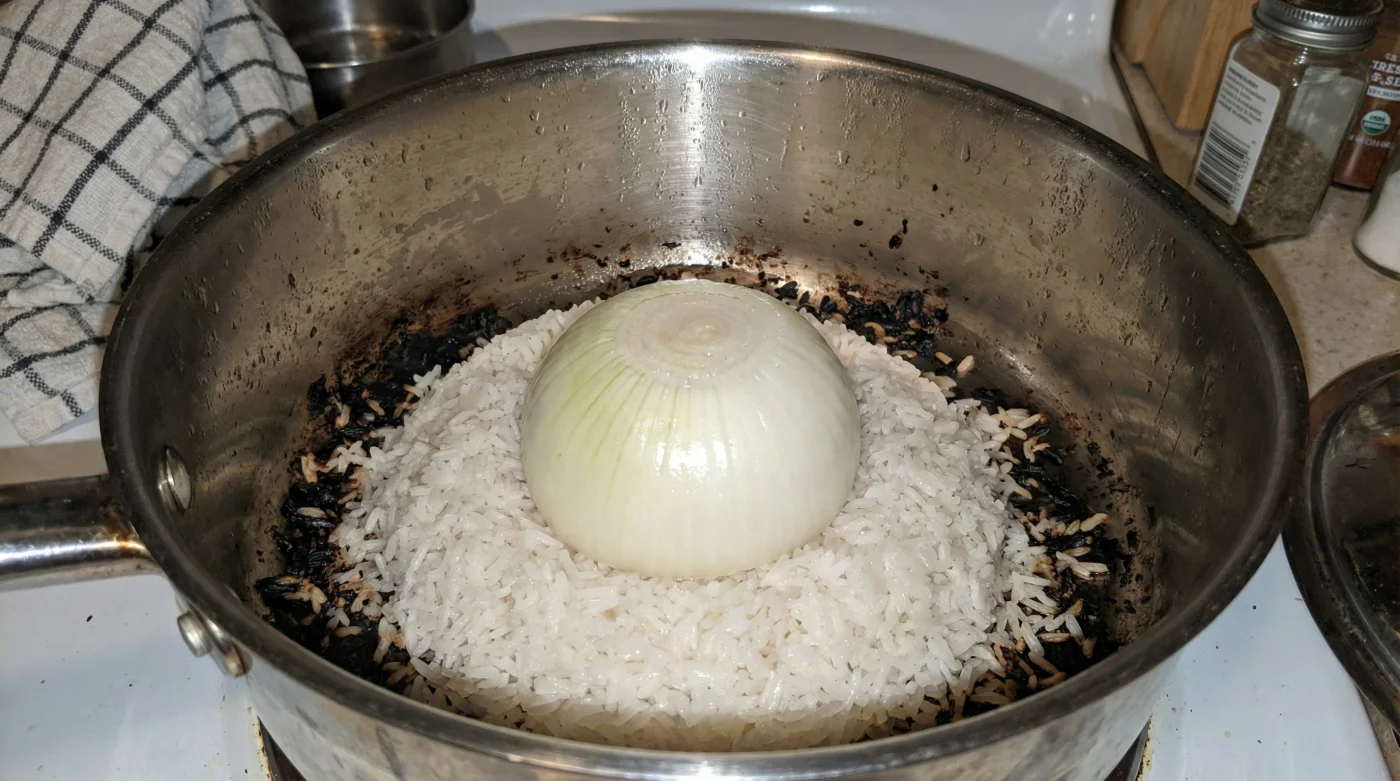
The sharp, acrid scent of carbonized starch hits the back of your throat before you even see the smoke. You turned away for just a moment to answer a text or chop a stray vegetable, and the quiet simmering of your stove has turned hostile. You lift the heavy lid, and a bitter, grey cloud immediately fills the kitchen space. Down in the depths of the pot, your Tuesday night dinner feels irreparably lost.
Most home cooks react with an immediate, frantic energy. You grab a wooden spoon and start frantically digging into the pot, hoping to find a few pristine grains, but instead, you pull up scorched black flakes. Panic forces a rushed reaction, turning a localized mistake into a full-batch disaster. The assumption is that the entire pot is ruined and must be scraped straight into the compost bin.
But a professional kitchen operates on a completely different set of physical laws. In a restaurant, tossing out a massive batch of starch during the middle of a dinner rush simply is not an option. The professional instinct is not to agitate the mistake, but to isolate it.
That dark, scorched crust at the bottom is not an infection spreading upward. It is actually a rigid, carbonized firewall. The grains resting above it are usually perfectly cooked and completely untouched by the heat source. The true enemy ruining the flavour of your dinner is not the burnt bottom at all; it is the trapped smoke circulating in the humid air of the pot.
The Perspective Shift: Treating Smoke Like a Spill
Think of the burnt rice problem as a localized environmental hazard. When the bottom layer scorches, it releases volatile aroma compounds—specifically, sharp, burnt-smelling pyrazines. These molecules ride the steam upward, clinging to the moisture of the unburned rice.
If you aggressively stir the pot, you physically mix the bitter ash into the clean starch. Stillness is your best tool. By leaving the structure intact, you keep the physical char trapped against the metal floor of the pan. You only need to address the airborne smoke that is currently tainting the water vapour.
This is where the humble, raw white onion acts as a natural sponge. The high sulfur content and raw, porous surface of a freshly cut onion desperately want to absorb surrounding odors. Placed directly onto the hot, steamy surface of the rice, the onion acts like a magnetic filter, pulling the smoke out of the air before it can permanently bond to the grains.
It feels entirely counterintuitive to ignore the blackened bottom layer and focus solely on the air above it. Yet, this simple pivot transforms a stressful culinary disaster into a mild, easily resolved inconvenience.
The Montreal Line Cook’s Secret
Elise Vachon, a 42-year-old line cook at a bustling, high-volume bistro in Montreal, knows this exact rhythm better than anyone. On a freezing Friday night last November, a distracted junior prep cook left a massive, 20-litre rondeau of basmati simmering over a high flame for ten minutes too long. The smell of burning starch began to creep across the prep line, threatening to derail fifty pending orders of roast chicken and pilaf.
Elise did not yell, and she certainly did not throw the pot out. She calmly pulled the massive pan off the burner, sliced two large white onions directly down the centre, and laid the flat, raw halves face-down across the top of the steaming rice. She replaced the lid tightly and set a timer for ten minutes. When she finally opened the pot and scooped out the fluffy, white upper layers, they tasted like nothing but sweet, clean basmati. The bitter smoke had been completely swallowed by the raw onions, which were quickly discarded. It was a silent, bloodless rescue mission executed right in the middle of a chaotic service.
Deep Segmentation: Adapting for the Grain
Not all starches behave exactly the same way when they meet excessive heat. The moisture content of your specific dinner dictates how quickly the smoke binds to the food. Understanding your specific base material ensures the raw onion trick works perfectly every time.
For long-grain white rice, this is the most forgiving scenario. Basmati and jasmine hold minimal surface moisture when properly steamed. The smoke rests loosely between the loose grains. A single onion half, placed face-down for ten minutes off the heat, will clear the pot almost flawlessly.
For sticky and short-grain sushi rice, the high starch content means these grains act like glue, trapping smoke much faster. You have a smaller window of time.
You must act within sixty seconds of smelling the smoke. You may need to score the face of the onion in a crosshatch pattern to expose more raw surface area, forcing it to absorb the harsh odors at a highly accelerated rate.
For wild and brown rice variations, the tough, fibrous bran on the outside of these grains makes them highly resistant to smoke absorption in the first place.
- Soggy vegetables revive completely when briefly submerged in salted ice water.
- Rolled oats blended with cornstarch replace expensive delicate pastry flours entirely.
- Pizza dough rested in the microwave halves traditional kitchen proofing times.
- Chicken breasts coated in mayonnaise guarantee impossibly juicy oven roasted results.
- Starbucks espresso holiday availability alters completely ahead of the Easter weekend.
Mindful Application: The Ten-Minute Extraction
Rescuing your dinner requires deliberate, minimalist movements. The moment you detect the sharp scent of burning starch, stop what you are doing. Do not immediately remove the lid. Do not shake the pan.
Move the pot to a completely cool, unused stovetop burner immediately. The residual heat from an electric element or cast iron grate will continue to carbonize the bottom layer, generating more smoke than the onion can possibly handle.
Follow this exact extraction sequence:
- Turn off the heat and move the pot to a cold surface.
- Cut a single, peeled white onion in half directly through the root.
- Swiftly lift the lid, place the onion halves flat-side down on the top layer of the rice, and immediately replace the lid.
- Leave the pot completely undisturbed for exactly ten minutes.
- Open the lid, discard the onions, and gently scoop the clean rice into a fresh serving bowl, stopping the moment your spoon touches the hardened bottom crust.
The Tactical Extraction Toolkit:
- Target Temperature: Ambient room temperature (remove from heat source entirely).
- Duration: 10 minutes (less time will not clear the air; more time risks the rice absorbing an onion flavour).
- Tools: One sharp knife, one raw white onion (yellow works in a pinch, but white has a harsher bite that neutralizes carbon faster), and a serving spoon with a wide, flat edge to avoid digging into the burnt base.
The Bigger Picture: Finding Peace at the Stove
It is deeply frustrating to ruin a meal before it even makes it to the table. We attach so much personal guilt to burnt food, viewing it as a glaring symbol of our own distraction or incompetence. A ruined pot feels like a wasted evening.
But learning to salvage the good parts of a mistake fundamentally shifts how you approach your kitchen. You stop fearing minor errors, recognizing that almost any physical mishap has a quiet, scientific solution. You learn to trust your ability to intervene rather than reacting with panic.
The burnt bottom layer remains exactly where it belongs: stuck to the metal pan, soaking in a bit of warm water to be scrubbed away later. Meanwhile, the dinner you intended to serve sits cleanly in a bowl, entirely unaffected by the brief moment of chaos. The smoke disappears, the meal continues, and you sit down to eat with the quiet confidence of someone who knows exactly how to fix a broken situation.
The difference between a ruined dinner and a perfect plate is usually just ten minutes of patience and knowing exactly what not to touch. – Elise Vachon
| Key Point | Detail | Added Value for the Reader |
|---|---|---|
| The No-Stir Rule | Never agitate a scorched pot with a spoon. | Prevents bitter ash from mixing into the clean, edible upper layers. |
| White Onion Absorption | Place raw halves face-down on the top layer. | Neutralizes airborne smoke and saves the bulk of your meal from the compost bin. |
| The Ten-Minute Rest | Leave covered, off the heat, undisturbed. | Provides a reliable, set-and-forget time frame that removes stress and guarantees results. |
Frequently Asked Kitchen Fixes
Will the rice taste like raw onions?
Not if you stick to the ten-minute rule. The onion absorbs the smoke rapidly, but it takes prolonged heat and moisture for the onion flavour compounds to leach downward into the starch. Ten minutes is the perfect, safe equilibrium.
Can I use a red onion or shallots instead?
White and yellow onions are ideal due to their specific sulfur compounds and surface area. Red onions contain different pigments and slightly sweeter profiles that do not absorb harsh carbon odors quite as effectively, though they will work reasonably well in an absolute emergency.
How do I clean the burnt layer out of the pot later?
Once you have scooped out the good rice, fill the cooled pot with warm water and two tablespoons of baking soda. Bring it to a rolling simmer for fifteen minutes. The alkaline water will naturally lift the carbonized crust away from the metal without heavy scrubbing.
Does this trick work for burnt soups or stews?
Unfortunately, no. In a liquid environment like a soup, the burnt carbon dissolves directly into the broth, immediately tainting the entire batch. This onion technique only works for stacked, layered starches where the smoke is airborne rather than dissolved.
Should I add more water when I do the ten-minute rest?
Never add cold water to a hot, scorched pot of rice. It will instantly flash-steam, driving the bitter burnt flavours aggressively up into the pristine grains. Rely on the residual humidity already trapped inside the pot.