You wake up to the chill of a mid-November Ottawa morning. The kitchen is quiet, save for the hum of the refrigerator. You reach for that beautiful sourdough loaf you bought two days ago from the neighbourhood bakery, anticipating thick slices of toast slathered in salted butter.
But your fingers meet a hard, unforgiving crust. The crumb has petrified overnight, turning a glorious artisan creation into an oversized crouton. Your first instinct is to toss it into the compost bin, a quiet defeat against the relentless march of time and dry indoor heating.
There is a subtle heartbreak in throwing away good bread. You imagine the flour, the hours of fermentation, the baker’s early morning shift, all discarded because the moisture simply evaporated.
Most people assume staleness is an irreversible decay. But professional bakers know bread is a living sponge, and dehydration is merely a temporary pause, not a permanent end.
The Anatomy of a Bread Coma
Think of a loaf of bread like a delicate network of microscopic sponges. When bread goes stale, it hasn’t spoiled; it has simply gone dormant. The starches crystallize, pulling moisture away from the soft centre and trapping it in an unyielding structure.
Trying to force a knife through it feels like sawing through raw cedar, yielding nothing but jagged crumbs and frustration. You cannot simply force it back into submission with a toaster, which will only dry it out further.
The secret is not heat alone, but steam. By reintroducing water into the environment, you coax those crystallized starches into relaxing. It is a kitchen fix so brilliantly simple, it feels like cheating time.
This is where a slightly damp tea towel becomes your most powerful culinary tool, transforming a seemingly ruined loaf into something warm, pliable, and freshly baked in mere minutes.
Marc-Antoine, a 42-year-old pastry chef working out of a bustling café in Montreal’s Plateau-Mont-Royal, knows this struggle intimately. During the height of the winter rush, he watched countless day-old baguettes harden on the rack as the shop’s radiators worked overtime. Instead of writing them off as waste, he started wrapping the stiff loaves in wet linen before sliding them into a low oven or an industrial microwave. ‘Bread doesn’t die when it gets hard,’ he often tells his apprentices. ‘It just faints. You just need to give it a little glass of water to wake it up.’
Tailoring the Revival to Your Loaf
Not all bread behaves the same way. The method you choose depends heavily on the hydration and density of the loaf sitting on your counter.
For the Dense Artisan Sourdough
A thick, crusty boule holds a lot of internal structure. Because the crust is already so robust, you need an approach that penetrates deeply without turning the exterior into a soggy mess. Wrapping the whole loaf in a towel that is barely damp—wrung out until it feels like a heavy mist—is ideal here.
For the Grocery Store Sandwich Bread
Commercial loaves with a high sugar and fat content react much faster. Their crumb is delicate. Applying too much water will collapse the weak gluten structure, leaving you with a gummy paste. A single paper towel, spritzed lightly with water, is all the coaxing this bread requires.
For the Stubborn Baguette
Baguettes have a high crust-to-crumb ratio. They turn into baseball bats within twenty-four hours. You need to focus the moisture entirely on the crust, allowing the steam to work its way inward naturally.
The Lazy Fix Execution
Implementing this rescue mission requires almost no effort, but it demands a precise balance of moisture. You are not trying to wash the bread; you are creating a localized sauna.
The microwave, often maligned by purists, is actually the perfect environment for this. It agitates the water molecules in the towel, generating immediate steam that forces its way into the bread’s crystallized starches.
Follow these mindful steps to ensure you restore that tender texture without crossing the line into mushiness. Keep your movements deliberate.
- Take a clean kitchen towel (or paper towel) and run it under cold water.
- Wring it out ruthlessly. If you think it is dry enough, wring it once more. It should feel cool and humid, not wet.
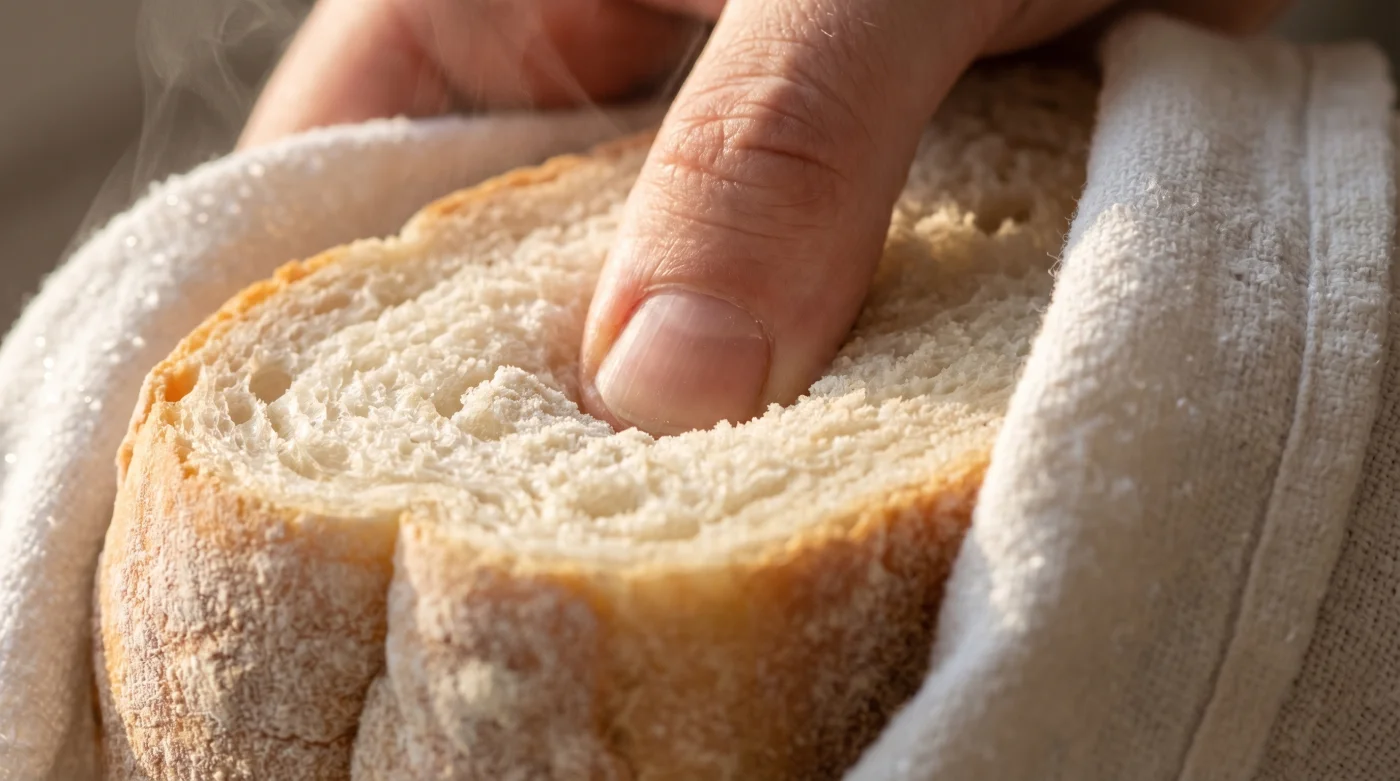
- Swaddle your stale loaf completely, ensuring no bare crust is exposed to the air.
- Place the wrapped bread on a microwave-safe plate.
Tactical Toolkit:
- Temperature: High power on your microwave.
- Time: 10 to 12 seconds maximum for slices, 20 seconds for a half-loaf.
- Tool: A 100-percent cotton cloth (avoid synthetic fibres that might melt or release chemicals).
Reclaiming Your Morning
Mastering this small act of preservation shifts how you interact with your kitchen. It removes the low-level anxiety of wasting good food and replaces it with a quiet sense of control.
You no longer have to eat an entire loaf in a single day out of panic, nor do you have to force down a breakfast that tastes like cardboard. You simply adapt.
By understanding the physical nature of what you are eating, you grant yourself grace in the kitchen. You turn an annoying problem into a thirty-second ritual of renewal.
The next time you encounter a rock-hard loaf, you won’t feel frustration. You will reach for a towel, turn on the tap, and watch as heat and water coax the softness back out of hiding.
A stale crust is just a lock waiting for the right amount of steam to turn the key.
| Method | Details | The Payoff |
|---|---|---|
| The Lazy Fix (Microwave) | 15 seconds with a damp towel | Instant gratification for quick morning toast. |
| The Purist Fix (Oven) | 10 minutes at 150°C (300°F) | Re-crisps the crust while softening the inside. |
| The Sieve Method (Stovetop) | Steaming over boiling water for 1 minute | Best for rescuing single, delicate rolls. |
Frequently Asked Questions
Can I use a paper towel instead of cloth?
Yes, as long as it is thoroughly wrung out to prevent it from disintegrating onto the bread.Will the bread stay soft all day after microwaving?
No. The microwave fix is temporary. Eat the bread within ten minutes before it cools and hardens again.Does this work on moldy bread?
Absolutely not. If you see blue or green spots, the entire loaf belongs in the green bin.Can I revive bread that has been frozen and left out?
Yes, the damp towel method works beautifully on thawed, dried-out bread.Why does my bread become rubbery after this?
You likely microwaved it for too long. Stick to short, 10-second bursts to avoid overcooking the starches.