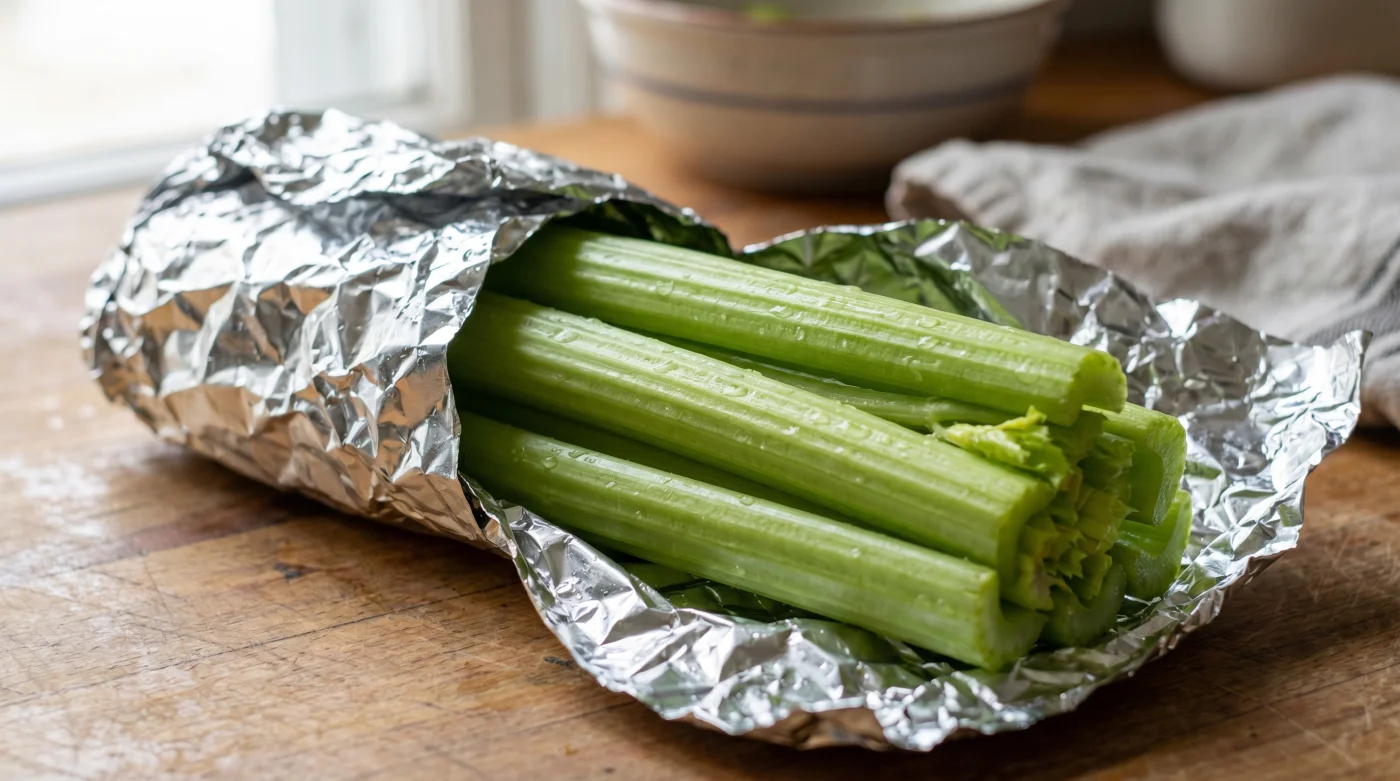
You return from the market on a Tuesday evening, the air outside carrying that sharp, unmistakable chill of late autumn. Unpacking the canvas bags on your kitchen counter, you pull out a heavy bundle of fresh celery. The stalks are rigid, heavy with water, and snapping one from the base yields a satisfying, loud fracture that echoes across the quiet room.
Fast forward five days. You reach into the depths of your refrigerator crisper drawer to build a quick soup base. Instead of that vibrant, structured vegetable, it bends completely in half without breaking. You are left holding a sad, limp shadow of what you bought less than a week ago.
We often accept this rapid decay as an unavoidable tax on fresh produce. We assume the cold environment simply drains the life out of green vegetables over time. But that wilted stalk is not a failure of time or temperature; it is a failure of packaging. You have inadvertently been suffocating your food.
Breathing Through Armour: The Ethylene Trap
Think of a stalk of celery as a living entity. Even after it is severed from the root in the field, it continues to exhale ethylene gas—a natural ripening agent. When you leave that stalk inside the tightly sealed plastic bag from the grocer, the gas has nowhere to go. It becomes trapped in its own exhalations, forcing the vegetable to rapidly over-ripen and rot.
This is where the standard advice fails you. Wrapping the stalks in damp paper towels only accelerates mushiness, while leaving them entirely bare turns them dry and fibrous. The physical solution requires a shift in how you manage moisture and air.
Aluminum foil changes the equation entirely. Unlike plastic, a foil wrap acts like a breathable shield. It is entirely impermeable to the dry air circulating in your fridge, keeping the stalk’s internal moisture locked in. Yet, because foil does not seal as hermetically as a clamped plastic bag, the ethylene gas slips out through the loosely folded ends. The crispness is preserved by balancing retention and release.
The Professional Pivot: A Lesson from the Prep Line
Elias Thorne, 42, is a prep chef at a bustling Toronto bistro where weekend services demand enormous quantities of mirepoix. For years, Elias struggled with the financial loss of throwing away wilted celery on Thursday mornings. His secret to keeping produce vibrant is not an expensive chemical wash; it is a heavy-duty roll of tin foil stationed right next to the cutting boards.
By wrapping his trimmed stalks in foil immediately after delivery, Elias maintains the crispness of base ingredients for up to three weeks at 4 degrees Celsius. It is a quiet, reliable rhythm in his kitchen that ensures every dish starts with bright, hydrated vegetables rather than sad, rubbery substitutes.
Adapting the Wrap: Tailored Storage Variations
Your relationship with celery dictates how you should store it. Not every household consumes this vegetable at the same pace, so the foil method must adapt to your specific daily routines.
For the Casual Snacker
If you reach for single stalks to pair with peanut butter or hummus throughout the week, convenience is your priority. Wash and thoroughly dry the whole bunch at once. Wrap the bundle in foil, but leave the top opening slightly loose. This allows you to slide a stalk out effortlessly without unwrapping the entire package, minimizing handling and maintaining the protective microclimate for the rest.
For the Sunday Batch Cooker
If you only buy celery to chop up for stews, braises, and massive batches of chili on the weekend, you need maximum longevity. Do not wash the stalks until you are ready to use them. Keep the base intact, wrap the entire unwashed head tightly in heavy-duty foil, and seal the ends completely shut. Store it in the coldest part of your crisper drawer. The natural dirt acts as a mild preservative until Sunday arrives.
For the Occasional Garnish
Perhaps you only need a single rib for a weekend Caesar cocktail. You do not want a massive foil log taking up space. Cut the stalks you need, and wrap the remaining cluster tightly. If you notice the outer ribs getting a bit soft after a month, rely on the inner heart. The pale, tender center stalks will remain perfectly crunchy inside their foil cocoon long after the outside begins to tire.
Mindful Application: Executing the Foil Method
Applying this technique requires only a few minutes of focused attention after your grocery run. The goal is to eliminate excess surface water before sealing.
- Remove the celery from its original plastic packaging immediately upon arriving home.
- Cut off the leafy tops if you do not plan to use them right away, as they draw moisture out of the stalks.
- Rinse the stalks lightly, then dry them completely with a clean cotton towel. Water trapped against the skin causes premature rot.
- Roll the celery in a large sheet of standard tin foil, pressing the foil gently against the ribs to shape it.
- Crimp the ends loosely—do not fold them over into a suffocatingly tight seal.
If you are dealing with stalks that have already gone slightly limp, you can execute a quick kitchen fix before wrapping them. Trim a centimetre off the bottom and stand them in a glass of ice water for thirty minutes. This forces cold hydration back up the capillaries, restoring tension to the plant before you dry and wrap them for long-term storage.
The Peace of Mind in Provisioning
Mastering this simple storage technique shifts your experience in the kitchen from reactive to proactive. You are no longer racing against the clock to consume your produce before it decays into waste. Taking five minutes to properly wrap your celery offers a small, tangible victory over the chaos of household management.
When you open your refrigerator days later and hear that sharp, bright snap as you break off a stalk, you are experiencing the quiet reward of doing things with intention. It is not just about extending freshness; it is about building a kitchen environment where your ingredients are respected, and you enjoy the peace of an organized fridge that works with you, rather than against you.
The difference between a frantic home kitchen and a calm professional space often comes down to how well you protect your water content on the very first day. — Elias Thorne
| Key Point | Detail | Added Value for the Reader |
|---|---|---|
| Moisture Control | Foil traps water vapor inside the wrapping while blocking fridge air. | Stops your celery from becoming dry, stringy, and hollow. |
| Ethylene Release | Loose foil ends allow ripening gas to slowly escape the package. | Prevents the stalks from turning yellow and rotting prematurely. |
| Revival Technique | Trimming the base and soaking in ice water before wrapping. | Saves you from throwing away already-limp celery, protecting your grocery budget. |
Frequently Asked Questions
Can I use the same piece of foil multiple times? Absolutely. As long as the foil is not torn or covered in sticky residue, you can gently smooth it out and reuse it for your next batch of celery to minimize waste.
Do I have to wash the celery before wrapping it? It is entirely up to your preference, but if you do wash it, you must dry every single drop of moisture from the stalks. Damp celery wrapped in foil will rot very quickly.
Does this foil trick work for other vegetables? Yes, this method works beautifully for broccoli and whole heads of lettuce. However, do not use it for mushrooms, which require paper bags to breathe and release moisture.
Should I cut the stalks into sticks before wrapping them? It is better to leave the stalks whole and attached to the base if possible. Cutting damages the cellular structure and accelerates oxidation, reducing the overall lifespan.
Where in the fridge should the foil-wrapped celery live? Keep it in the crisper drawer. The drawer provides an additional layer of temperature stability and humidity control, keeping the foil from getting too cold and freezing the water inside the stalks.