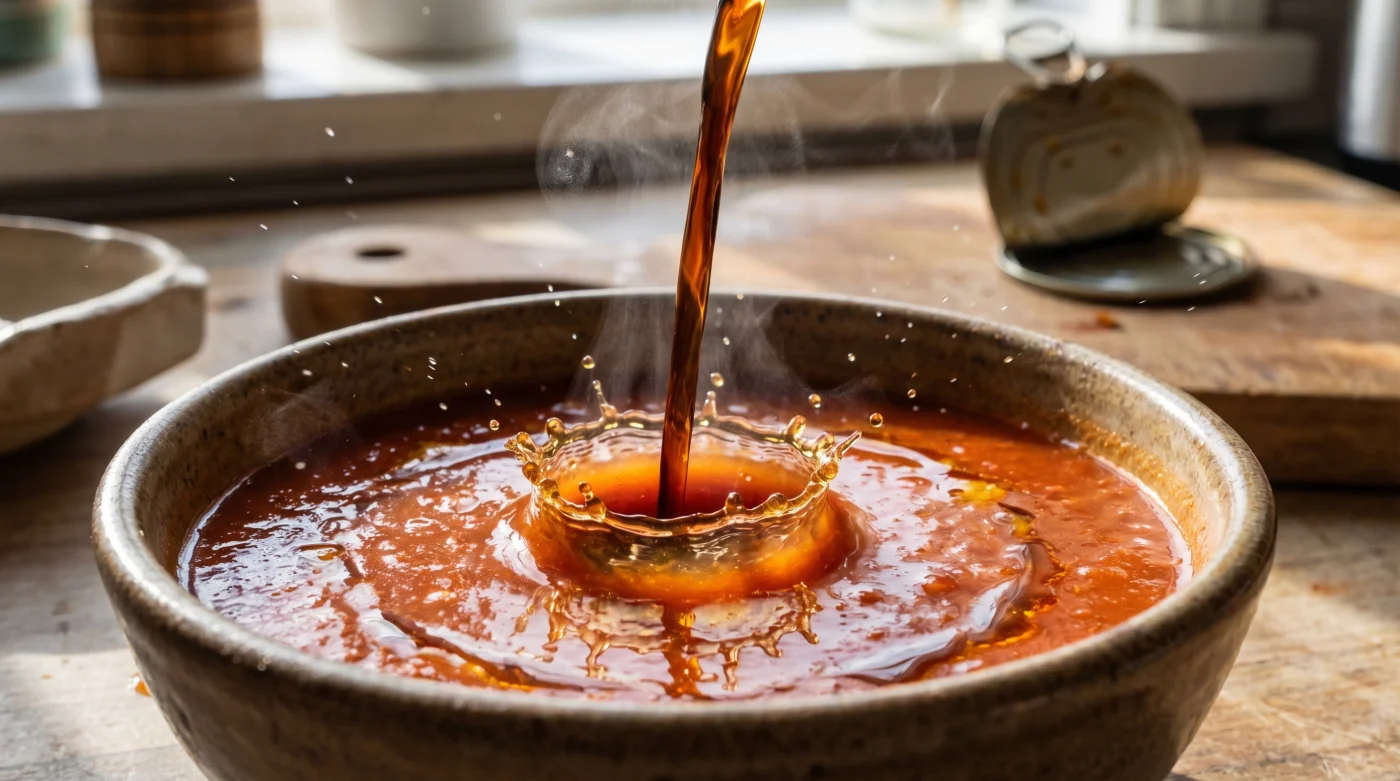
The tin lid peels back with a dull, metallic pop, echoing slightly in the quiet of a damp Tuesday afternoon. Outside, a persistent Canadian drizzle turns the asphalt grey, making the warmth of the kitchen feel like a small refuge. You tip the can over a cold saucepan, watching a gelatinous cylinder of chicken noodle or tomato bisque slide out with a heavy thud. It is sustenance in its most practical, predictable form.
As the burner glows amber and the soup begins to bubble at the edges, a familiar, slightly flat aroma fills the air. It smells like convenience. It smells mildly metallic, carrying that unmistakable signature of industrial processing—heavy on the salt, light on actual character. You stir it slowly, resigning yourself to a bowl of warmth that will fill the stomach but leave the palate completely bored.
But what if that dull, tinny broth wasn’t the final product? In commercial kitchens across the country, line cooks don’t rely solely on twelve-hour bone broths to build a complex bowl. They rely on strategic chemical reactions. The secret isn’t adding more herbs or a pat of butter. It’s about introducing a harsh, cheap liquid that forces the flat notes of canned soup to suddenly stand up straight and command attention.
The Liquid Architecture of Umami
Let’s talk about the cheapest bottle of soy sauce in your fridge door. The one you bought on sale for two dollars, sitting neglected behind the mustard. You probably view it as a blunt instrument, a salty puddle meant only for dipping frozen dumplings. But in the context of a flat, canned broth, that cheap soy sauce acts as a structural foundation beam, supporting flavours that are too weak to stand on their own.
When you execute the kitchen secret, you aren’t trying to make your chicken noodle taste like an Asian stir-fry. You are executing a professional pivot that separates amateur home cooks from seasoned professionals. It’s an exercise in stealth umami. The fermentation process behind even the most basic soy sauce creates glutamates—compounds that don’t just taste salty, but actively wake up the savoury receptors on your tongue.
Think of a standard canned soup as a song playing out of a cheap radio. The treble is too high, the tinny notes scrape the ear, and there is absolutely no depth. Stirring in a spoonful of soy sauce is like turning up the bass. Suddenly, the carrots taste sweeter. The dull chicken broth tastes like it was roasted. You build rich flavour not by masking the soup, but by giving it a shadow.
Elias Thorne, a forty-two-year-old diner veteran who ran a bustling breakfast counter in Halifax for a decade, understood this mechanism perfectly. Elias didn’t have the margins to simmer soup from scratch every morning, so he relied on large catering tins. His trick was entirely unromantic. Every morning, he would crack open those massive tins, bring them to a bare simmer, and pour soy sauce—exactly one quarter-cup of the cheapest, darkest variety—straight into the pot. He knew you don’t need artisanal ingredients to build rich flavour; you just need to know how to trick the palate into perceiving slow-cooked depth.
Adapting the Trick to Your Pantry
Not all canned soups behave the same way under heat. Applying this technique safely requires a slight adjustment depending on what you just poured out of the tin.
For the Tomato Bisque Purist
Tomato soup often suffers from a cloying, sugary sweetness designed to mask acidic preservatives. By adding a splash of soy sauce, you counteract that artificial sugar. The salt cuts the sweetness, while the umami deepens the roasted tomato profile, making a ninety-nine-cent tin taste closer to an heirloom puree.
For the Cream-Based Comfort Seeker
Clam chowders and cream of mushroom soups are notoriously heavy, coating the mouth in a slick of dairy fat that deadens other flavours. Here, the soy sauce acts as a sharp knife. It slices through the lipid layer, allowing the earthy mushroom or briny clam notes to actually reach your tastebuds without causing palate fatigue.
For the Clear Broth Minimalist
Chicken noodle or vegetable broths are the most fragile. If you are too heavy-handed, the broth will simply taste like cheap takeout. You must tread lightly here. To build rich flavour safely, pour soy sauce drop by drop, tasting after each addition. You are looking for the exact second the broth stops tasting like a tin can and starts tasting like roasted poultry.
Mindful Application
Executing this professional pivot requires restraint. If you pour directly from the bottle, you risk ruining the pot. You want to build rich flavour incrementally.
- Heat the soup to a simmer first: Cold soup hides its flaws. You need the liquid at a gentle bubble (around 85 Celsius) to accurately gauge its baseline saltiness.
- Measure into a spoon, never the pot: A slip of the wrist will turn your lunch into a sodium bomb. Pour cheap soy sauce into a teaspoon first.
- Stir and wait thirty seconds: Let the liquid circulate and the glutamates bind to the fats and proteins in the broth before you taste it.
- Look for the colour shift: A pale yellow chicken broth should take on a slightly deeper, golden-amber hue. If it turns brown, you have gone too far.
Reclaiming the Lunch Hour
Mastering this tiny, seemingly insignificant kitchen secret shifts how you view your pantry. You no longer have to settle for the mediocrity of heavily processed convenience foods, nor do you have to spend an entire Sunday roasting bones to enjoy a decent bowl of soup. You learn to control your food, rather than letting the food manufacturer dictate the experience.
It is incredibly freeing to realize that flavour is just a puzzle, waiting to be solved. By keeping a simple, inexpensive bottle of soy sauce on hand, you grant yourself the ability to rescue a bland meal in seconds. You take a mundane, rainy-day lunch and turn it into something genuinely deeply satisfying, proving that sometimes, the most profound changes require the smallest interventions.
Perfection in the kitchen isn’t about expensive ingredients; it is about finding the exact chemical counterbalance to a dish’s greatest flaw.
| Key Point | Detail | Added Value for the Reader |
|---|---|---|
| Tomato Soups | Counteracts artificial sugars | Brings out roasted, heirloom notes |
| Cream Soups | Cuts through heavy dairy fats | Prevents palate fatigue |
| Clear Broths | Deepens pale, watery liquids | Mimics slow-simmered bone broth |
Frequently Asked Questions
Will this make my soup taste like takeout? No. In small doses, the glutamates act as a savoury enhancer, not a primary flavour profile.
Do I need expensive, aged soy sauce? Absolutely not. Cheap soy sauce is actually preferred here for its sharp, aggressive salt content.
Can I use tamari instead? Yes. Tamari provides a very similar glutamate boost for those requiring a gluten-free option.
Does this work with low-sodium soups? Yes, it is especially effective there. It replaces the missing sodium while adding crucial depth.
Should I add the soy sauce before or after heating? Always add it while the soup is simmering to allow the compounds to bind properly.