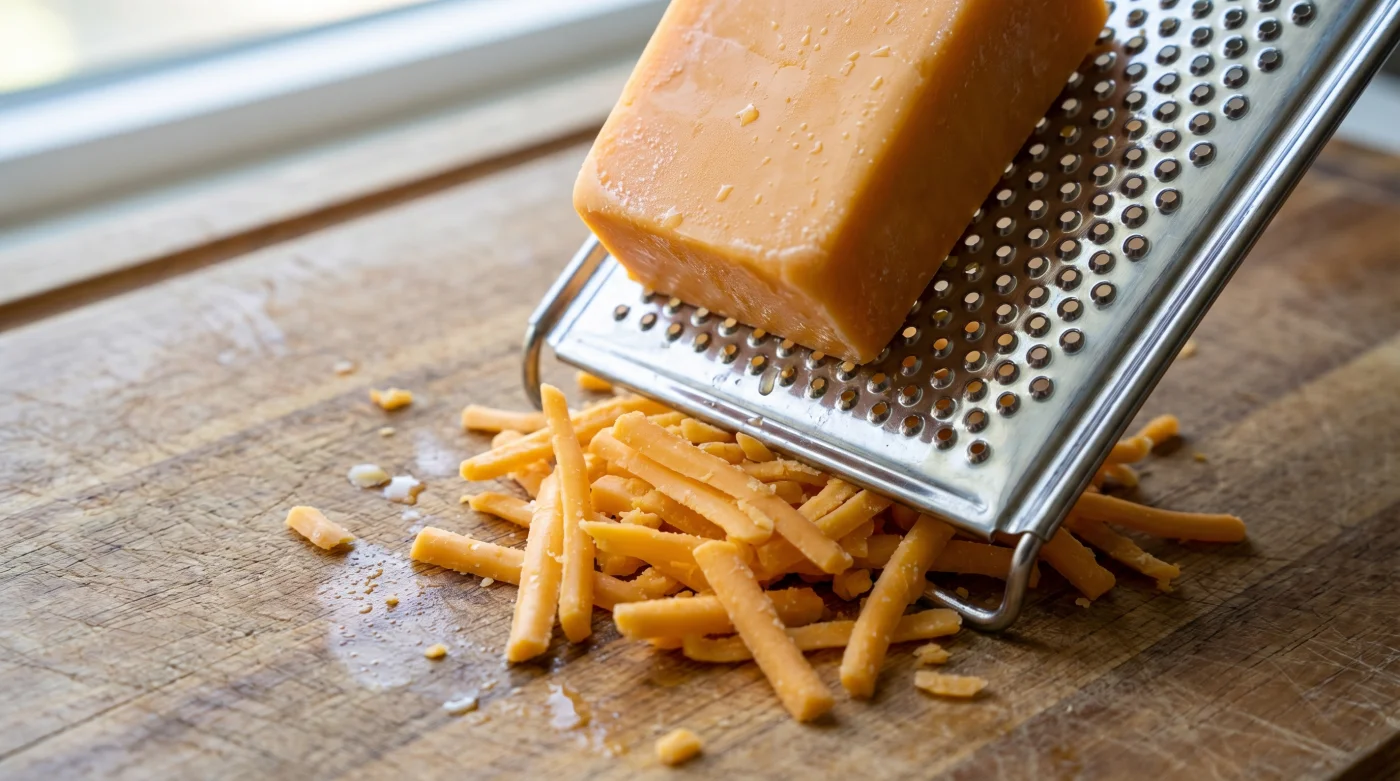
You are standing at the kitchen counter on a Tuesday evening, the fading light casting long shadows across the cutting board. You reach for the box grater and a block of medium cheddar, intending to quickly prep a topping for tonight’s baked pasta. But as you press the cheese against the metal tears, it drags. The block smushes, crumbling into greasy, uneven clumps that cling stubbornly to the inside of the metal pyramid.
You find yourself pressing harder, using force to compensate for the friction. Your knuckles graze the metal, and the cheese seems to melt just from the heat of your hands. This is the frustrating reality of prepping dairy in a warm room; you are fighting the very nature of the ingredient.
Now, imagine a different scenario. The cheese glides across the blades with a faint, satisfying rasp. Perfect, distinct ribbons pile up like dry snow on the cutting board, completely independent of one another. The box grater remains remarkably clean, requiring little more than a quick rinse under the tap.
This is not about buying better equipment or spending more money on aged dairy. It is a simple, physical manipulation of your ingredient’s state. By placing that block of soft cheddar in your freezer for exactly ten minutes before you begin, you completely eliminate the kitchen friction, allowing you to grate fast and easily.
The Mechanics of Butterfat and Friction
Think of soft cheddar not as a solid block of wood you are trying to whittle, but as a densely packed emulsion of water, proteins, and butterfat. When you apply friction through grating, you generate heat. This warmth causes the butterfat to weep, turning a solid ingredient into a tacky paste that fights the blade.
The traditional approach is to simply power through the sticky mess, accepting the inevitable clump and the frustrating cleanup. But when you shift your perspective, you realize the cheese’s softness is not a flaw. That high moisture content is exactly what gives it superior melting qualities for your macaroni or grilled sandwich. You do not want to change the cheese; you simply need to pause its behaviour.
By bringing the surface temperature of the cheddar down drastically—just to the brink of freezing without actually solidifying the moisture inside—you firm up the butterfat. The exterior becomes taut and resilient. The grater slices cleanly through the fat molecules instead of smearing them. You are no longer following a recipe instruction; you are managing a physical system.
Éric, a 42-year-old line cook at a bustling twenty-four-hour diner in Montreal, understands this physical system intimately. Every morning at 5:00 AM, before the first rush of breakfast poutines and fluffy omelettes, he processes enormous blocks of mild, high-moisture cheddar. He doesn’t muscle through the prep. Instead, he portions the dairy into manageable bricks and slides them onto a stainless steel tray in the walk-in freezer. Ten minutes later, he pulls them out. The cheese yields to the commercial shredder in seconds, leaving no greasy residue behind. His secret isn’t elbow grease; it is a calculated, temporary chill that respects the ingredient entirely.
Tailoring the Chill to Your Plate
Not every meal demands the exact same preparation. Understanding how to apply this ten-minute kitchen fix allows you to adjust your technique based on the final dish.
If you are preparing an everyday grilled cheese sandwich, you belong in the Quick-Melting Purist category. You need distinct shreds that will melt rapidly and evenly under the heat of a cast-iron pan. Freezing the block for exactly ten minutes ensures the shreds remain separate in the bowl, creating tiny pockets of air when piled on the bread. This aeration is what leads to that perfect, uniform melt.
For the Sunday meal planner managing a busy household, bulk preparation is the priority. You might be breaking down a large, two-kilogram block to store in portions. Here, the ten-minute rule saves your wrists. Slice the large block into quarters, freezing only the section you are actively grating. This keeps the butterfat stable and prevents the cheese from weeping oils into your storage containers, drastically extending its freshness in the fridge.
Finally, consider the approach for finely garnished delicate dishes. If you are using a microplane to dust a bowl of chili or a baked potato with soft cheddar, the friction is incredibly high. Pushing the freezer time to twelve or fifteen minutes gives the cheese the temporary rigidity of a hard Parmesan, allowing you to create microscopic, fluffy clouds of cheddar that dissolve instantly on the tongue.
Executing the Ten-Minute Freeze
Implementing this method requires a shift from frantic rushing to mindful preparation. It is about pausing to set up your environment before you actively start cooking. By making this small adjustment, you gain control over your kitchen space.
You do not need specialized equipment, just a respect for temperature and timing. Simply unwrap the cheese to allow the cold air direct contact with the surface, and ensure your grater is completely dry before you begin.
Follow these precise steps to execute the technique flawlessly:
- Remove the cheddar from its plastic wrapping to prevent condensation from freezing on the surface.
- Place the block on a small plate in the coldest zone of your freezer, usually near the back ventilation, for exactly ten to twelve minutes.
- While the cheese chills, gather your bowl and grater. Ensure the metal is room temperature, not warm from the dishwasher.
- Grate using long, downward strokes, lifting the cheese completely off the blade on the upward motion to prevent dulling the tool.
The Tactical Toolkit requires very little overhead. You are aiming for a standard freezer temperature of -18°C. Your ideal time is ten minutes for medium or soft cheddar, and up to fifteen minutes for very soft marble blends. Pair this with a standard, sharp stainless-steel box grater for flawless execution.
Reclaiming Your Kitchen Rhythm
We often accept small, daily frustrations as an inherent part of cooking. The crumbled cheese, the scraped knuckles, the sponge ruined by a greasy box grater—these are treated as the inevitable tax of a home-cooked meal. But culinary satisfaction rarely comes from buying more expensive tools; it comes from eliminating the physical resistance in your tasks.
When you freeze your cheddar for those ten minutes, you are buying yourself mental clarity. The grating becomes a brief, satisfying, and nearly effortless task. The cleanup involves a simple rinse under hot water, rather than a frustrating scrubbing session.
This is how you build a more peaceful relationship with your kitchen. By understanding how temperature interacts with butterfat, you transform a messy chore into a seamless motion. You are no longer fighting the ingredients you bring into your home; you are working alongside them, using their natural properties to your absolute advantage.
The kitchen rewards those who pause; manipulating temperature is always more effective than applying brute force.
| Key Point | Detail | Added Value for the Reader |
|---|---|---|
| Temperature Control | Freezing soft cheddar for 10 minutes at -18°C. | Eliminates physical struggle and drastically reduces grating time. |
| Friction Reduction | Cold butterfat resists smearing against metal blades. | Keeps the box grater clean, making dishwashing nearly effortless. |
| Aerated Shreds | Shreds remain separate rather than clumping into a ball. | Provides a faster, more uniform melt for sandwiches and pastas. |
FAQ
Why exactly ten minutes? Any less, and the butterfat remains too soft to resist the blade; any more than fifteen minutes, and the water content begins to crystallize, altering the texture of the melt.
Does this work for pre-shredded cheese? No, pre-shredded cheese is already coated in anti-caking agents like cellulose. This technique is specifically for breaking down block cheese smoothly.
Will this dull my grater? Not at all. The cheese is only chilled on the surface, not frozen solid. It actually protects your grater from sticky buildup.
Can I leave it in the freezer if I forget? If left for hours, the cheese will freeze solid, causing it to crumble entirely when thawed. If you forget it, let it thaw in the fridge overnight before attempting to use it.
Should I wrap it in paper towel first? Leave it bare. Wrapping it can trap ambient kitchen moisture against the surface, which will form a thin layer of ice that causes the grater to slip.